Pricing Agentic AI Workflows Where Credit Consumption Is Unpredictable
Agentic AI's unpredictable costs defy traditional software pricing models.

Agentic AI doesn't spend money the way software licenses do. A single agent can fire off dozens of model calls, tool invocations, and database lookups to finish one task, and the cost of that task can swing by a hundred times depending on how the work unfolds. Pricing that ignores this variance either bleeds margin on the heavy cases or overcharges everyone else, and most of the pricing models on the market today only solve half that problem. The rest of this piece works through what the full architecture actually needs to look like, and the honest answer is that no single model gets there alone.
Start with the distinction that makes the rest of this legible. Generative AI tools cost roughly what you'd expect: more generations requested, more spend, a fairly straight line between the two. Copilots track user sessions, so per-seat pricing still holds up there too; someone using a coding assistant eight hours a day costs more than someone who checks in twice a week, but the range is bounded by how many hours are in a workday. Agentic AI breaks that logic entirely. A configured agent runs on its own, inside a workflow, with no one sitting at a keyboard triggering each step. It processes transactions around the clock with zero relationship to how many seats a company bought.
That's the fan-out problem. One instruction from a user can decompose into multiple model calls, several tool invocations, a handful of vector database searches, function executions, and output validation steps, each with its own cost curve. A narrow-scope agent like Intercom's Fin, which resolves support tickets against a known documentation set, produces fairly standardized, measurable output. A broad-scope agent like Replit, building an app from an open-ended prompt, fans out however the problem demands. The same billing unit can't sensibly serve both. Prompt chaining makes it worse: a user who front-loads rich context gets a different cost profile than one who issues a string of small follow-up instructions, because each new instruction in a chained session can force the agent to reprocess everything that came before it. Nevermined's research on agent workloads puts the swing between simple and complex tasks at roughly 100x. That's not a rounding error, and vendors who ran generous pilots are finding out the hard way, with cost estimates missing actual production spend by 500 to 1,000%, the kind of gap that shows up as invoice shock and quietly kills renewal conversations.
Why per-seat, flat-rate, and naive per-token models each fail agentic workloads
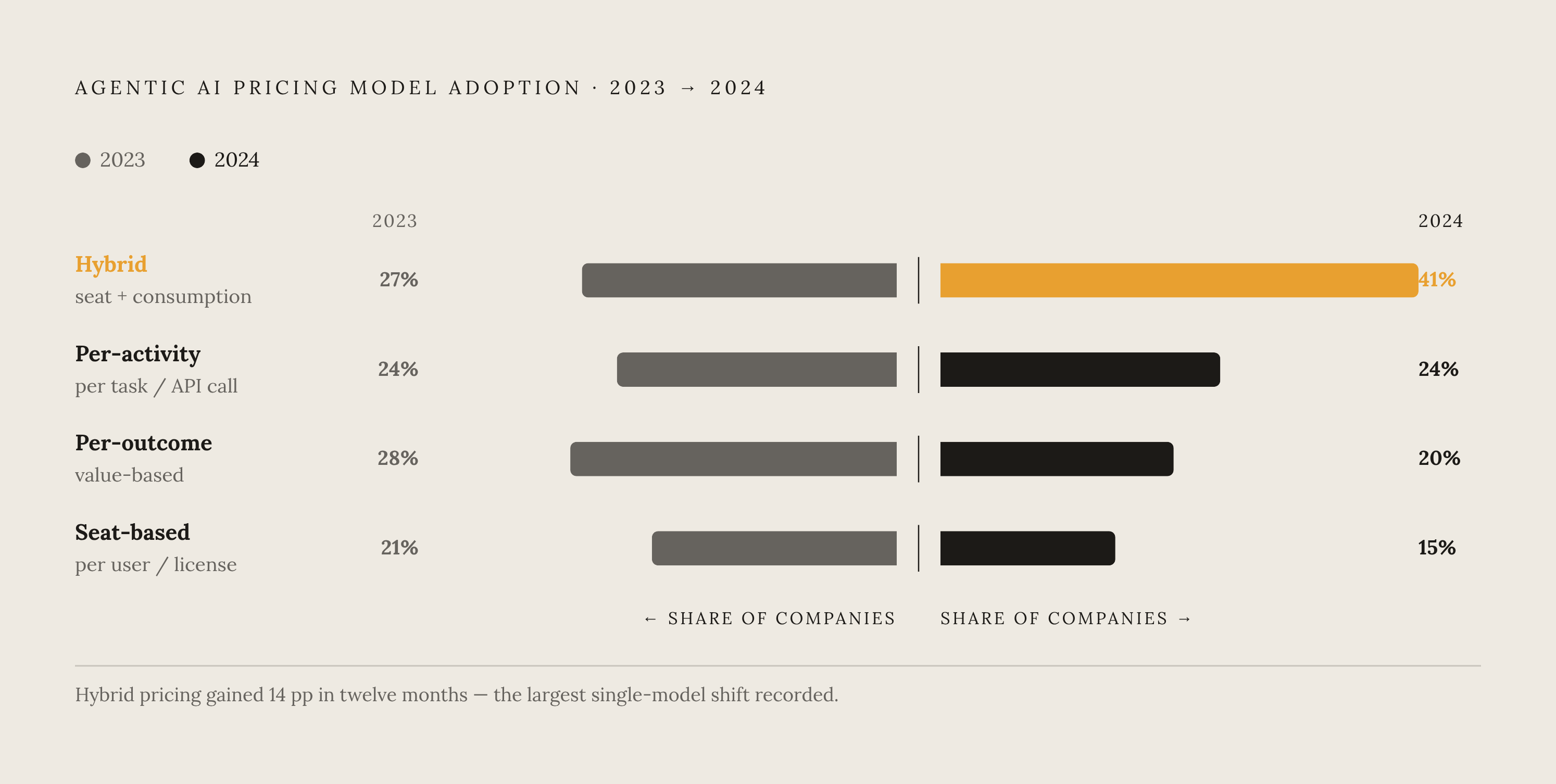
Per-seat pricing assumes a person is doing the work. Agents don't log in, don't hold licenses, and can finish thousands of tasks in the time it takes a person to finish one. Charging per seat for a fleet of autonomous agents is a bit like charging a taxi company by the number of parking spaces it owns, and it's the weakest of the three models here, not just an imperfect fit. Buyers have noticed: in a survey cited by BCG, 40% of IT buyers named seat reduction as their main lever for cutting software costs, and agentic AI only adds pressure to cut further. Growth Unhinged's 2025 State of B2B Monetization report found seat-based pricing dropped from 21% to 15% of companies surveyed over twelve months. That's a fast move for a model that dominated enterprise software for two decades.
Flat-rate and unlimited plans fail from the other direction: they protect the buyer's budget but not the vendor's margin. One heavy user's workflow can burn through compute that dwarfs the entire flat fee they're paying. BCG documented margin variance exceeding 70 percentage points across accounts for one customer engagement vendor, all on the same flat-rate plan. Billing platforms like Flexprice are built to run prepaid and postpaid consumption on the same engine precisely because that kind of variance can't be absorbed by a flat structure. This tension is sometimes framed as an impossible triangle: cost-to-serve, customer adoption, and value delivered can't all get maximized at once. Flat-rate pricing wins on adoption and loses on margin the moment usage gets uneven, and agentic workloads are nothing if not uneven.
Naive per-token pricing solves the vendor's margin problem and hands the buyer a new one. Sub-cent charges across hundreds of micro-activities in a single conversation just aren't something a finance team can forecast or explain internally. Tokens describe a vendor's internal cost structure, not the value a customer gets, and exposing that structure to a buyer doesn't help anyone budget. Tokens are a cost unit dressed up as a price, and buyers can tell the difference, which is the real reason token-metered products keep pushing customers toward wrapped, higher-level units instead.
Underneath all three failures sits the same broken assumption: that there's a stable relationship between license cost and revenue per license. Agentic AI severs that link on both ends at once. The vendor's cost per license rises with activity, and the buyer's value per license rises with activity too, so neither side of the old bargain holds anymore.
The four pricing models actually in use for agentic AI and what each one trades away
Four models have replaced it, and each trades away something different.
Per-activity or workflow-based pricing charges for a defined action or a finished workflow instead of exposing the token math underneath it. Salesforce launched Agentforce at a low per-conversation price in October 2024, the clearest example of this model in the wild, before shifting toward credits spent across multiple agent actions. N8N charges for workflows run, not for the number of background tasks the agent quietly executes to get there, which keeps the billing unit something a buyer can actually reason about. This model works when the scope of an action stays bounded and roughly uniform. It breaks the moment one action can fan out into wildly different amounts of compute, which is exactly the fan-out problem described above.
Per-output or artifact-based pricing charges for the thing produced: an image, a contract, a report, a demand letter. Adobe Firefly sells credit packs against image generations. EvenUp charges per demand letter drafted. The vendor absorbs the cost variance of producing each artifact, which only works if that variance stays inside a manageable range and the artifact is clearly what the customer thinks they're paying for. Fireflies.ai and Synthesia price by output units, meeting minutes and video minutes respectively, which keeps spend predictable and hides the model complexity from the buyer entirely.
Per-outcome or resolution-based pricing is the newest, and on paper the best aligned with what the customer actually wants: a resolved ticket, a signed contract, a booked meeting. Zendesk's AI resolution agent charges $1.50 per resolved conversation. Intercom's Fin charges $0.99 per resolved ticket. Decagon offers both per-conversation and per-resolution pricing, and most of its customers pick per-conversation anyway, because it's easier to predict. Companies with outcome-based components report meaningfully higher retention and satisfaction scores, since charging for results rather than activity signals a kind of confidence that buyers notice. But the friction is real. A survey from Andreessen Horowitz found 47% of buyers struggle to define outcomes clearly enough to price against, 36% worry about cost predictability even with outcome pricing, 25% have trouble agreeing on how to attribute value, and 24% point out that outcomes often depend on factors the vendor doesn't control. Most enterprise AI deals in 2025 still run on usage-based or hybrid pricing. Pure outcome pricing stays the exception here, not the rule, and that's unlikely to flip soon given how hard the attribution problem is to solve cleanly.
Seat-plus-consumption hybrids pair a subscription floor with consumption on top: a revenue floor and buyer predictability from the subscription, margin protection from the overage. Atlassian bundles 25 Rovo AI credits per user per month into its standard plans, then charges $0.30 per conversation once a customer's Virtual Service Agent usage runs past what's included. HubSpot charges $10 per 1,000 AI credits beyond the allotment baked into each subscription tier. ServiceNow sells AI as an add-on SKU, with each licensed user receiving a credit allotment tied to their subscription tier. This is the category growing fastest: Growth Unhinged's 2025 report put hybrid pricing at 41% of companies surveyed, up from 27% twelve months earlier. That growth rate alone should settle which of the four models is becoming the default, and it isn't outcome pricing.
One useful framework for choosing among these four before building anything is to map the scope of an agent's work (task, process, or goal) against how directly its output can be attributed to value (diffuse, medium, or direct). Narrow-scope, direct-attribution agents fit per-outcome pricing well. Broad-scope, diffuse-attribution agents usually need a hybrid.
Why credit abstraction is the right consumption layer for unpredictable workflows, and where it reaches its limits
Credits solve a specific problem: they take a fungible unit that can represent wildly different underlying compute costs and let a buyer prepay against it without needing to understand what a unit costs the vendor to produce. A complex task burns more credits than a simple one, and the buyer never has to see the token math that produced that ratio. PricingSaaS found credit models grew 126% in 2025 among the top 500 AI and SaaS companies it tracked, which is about as clear a signal as this market gives that credits have become the default abstraction layer for agentic pricing.
That convergence is often less a strategic choice than a practical one. Vendors know their GPU time and inference costs down to the decimal. They usually have far less certainty about what a customer values, especially early on, and credits let them price without settling that question first. LLM consumption is volatile by nature, and a credit balance turns that volatility into something a buyer can budget against in advance. Plenty of teams building agentic products also just don't have the metering infrastructure yet to track usage across several AI features at once, so a single credit currency becomes the fastest way to launch pricing without solving instrumentation first.
Credits work as a bridge, though, not as a destination, and treating them as a permanent answer is the mistake worth naming here. Token-based API pricing is common across major model providers, yet enterprise buyers routinely seek committed-use deals on top, because raw token pricing still doesn't give them the predictability they need. Credits carry the same limitation one layer up. They don't, by themselves, tell a buyer what they're actually getting for their money, and vague conversion rates between credits and real actions erode trust fast once a customer starts asking questions. Without guardrails layered on top, a credit model can still produce a surprise invoice. Notion, Slack, and Loom are already folding AI features back into flat subscription bundles rather than metering them separately, and that re-bundling trend is a tell: credits are a stage in pricing's evolution, not the final form.
How to meter at the action level in real time: the infrastructure requirement underneath any of these models
None of the four models above work without metering that operates at the level of the individual action. Sub-cent transactions across hundreds of micro-activities in a single conversation have to get captured event by event: each model call, each tool invocation, each retrieval lookup, each function execution logged as it happens, not reconstructed at the end of a billing cycle.
What has to get captured is fairly specific. Each step in an agent's reasoning chain needs to register as its own event, carrying its own cost weight. Tool calls need to be counted and typed, since different tools carry very different cost curves; a web search and a code execution are not the same line item. Context-window consumption per call matters too, since longer context windows drive higher inference cost, and in a chained session that context keeps piling up call over call. And a buyer's real-time credit balance needs to update after every single event, not in a nightly batch, because an agentic workflow can burn through an entire credit allocation inside one extended session.
Latency matters just as much as granularity here. If checking a usage balance adds noticeable delay to a reasoning chain, one of two things happens: the agent stalls mid-task waiting on a permission check, or engineering quietly routes around the check to keep things fast, which defeats the whole point of metering. Enforcement needs to run at the millisecond level to stay invisible to the agent's own execution loop. Billing systems built around monthly invoice cycles simply can't operate at this frequency; the underlying architecture needs to stream events as they happen rather than aggregate them in batches after the fact. Given the wide cost spread between a simple task and a complex one, a metering gap here isn't a rounding error. It's the difference between a workflow that's profitable and one that quietly isn't.
Pairing a baseline commitment with a consumption layer to protect both margins and buyer predictability
Pure consumption pricing protects vendor margin and fails buyer predictability. Pure subscription pricing protects buyer predictability and fails vendor margin the moment agentic usage spikes. Neither one works alone for agentic workloads, which is exactly why the hybrid structure keeps showing up across every serious vendor in this space, and betting on either extreme in isolation is a mistake the market has already priced out.
The structure has two layers. A baseline commitment, whether that's a subscription floor, a prepaid credit block, or a minimum spend commit, gives the buyer a number to budget against and gives the vendor a revenue floor regardless of how usage swings month to month. A consumption layer sits on top of that: additional credits, per-activity overage, or per-resolution charges that capture value once usage runs past what the baseline covers, without capping the vendor's upside. That consumption layer only works if it's metered at the action level in real time, the way described above, so overage charges reflect what actually happened rather than an estimate reconciled after the fact.
The commitment layer answers two objections enterprise buyers keep raising: cost predictability, which over a third of buyers name as a specific worry, and cost forecasting broadly, which most CIOs call their top challenge in adopting AI at all. A baseline gives a buyer a ceiling on their worst-case exposure. The consumption layer answers the vendor's side of the same problem: recall the 70-plus percentage point margin variance BCG found across accounts on a single flat-rate plan. Without a consumption layer to capture what heavy-use accounts actually cost to serve, that variance turns into cross-subsidization, light users effectively paying for heavy ones, and unit economics erode from the inside.
Sizing the baseline is its own discipline. It should reflect the buyer's predictable, repeatable workload, the light agent tasks that recur every week without much variation, while the consumption layer handles the complex, multi-step work that's genuinely hard to forecast in advance. Structured this way, the baseline also becomes a natural expansion path: as a customer's agent usage matures and grows, more of their workload shifts from the unpredictable consumption layer into a larger, renegotiated baseline, and that's a healthier upsell conversation than a surprise overage bill. None of this is free from an accounting standpoint, either. Revenue recognition rules under ASC 606 and IFRS 15 require allocating transaction price across separate performance obligations, and a subscription-plus-credits-plus-commitment structure is exactly the kind of arrangement that turns into a finance team's manual spreadsheet exercise every month-end unless the billing system handles that allocation on its own.
Spend guardrails: how to enforce limits without breaking agent workflows mid-task
Guardrails exist to solve one problem: a large share of IT leaders report unexpected charges under consumption-based AI pricing, and cost forecasting still ranks as the top deployment challenge CIOs name. Predictability failure, more than price itself, is what makes enterprise buyers hesitate on consumption models. Guardrails are the mechanism that makes consumption pricing safe enough for a buyer to actually say yes to.
Soft alerts are the lightest version: notify a user or a finance team as spend nears a set threshold. They preserve continuity, since the agent keeps running uninterrupted, but they don't stop overspend from happening. They suit buyers with high trust in the vendor relationship and lower sensitivity to cost surprises, since the alert is a warning, not a brake, and that's a real limitation worth sitting with rather than glossing over.
Hard caps are the opposite tradeoff, and the better default for most enterprise deployments despite the disruption they cause. Once a credit balance or spend limit hits zero, agent execution halts, which protects both the vendor's margin and the buyer's budget in absolute terms. But halting an agent mid-task can leave a workflow in a broken or partially completed state, and that's a real design decision, not a footnote: does the system let the current action finish before cutting off, or does it stop the instant the limit is crossed, even mid-step. Vendors are still working through which answer serves each type of workflow, and the right choice probably differs by use case rather than converging on one standard, but shipping a hard cap that at least finishes the in-flight action beats an alert system that lets spend run past the point anyone can explain it.