Enterprise Trial Credit Programs and Proof-of-Concept Design
Structure AI pilots with clear success metrics and billing terms to convert trials into sales.

Enterprise trial credit programs and proof-of-concept engagements succeed when their billing mechanics are designed to produce a buying decision. Success criteria, credit allowances, consumption tracking, and conversion terms must fit together in the deal from the start. Without that structure, an AI pilot can give the customer useful results but turn into free work that never leads to a sale.
Why enterprise AI trials fail before the pilot room empties
The free consulting pattern begins when a team delivers useful work without establishing what that work will qualify the customer to buy. The customer gets integration support, evaluation results, and help using the product with its data. Yet the engagement ends with “interesting results — let's revisit next quarter” because nothing connects those results to a purchase. This failure arises from the engagement's structure.
Bosin points to the same gaps coming up again: success criteria nobody can measure, a pilot fee that has no link to the subscription, and data terms written for traditional software. Credits sized without regard to inference cost add financial exposure to that uncertainty. Vague acceptance language also leaves the customer with no clear grounds on which to defend approval. If conversion terms are also missing, the pilot closes an evaluation only to open a new negotiation.
What makes an AI pilot structurally different from a traditional software POC
Traditional software POCs can often use binary tests, such as whether an integration works or a report runs. Bosin's POC guide explains why AI output needs a different approach. The same input can produce different outputs, and quality is a matter of degree. “Accuracy” therefore has no commercial meaning until both parties define what it is measured against. Acceptance based on “performs to the customer's satisfaction” leaves the decision subjective.
AI pilots also have a real marginal inference cost for each model query. A team running batch jobs over a large document set can consume more than a fixed pilot fee covers. The commercial agreement must set out both the evidence needed and the resources the team can use to produce it. A paid pilot fits an enterprise buyer with procurement and a budget owner, a working product, and a need to test its own data before an annual commitment. It is a bounded buying process.
How to define success criteria that make conversion a factual question
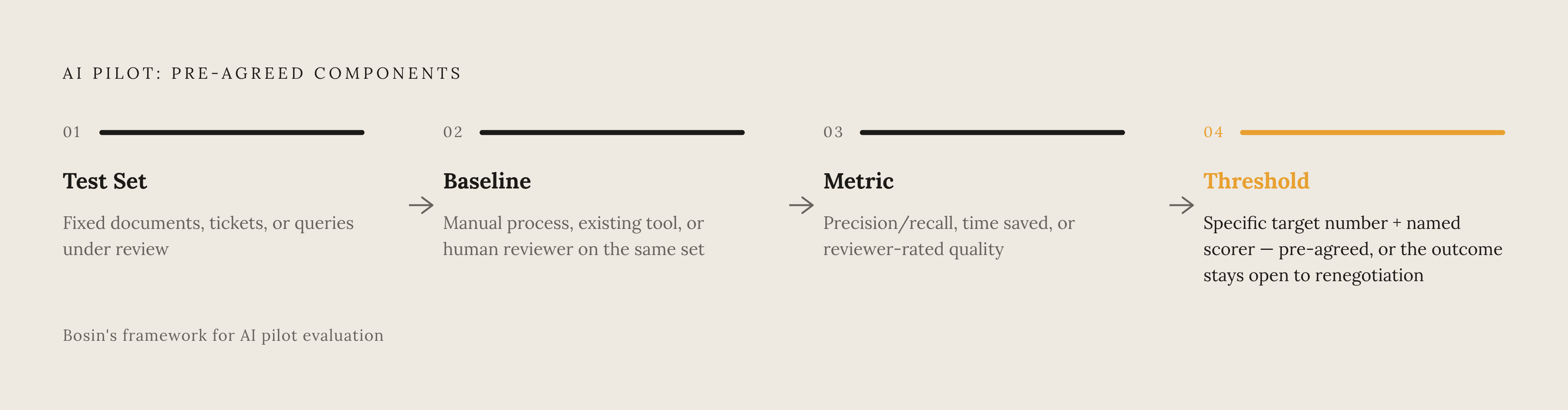
Success criteria give the customer a defensible evaluation and the vendor a clear close signal. Bosin's framework requires four components agreed before work begins, namely the test set, baseline, metric, and threshold. The test set fixes the documents, tickets, records, or queries under review. The baseline establishes whether the comparison is with a manual process, an existing tool, or a human reviewer's results on that same set.
The metric then defines the kind of improvement being tested, such as precision and recall, time saved per task, or reviewer-rated quality on a defined scale. The threshold states the number that counts as success, while the agreement names who will score the results. Neither the target nor the scorer should remain open to interpretation after the evaluation. More broadly, credit-funded work should produce evidence, whether about quality, latency, inference cost, or production reliability. That evidence makes conversion a factual determination rather than another negotiation over what the pilot proved.
Structuring the pilot fee and credit to filter serious buyers and fund the close
Charging for the pilot establishes that the buyer can obtain internal budget approval. Bosin treats this as a filter for serious prospects because a budget owner must exist before the evaluation ends. The fee also defines the work being purchased rather than leaving onboarding and integration support without a boundary. Its agreement should state payment timing, typically upfront or split between kickoff and midpoint, and the seats, usage, and services covered.
The conversion credit gives that payment a second role. A full or partial credit against first-year subscription fees ties what the customer spends on evaluation to the annual purchase if it signs within a set window. This is a structural device rather than a general discount because its value depends on completing the buying decision on time. The agreement should also state that failure does not earn a refund unless the vendor chooses to offer one as a sales concession. Together, these terms make the pilot a paid engagement with an explicit route into the subscription.
Credit sizing and the actual cost of the customer's workload
The usage allowance needs to be worked out separately from the pilot fee. Work backward from the expected workload volume and the resources needed to complete the agreed test set. Inference cost depends on how complex a request is, the length of the context window, and the model tier. The allowance should therefore use workload-appropriate units, including queries, documents, tokens, or API calls.
Bosin specifies that the pilot order must also define what happens at the cap, whether through throttling, notice-and-approve, or overage fees. Rate limits must remain consistent with upstream model-provider limits so that the promised allowance does not imply unlimited throughput. Too little credit can prevent the customer from completing the test set, while an uncapped allowance can make the engagement cost more than it earns. The design must also settle whether cost variance is absorbed within a fixed markup, passed through proportionally, or smoothed through credits.
Real-time consumption tracking as a commercial safeguard, not a product feature
An allowance cannot protect either party if consumption remains invisible until invoicing. The evaluation team needs real-time or near-real-time visibility into credits used and credits remaining. Threshold alerts must arrive before exhaustion so the team can pause work, request more credits, or approve overages. Attribution by workload or user then explains which activities are consuming the budget.
These controls matter to finance and legal teams as well as technical evaluators. Without them, even a technical test that goes well can leave procurement facing a risk of bill shock it cannot accept. Budget forecasting, spending caps, and visible consumption make the evaluation commercially legible. They also demonstrate the controls the customer will receive at scale, because pilot metering is the foundation of production billing. A vendor that cannot show consumption during evaluation has not demonstrated how the customer will manage ongoing spend.
Pre-agreeing the conversion path so the pilot ends with a decision, not a follow-up
Bosin's conversion framework sets the subscription price and term, the period for which the offer remains open, and the form of commercial agreement before the pilot starts. Ideally, the vendor's MSA is attached or referenced in the pilot agreement. This lets the customer assess what it would buy with the commercial terms in hand before it approves technical work. It also prevents successful results from becoming the starting point for price renegotiation.
Some vendors attach a signed conditional order that takes effect when the criteria are met unless the customer opts out in writing. Enterprise buyers often resist automatic conversion, but even a non-binding price commitment shortens the path to signature. The important mechanism is the connection among the success threshold, expiring fee credit, and conversion offer. Vague criteria remove the trigger, while a distant closing window weakens the credit's urgency. These are not three independent clauses but one architecture in which evidence establishes eligibility, the order defines the purchase, and the credit rewards a timely decision.

Data scope, liability, and expiry terms that keep the pilot from drifting into unpaid production use
A well-received pilot can expand without converting if nothing requires it to stop. Bosin's framework addresses this with a fixed expiry date, explicit data scope, training rights, and liability proportionate to the pilot. The evaluation period must end on a set date, even if the parties are still discussing next steps. Combined with the conversion offer's closing window, that boundary turns an indefinite extension into a decision.
The data terms should identify what the customer supplies, whether it can be used to improve or fine-tune models, and how it will be deleted. Deletion needs to cover logs and embeddings because removing raw data may not remove model-layer representations. The agreement must spell out training rights instead of carrying them over from terms written for conventional software. Liability should be capped for the pilot rather than the eventual production engagement, with a separate approach for data incidents. These boundaries keep the agreement proportionate to the evaluation it actually funds.
How hyperscaler credit programs fit into enterprise POC design — and where they fall short
Infrastructure credits can reduce pilot cost, but their eligibility and coverage must fit the engagement. OpenAI Startup Credits does not publish a dollar amount, and its primary program is gated through named VC partners. Anthropic Startup Program takes applications with or without VC backing, but its credits can be used only for the first-party Claude API through Claude Console and cannot be used for AWS Bedrock or Google Vertex AI. Accepted startups also receive Anthropic's highest rate limits. A team planning to consolidate infrastructure on a hyperscaler cannot treat those credits as interchangeable.
Together AI Startup Accelerator ties credit tiers to funding raised and requires a minimum upfront purchase for API access. Fireworks AI also requires venture backing above a threshold and excludes companies that have reached Series D. Expiry creates another constraint. OpenAI's Service Credit Terms state that unused credits expire one year after purchase or issuance unless otherwise specified at purchase. AWS Activate, Google for Startups Cloud, and Microsoft for Startups pay for infrastructure, but whether they cover AI API use depends on which programs and services qualify. These programs can support a pilot's cost base, but none supplies its acceptance criteria or conversion agreement.
Why credit program design is a pricing and monetization decision, not a sales tactic
Windsurf's retirement of credit billing in March 2026 shows how a pricing unit can distort behavior. Its flat credit rate “charged the same rate for both simple and complex requests,” which “led users to be scared of asking quick questions” and to “cram multiple requests into single prompts”. Windsurf moved to quota-based plans with allowances that refresh daily and weekly, and bills extra usage at API pricing. Cost per message varied by model, task size, and complexity. A credit unit that fits poorly can lead the customer to use a pilot in ways that differ from normal production use.
The April 2026 repricing announcements from HubSpot and GitHub also show a market still choosing among different approaches. GitHub's usage-based billing transition took effect on June 1, 2026. Across the market, consumption credits, per-resolution outcome billing, and per-token metering represent different allocations of usage risk. Hybrid pricing can raise total contract value while exposing unpredictable users to downgrades or overconsumption disputes. The trial should use a pricing structure the vendor can keep in production, even if another would make the evaluation look cheaper.
The billing infrastructure a well-designed trial actually requires
To make this design work, the billing infrastructure must be built for usage-based and credit-based pricing. Prepaid wallets must be first-class objects that can be shared across products, users, and agents, with balances depleted as usage events arrive. Query-level event ingestion must support timely alerts and spending caps, while attribution by workload, model tier, user, or business unit supports enterprise cost allocation. Conditional conversion logic must also be able to activate a pre-agreed order or plan change when the agreed thresholds are met.
Companies often build usage metering internally while buying invoicing, plan management, and payments. For AI pilots, separating those systems creates a reconciliation burden because consumption and billing are inseparable. A common engine supporting prepaid wallets and postpaid invoicing keeps the trial and production relationship on the same basis. Deployment also matters for regulated enterprise buyers that require billing within their infrastructure or sovereign cloud, making on-prem support a selection requirement. This infrastructure supports a better trial dashboard and an executable commercial agreement in which measured usage, bounded cost, and demonstrated success lead to a defined purchase.