Real-Time Credit Balance Enforcement for Millisecond-Speed AI Workloads
A policy enforcement gateway checks balances and gates requests before inference costs spiral.
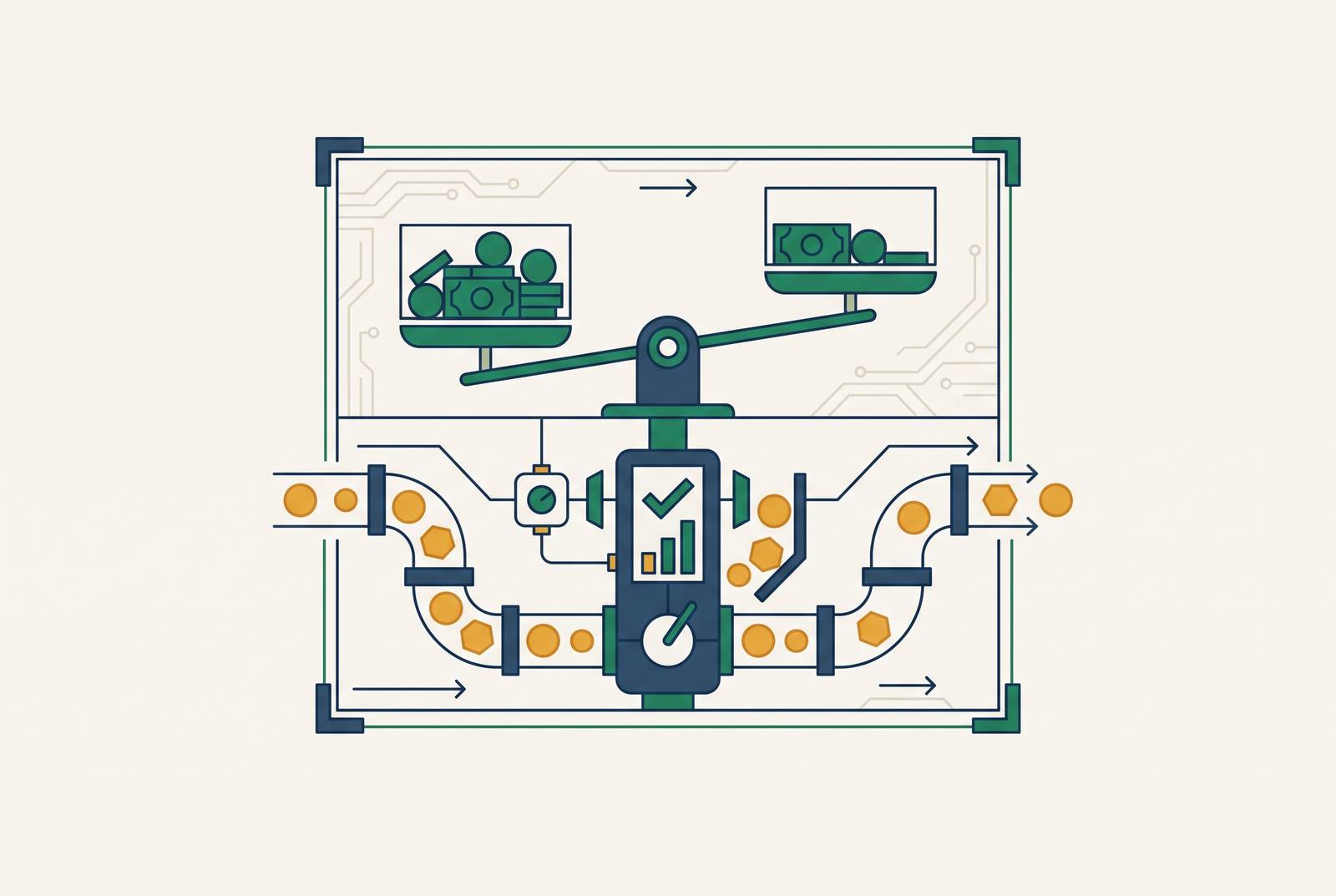
Real-time credit balance enforcement for AI workloads is an infrastructure problem. It requires an event pipeline that can evaluate, decrement, and gate usage at the speed of a single inference call, before runaway consumption turns into a financial liability. This article lays out what that architecture looks like, where the billing stacks most companies already run fall short of it, and what "enforcement" has to mean once you're counting tokens instead of seats.
Why AI inference broke the assumptions traditional billing was built on
Subscription billing grew up in a world where adding one more user cost almost nothing. AI inference does not work this way. Every token a model generates has a real, metered cost attached to it by the provider underneath, and that cost scales with how hard a given user leans on the product, not with how many users are on the account.
Input tokens and output tokens are priced separately, and the price per token shifts depending on which model tier handles the request. A vendor that bundles AI cost into an "included" tier is effectively asking its light users to subsidize its heavy ones. That arrangement might hold at small scale, but as adoption grows, the gap between what customers pay and what the underlying inference actually costs widens, and it widens in the direction of the vendor's margin, not away from it.
None of this is a pricing problem. The failure sits one layer below pricing, in the fact that the billing system has no live signal telling it what's being consumed as it happens. Without that signal, there's nothing to act on, no matter how well the price itself is designed. Cursor's public run-ins with usage-based pricing make the point concretely: when a product's cost structure is driven by inference and the billing layer can't see consumption in real time, spend caps and usage dashboards stop being nice-to-have UX polish. They become basic engineering requirements, on the same level as authentication or uptime.
What "real-time enforcement" means at token-level granularity
Real-time credit enforcement means a system checks a user's remaining balance, subtracts the cost of the request being made right now, and either lets it through or blocks it, all before the response goes back to the user. Not at the end of the month. Not at the end of the day. Before the answer is returned.
At token-level granularity, this can't be a check that runs once per session or once per login. Every single API call, every token the model produces, has to generate its own timestamped event record, and that record has to flow into a pipeline built to act on it the moment it arrives. The loop looks like this: a request comes in, the system checks the balance, a decision gets made to permit or gate the request, an event gets recorded, and the balance gets decremented, all in a tight sequence measured in a small number of milliseconds, not seconds and certainly not minutes.
The component that does this work is best thought of as a Policy Enforcement Gateway, an inline piece of infrastructure sitting between the AI system and whatever resources it draws on. If the gateway isn't there, none of those behaviors can exist, no matter how the pricing page is worded.
Where the Event Ingestion Pipeline Breaks
An enforcement layer is only as good as the events reaching it, and most pipelines built in-house were never designed for the delivery guarantees, throughput, or deduplication that token-level billing demands. A logging system won't do it. A cron job won't do it. A database poll running every few minutes won't do it either.
The first failure mode is quiet. A dropped event doesn't throw an error anyone sees; it just disappears, and a disappeared event is both lost revenue and a usage limit the system wrongly believes hasn't been hit yet. A customer could keep consuming past a credit cap for minutes or longer, and nothing in the system would flag it, because the event that should have triggered the gate never arrived.
The second failure mode occurs in aggregation. Raw events have to be rolled up into billable units by the hour, by the day, and across the full billing period, and that rollup logic has to handle retries, deduplicate records, and absorb events that arrive late, all without counting anything twice. This is where most homegrown implementations break first, because it's the part of the system that looks simplest on a whiteboard and turns out to be the hardest to get exactly right under load.
A third problem appears for any product that routes requests across multiple model tiers depending on task complexity. Raw token counts from a lightweight model and a frontier model aren't comparable on their own; they need a normalization layer that converts everything into one common cost unit, usually a dollar figure or an internal credit, before any of it reaches enforcement or billing. Skipping that step leaves the enforcement system comparing numbers that don't mean the same thing. Its decisions are wrong even when every individual event was captured correctly.
How much this costs in practice is easiest to see in a single incident: a Series B fintech company once spent three days untangling failed cron jobs that had silently dropped thousands of billable API requests. The damage wasn't the time it took to build the original pipeline. It cost ongoing engineering effort to keep a fragile, custom system alive, and that cost became visible at exactly the moment the company could least afford the distraction.
Why traditional billing stacks cannot be extended to solve this problem
Subscription billing platforms were built to check state at specific moments in time: a plan change, a renewal date, the night an invoice gets generated. None of that is the same job as making a gate-or-permit decision in milliseconds against a continuous stream of events. Extending a tool built for discrete-moment billing into continuous enforcement means forcing it to do something it was never architected to do.
The usual workaround is to bolt a metering tool onto a subscription billing platform, so one system counts usage and a separate system holds the balance and produces the invoice. One metering vendor plus one billing vendor, wired together, is two products pretending to be one, and the gap between them is where enforcement failures live.
That gap gets worse once a company needs both prepaid and postpaid billing running at the same time, which is the normal case for AI and enterprise products, not the exception. A stack assembled from two vendors, each built around one of those modes, cannot serve both reliably, because neither vendor designed their system assuming the other mode would need to run on the same event stream at the same time.
The clearest symptom appears in spend visibility. Customers experience the absence of that visibility as bill shock, and bill shock generates churn and support tickets at a cost that, over time, exceeds the cost of replacing the platform.
The Enforcement Gap as a Cost Forecasting Crisis
Enterprise buyers describe the symptom, not the cause. A buyer doesn't see a missing event bus or a broken aggregation job. A buyer sees an invoice that doesn't match what finance expected, and that single bad experience shapes how the entire procurement process treats the vendor from then on.
From inside procurement, a surprise invoice is a compliance and budgeting risk, the kind of thing that gets escalated past the original buyer to finance and legal. Skills gaps and governance concerns already rank near the top of the list of challenges CIOs name when they talk about deploying AI, and a vendor's enforcement architecture directly shapes whether that CIO's team can get the product approved. A product that cannot guarantee a spend cap will hold is a product that cannot credibly answer a procurement officer's most basic question: what will this cost us next quarter.
The fixes vendors reach for, usage caps, real-time cost alerts, prepaid credit bundles, all depend on the enforcement infrastructure described earlier in this piece. They are outputs of a metering and balance pipeline that either exists or doesn't, not settings a product manager can toggle in a dashboard.
Snowflake's credit model points toward a better pattern. Snowflake charges credits per second of virtual warehouse activity, with a 60-second minimum each time a warehouse starts or resumes, and after that first minute, billing continues per second for as long as the warehouse keeps running. The credit itself is the abstraction the customer forecasts against. Underneath it, Snowflake still meters consumption down to the second, but the customer never has to reason in those units directly. That's the design goal for any enforcement architecture serving enterprise buyers: granular metering on the inside, a predictable, forecastable unit on the outside.
Anatomy of a Purpose-Built Enforcement Architecture
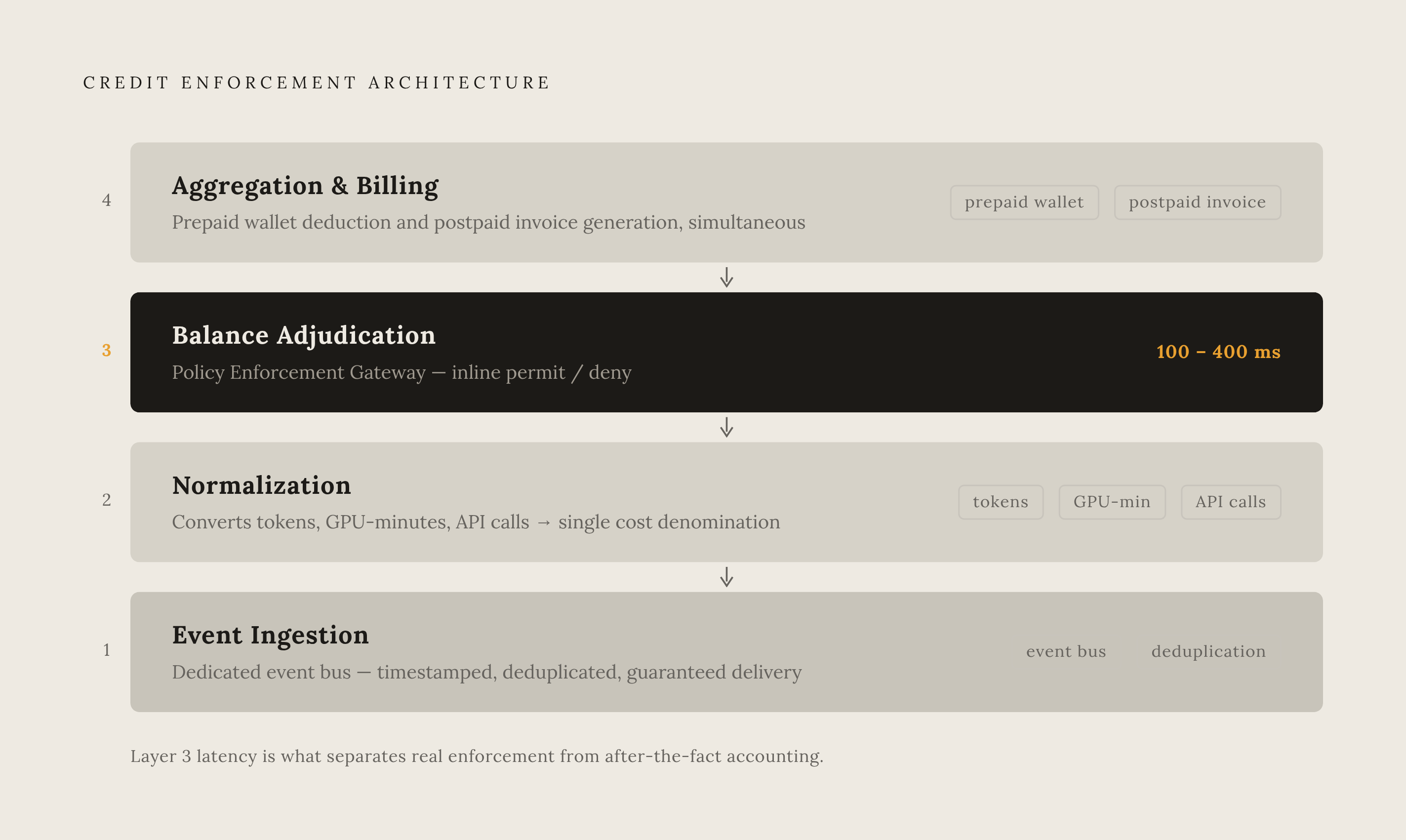
A production-grade enforcement system breaks into four layers, and each one carries its own correctness and latency requirements. Skipping or under-building any single layer weakens every layer that depends on it downstream.
The event ingestion layer sits at the bottom. It needs a dedicated event bus with guaranteed delivery, not a logging system repurposed for the job, and every API call has to generate a timestamped, deduplicated record at the moment consumption happens. That bus has to hold up under the full throughput of a production AI workload without dropping events, because a dropped event silently corrupts both the accuracy of enforcement decisions and the revenue tied to them.
The normalization layer sits above ingestion. Its job is converting raw token counts, GPU-minutes, API calls, and any other unit of consumption into one common cost denomination before the event ever reaches the balance system. Any product routing requests across multiple model tiers needs this layer specifically, because without it, everything downstream is comparing numbers that were never meant to be compared.
The balance adjudication layer is the Policy Enforcement Gateway itself, and it's where enforcement actually happens. It operates inline between the AI system and the resources it calls, reading current balance state, checking that state against policy, and returning a permit or a gate decision within whatever latency budget the product can afford. Full real-time decisioning architectures, the kind used in payment risk systems, typically budget somewhere in the range of 100 to 400 milliseconds for an end-to-end decision, which gives a useful sense of the order of magnitude an enforcement gateway is working within, even though the AI inference case and the payment case aren't identical.
The aggregation and billing layer sits on top. This layer also has to support prepaid credit wallet deduction and postpaid invoice generation at the same time, because those aren't two separate pipelines. Pricing changes, new tiers, new models, new credit denominations, should be something product and finance teams can configure directly, without needing an engineering deployment every time a number on the pricing page changes.
Why building this pipeline in-house costs more than it appears to
The pipeline described above looks, from a distance, like a project two engineers could finish in a few months. The event bus, the normalization logic, the balance store, the deduplication rules, the aggregation jobs, each of those needs permanent maintenance once it's live, and each one has to be upgraded, debugged, and scaled as usage grows well past whatever volume it was first built to handle.
One more filter has to run before any build-versus-buy decision gets made: whether the deployment even allows a SaaS platform. Products built for classified environments or sovereign cloud requirements often cannot use an externally hosted billing system regardless of its capabilities. For those cases, on-premises deployment capability is a hard filter that rules certain vendors out before any other criterion gets evaluated.
What to evaluate in a billing platform that claims to handle real-time enforcement
Judge a platform against the specific pipeline requirements laid out above, not against a generic feature checklist, since most billing tools on the market were built first for subscription billing and had metering added on as an afterthought.
Start with event ingestion quality. A platform relying on batch imports or periodic syncs cannot enforce a balance in real time, whatever the sales deck claims.
Check balance adjudication latency next. Ask where the enforcement decision actually executes, in the vendor's cloud, at an edge node, or in a component deployed inside the buyer's own infrastructure. That answer shows whether the latency budget needed at inference speed is realistic.
Confirm on-premises and sovereign cloud deployment are real options, not roadmap promises. For regulated industries or classified environments, a SaaS-only platform is disqualified before the rest of the evaluation even starts. On-prem deployment is a legitimate infrastructure requirement, not an edge case to dismiss.
Look closely at developer API quality. A clumsy event ingestion API or a weak SDK forces the engineering team to build the exact abstraction layer they were trying to avoid building by buying the platform. The quality of that API surface tells you, more reliably than any marketing claim, whether a platform was designed for this problem from the start or retrofitted onto it later.
This is the problem a purpose-built enforcement platform exists to solve: one engine that ingests usage events at inference speed, models any mix of pricing dimensions a product needs, runs prepaid and postpaid mechanics side by side, and deploys wherever the customer's infrastructure requires, on-premises included. Measured against the seven criteria above, that's the bar any platform claiming real-time enforcement needs to clear.