Credit Burn Rate Patterns Across SaaS Product Categories
How consumption patterns differ across SaaS categories and what that means for your pricing model.
A SaaS vendor can raise what a customer actually pays without ever touching the price on the website. The sticker price stays put and the per-credit rate stays put, yet the bill still climbs, because the real pricing surface isn't the price list but the burn rate: how fast a customer works through a credit allotment and what triggers that exhaustion. Zylo's 2026 SaaS Management Index found that a large majority of IT leaders experienced unexpected charges tied to consumption-based or AI features in the past year, and that pattern traces back to a simple fact about compute. Burn rate varies sharply from one product category to the next, and if you set or evaluate SaaS pricing today, understanding those differences has become a practical requirement.
The three variables behind burn rate differences across product categories
Three variables interact to produce a product's burn signature, and no two SaaS categories combine them the same way. The first is compute profile: how much infrastructure cost a single billable action actually incurs. The second variable is user behavior, specifically whether usage is steady and forecastable, like a fixed workflow that runs daily, or bursty and erratic, like a creative session or a support volume spike. The third variable is the action-to-value ratio: how much perceivable value a single credit-consuming action delivers. When credits fund open-ended generative exploration with uncertain output, the value is diffuse, so outcome-based pricing is not a realistic option and raw consumption metering is the only workable model. These three variables also sort categories by margin risk. A category with high compute per action, bursty usage, and a low action-to-value ratio is a margin trap under flat pricing, while a category with high compute, predictable usage, and a high action-to-value ratio can sustain outcome-based billing without much risk. That variance is visible in gross margins across AI-augmented products generally: AI features are compressing SaaS margins compared to pre-AI products, and the degree of compression differs by category precisely because these three variables differ by category.
AI coding and developer tools: high compute per action, heavy-user variance, and the shift from unlimited to metered
Developer tools carry some of the most volatile burn signatures anywhere in SaaS, because a single power user's session can consume orders of magnitude more compute than a casual user's. Flat or unlimited pricing cannot survive that kind of variance for long. Usage in this category is bursty by nature, intensive coding sessions interspersed with stretches of inactivity, so a monthly credit budget can be exhausted in a few days of heavy work and then sit untouched. The action-to-value ratio here is moderate and depends heavily on context: a completion that ships a working feature carries real value, while a generation the developer discards carries almost none, and that unpredictability is what makes outcome-based pricing impractical for this category. For vendors, flat unlimited pricing in a high-compute, heterogeneous-user category is a standing liability. If developers on the team are heavy users, budgeting by monthly credit allotment understates true cost, so you need to model actual spend against session intensity.
Creative and generative image tools: variable credit consumption by feature, expiry risk, and the "exploration tax"
Creative and generative image tools produce a different kind of burn signature. Consumption here depends less on how intensely any one user works and more on which specific feature gets invoked, because different generation types carry very different compute costs. Compounding that, creative work is non-deterministic by design, so a meaningful share of credit consumption produces no usable output. The action-to-value ratio here is the lowest of any category covered in this piece. A single generation may or may not yield a usable asset, and a large share of credits fund the process of discovery rather than a discrete deliverable, which makes outcome-based pricing nearly impossible to apply to creative tools in any coherent way. Vendors have responded by moving specific high-compute features off unlimited tiers and onto metered credit consumption, as seen in Magnific's 2026 plan changes, often paired with grandfather clauses that expire at the subscriber's next renewal date. Metering credit cost by feature is a more sustainable margin model for vendors than flat unlimited access, but it only works if the metering is transparent enough to show users which actions are consuming the most. Without that visibility, trust erodes, and churn follows close behind.
CRM and marketing automation: outcome-based pricing is arriving, but the transition from per-action to per-resolution changes burn dynamics entirely
CRM and marketing automation have become the most visibly documented site of pricing transition in SaaS during 2026, as vendors move from billing for activity to billing for results. That shift changes the burn signature from credits consumed per action taken to credits consumed per result delivered, and the difference reshapes vendor margin exposure and buyer forecasting alike. HubSpot's transition in April 2026 is the clearest documented case: Breeze Customer Agent moved from $1.00 per conversation to $0.50 per resolved conversation, priced at 50 credits per resolution, while the Prospecting Agent moved to $1.00 per qualified lead recommended for outreach, priced at 100 credits per lead. In both cases, the unit of billing moved from the interaction itself to the outcome the interaction produced. Intercom Fin's $0.99-per-outcome model points in the same direction: credits are consumed only when the AI delivers a defined result, not simply when it processes a request. Outcome-based pricing cuts against the intuition that measuring results makes billing simpler, because that unpredictability runs in the vendor's direction as much as the buyer's. The market's reaction to HubSpot's move offers a signal of how seriously this shift is being taken: HubSpot's stock dropped 19% in a single day as investors responded to the company's move to outcome-based AI pricing, accompanying price cuts, and a slow start to the second quarter. The size of that reaction suggests the market expects CRM vendors generally to keep moving toward outcome or consumption pricing, even where the operational transition is genuinely difficult to execute cleanly.
Data and analytics platforms: high-volume, predictable burn that rewards committed consumption tiers
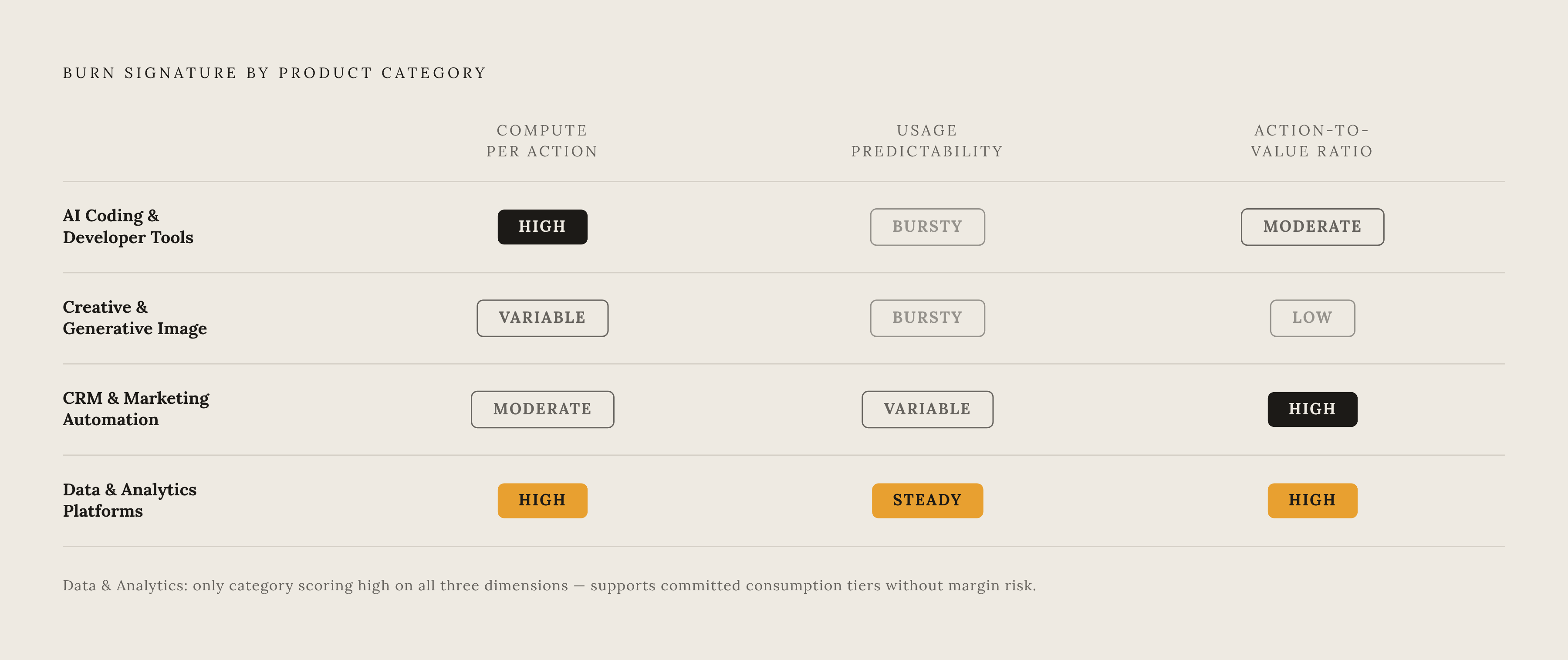
Data and analytics platforms sit at the opposite end of the predictability spectrum from coding tools and creative tools alike. Consumption scales with business workflows that are regular, recurring, and plannable, and compute-credit metering at this scale has produced strong retention rather than the churn that unpredictable burn tends to generate elsewhere. The burn profile here is high in volume but relatively steady across a billing period, with spikes tied to identifiable business events, quarter-end reporting cycles, model training runs, scheduled ETL jobs, that customers can see coming and plan around. The action-to-value ratio is high and legible in a way few other categories can match: a query that surfaces a business insight, or a training run that produces a usable prediction, is a discrete and valuable unit of work, unlike an exploratory creative generation or an open-ended agent conversation. That predictability is what makes committed consumption tiers and prepaid credit structures viable here. Customers can commit to a monthly or annual credit volume with real confidence they will use it, which reduces the vendor's breakage risk and produces stable, forecastable cash flow on both sides of the relationship. Datadog's hybrid per-host-plus-usage model follows the same underlying logic: revenue grew substantially year over year in Q1 2026, with metered observability data layered onto a predictable per-host baseline, so the baseline anchors revenue while the usage layer captures expansion as customers scale up their monitoring footprint. For vendors building in this category, the burn signature supports credit commitment tiers with modest rollover, because consumption is predictable enough to price confidently. The margin risk here has less to do with tail users than with pricing credits at a rate that keeps pace with compute costs as AI workloads themselves grow more expensive to run.
Collaboration and productivity tools: low compute per action, high action volume, and the credit bundling compromise
Collaboration and productivity tools present a burn challenge that looks almost nothing like the categories above, because the pressure comes from aggregate volume across large user bases rather than from compute intensity in any single action. Monday.com prices AI credit top-offs at $0.01 per credit on its annual plans, with a preset monthly allotment built into each plan tier. That low per-credit price reflects how little compute a single action actually costs, but multiply it across thousands of users in a workspace and the aggregate cost becomes material in a way the per-unit price obscures. The action-to-value ratio in this category is diffuse by nature: a single AI-assisted task, summarizing a document, drafting a project plan, autocompleting a field, carries modest value on its own, and value only accumulates through sheer frequency across many users. Per-action pricing is hard to justify to buyers, even though the aggregate consumption cost to the vendor is substantial. Notion's hard-stop auto-pause model is a direct vendor response to that forecasting problem: rather than billing overage after the fact, the product simply stops working until an administrator intervenes. That protects vendor margin, but it does so at the cost of user experience, and teams that hit the cap without warning face real workflow disruption in the moment it happens.
Burn rate divergence as a billing infrastructure problem
Because burn rate is specific to each category rather than uniform across SaaS, any company operating multiple product lines, or layering AI features onto an existing product, cannot rely on a single metering model to cover all of them. A business running a CRM product with outcome-based burn, a creative tool with feature-variable burn, and a data product with volume-predictable burn, each on its own billing codepath, spends significant engineering and finance time every month reconciling three fundamentally incompatible credit models. Real-time metering stops being a nice-to-have the moment burn rates diverge this sharply across a product line. If a coding tool auto-bills overage at API rates in arrears, the way Cursor does, it needs event ingestion accurate to the millisecond to avoid disputed invoices, while a creative tool whose credits expire at month-end needs balance tracking precise enough to warn customers before they lose allotments they never used. Visibility is a mechanical requirement: customers who cannot see their burn rate in real time have no way to adjust their behavior before they exhaust an allotment, and the result is either an overage bill they did not expect or wasteful over-purchasing meant to guard against running out. Outcome-based models add a further layer of complexity that consumption metering never required in the first place: a per-resolution or per-qualified-lead system has to record not just that an action occurred, but that the action produced a defined, attributable result, and that attribution layer is a materially different infrastructure problem than counting tokens or API calls. Prepaid credit wallets and postpaid overage invoicing need to run on the same engine, because a single customer may prepay a credit allotment for predictable workflows while being billed in arrears for bursty overage, and both mechanics have to appear clearly on one invoice to be workable for anyone trying to read it. When burn patterns differ this much by product line and the billing infrastructure underneath cannot model all of them at once, the first week of every month becomes a manual reconciliation exercise for finance. The category-specific burn signatures documented across the sections above are why general-purpose subscription billing tools fail companies that are building AI features into multi-product SaaS businesses.
Designing sustainable credit pricing for each burn signature type
Sustainable credit pricing is a design decision anchored to each category's compute profile, usage behavior, and action-to-value ratio, and the teams that get this right build their metering before they announce a pricing structure. For high-compute, bursty categories like coding and developer tools, compute-dollar caps with transparently priced, auto-billed overage hold up better than flat request limits or unlimited tiers, and the credit allotment should be sized to cover median session intensity. For outcome-measurable categories like CRM agents and customer support AI, per-resolution or per-outcome billing is the highest-margin structure available, but only if the attribution infrastructure behind it is trustworthy. Without transparent measurement, buyers will dispute charges, and the cost of resolving those disputes eats into the margin advantage the model was supposed to deliver. A hybrid structure, a base access fee combined with per-outcome credits, reduces the vendor's revenue variance while still preserving the alignment that makes outcome pricing attractive. For high-volume, predictable categories like data and analytics platforms, committed consumption tiers with rollover provisions remain both the most buyer-friendly and the most revenue-stable structure, and the pricing variable that matters most is the credit rate relative to actual compute cost, which has to be modeled against AI workload intensity as it grows rather than against static query costs from an earlier era. One principle holds across every category examined here: customers cannot govern what they cannot see. Real-time spend visibility, in-product usage dashboards, and threshold alerts are not premium add-ons, they are the baseline a consumption-based pricing model needs in order to earn customer trust and let churn risk surface before it turns into an actual cancellation. Pricing itself needs to stay a lever that can move without an engineering project behind it, because burn rates will keep shifting as model costs change, as features mature, and as customer usage patterns evolve, and any team that needs an engineering ticket just to adjust how many credits an action consumes will always be a step behind the market it's trying to price for.