Credit Consumption Metrics That Finance and Product Should Share
Shared credit metrics let finance and product stop building separate dashboards from the same data.

Credit consumption has broken the common measurement that finance and product teams used to share, and the two sides are now reading the same billing data as two different stories. This piece lays out the specific metrics that can carry both meanings at once, so neither team has to build its own separate system to get the answer it needs.
Credit Consumption and the Shared Language of Finance and Product
Seat-based pricing gave finance and product one stable thing to count: the user. Credit consumption doesn't work that way. The same credit-burn event means two different things depending on who's reading it: finance sees variable cost and a slice of deferred or earned revenue, while product sees feature engagement, a load signal, and raw UX feedback. Both readings are correct. They just don't agree with each other, and they diverge the moment the data hits separate dashboards.
The stakes here are higher than they look, because AI has put real marginal cost back into software economics. Zylo's 2026 SaaS Management Index found AI-native SaaS application spending up 108% year over year, and now every prompt, every agent run, and every generative task triggers a real infrastructure bill behind it. A misread consumption chart used to be an analytics problem. Now it's a financial one, because the infrastructure spend behind each credit is real money leaving the building in real time.
Much of this traces back to a pricing mistake that predates AI but gets worse under it: legacy pricing metrics charge for infrastructure, not for the work a system actually performs. You can see that mismatch when finance and product each pull their own report off the same credit ledger and walk away with different conclusions. A single AI application can now rack up cost from the seat license, from credit consumption, from API call volume, and from compute overages, all inside one contract. The old habit, where each team owns one number and defends it, doesn't hold up when the bill is coming from four directions at once.
How hybrid pricing structures made one team's signal another team's noise
The hybrid pricing model, subscription plus credits, produces this gap, and here is how. The credit layer is the reverse. It's packed with behavioral detail, which features get used, how often, where people drop off, but it arrives on finance's desk as a pile of variable consideration that's genuinely hard to recognize cleanly under ASC 606.
Credit-based pricing earns its popularity because it smooths variable workloads into something that looks like a predictable allowance. Averaging out usage into a tidy credit allotment hides the granular, feature-level detail that product needs to do its job, and it hands finance a number so smoothed over that it stops reflecting when costs actually land.
Prepaid credit wallets make the split even sharper. When a customer pays for a block of credits up front, finance has to record that as deferred revenue and hold it there until the credits get consumed. Finance and product are looking at opposite ends of the same transaction's life, so if no metric is built specifically to connect those ends, nothing links the two views. Each team optimizes for a number the other team can't see.
The metrics that translate credit consumption into both financial and product terms simultaneously
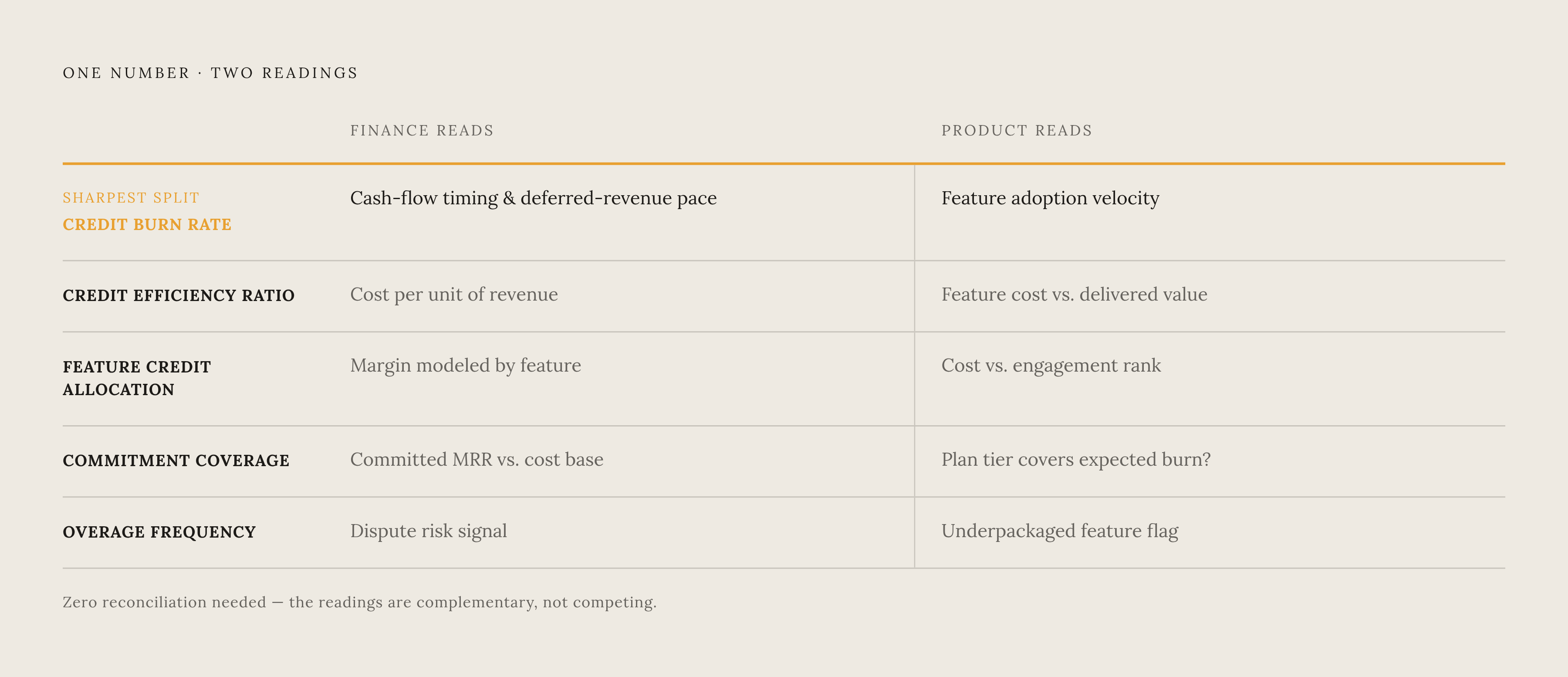
A handful of metrics can carry both meanings at once, financial and behavioral, but only if they're defined precisely enough that neither team has room to read them differently. The number has to answer both finance's question and product's question honestly, with neither side getting to compromise on it.
Credit Burn Rate, measured as credits consumed per customer per day or week, is the clearest example of this. Finance reads it as cash-flow timing and as a pace-setter for how fast a prepaid balance should convert into recognized revenue. Product reads the same number as feature adoption velocity, a gauge of how healthy the core usage loop actually is. When burn rate accelerates mid-period, it tells product that a feature is stickier than the roadmap assumed, and it tells finance that deferred revenue is going to convert faster than the model projected. Both teams have reason to act, and they can act from the exact same chart.
Product can weigh a feature's cost against the value it delivers with the Credit Efficiency Ratio, which measures output value or completed tasks per credit consumed, and finance can use it to track whether cost-per-unit-of-revenue is holding steady or drifting. The underlying principle is simple: AI pricing works best when the billing unit reflects real work performed, not raw infrastructure load. The Credit Efficiency Ratio is that principle turned into a number both teams can actually look at and argue from.
Feature-Level Credit Allocation breaks credit consumption down by feature or workflow. Finance uses it to model margin feature by feature. Product uses it to rank features by how much they cost against how much engagement they generate, which feeds directly into roadmap decisions and pricing rebalancing. Without that feature-level split, finance can't tell which features are protecting margin and which are eroding it, and product has no way to see which capabilities are actually driving the cost pressure.
Commitment Coverage Ratio compares committed MRR against the expected cost base, so it starts as a finance number, but if you break it out by feature tier, it turns into a product number. At that level of detail, you can see whether the customers on a given plan are generating enough committed revenue to cover the credits they're expected to burn through. One number, two decisions, made off the same evidence.
Overage Frequency and Pattern tracks how often customers exceed their included credit allocation, and you can see which features trigger the breach. Finance treats this as a measure of operational friction and dispute risk. Product treats it as a sign that a feature is underpackaged or priced wrong relative to its cost. Atlassian's Rovo AI structure makes the point well: standard plans include a fixed credit allocation per user each month, and Virtual Service Agent conversations only generate overage charges on Premium and Enterprise plans, since Standard doesn't include VSA. Finance sees that pattern as dispute risk waiting to happen. Product sees a feature valuable enough that customers are willing to pay past their limit for it, which is exactly the kind of signal that should inform the next repricing decision.
What real-time visibility into these metrics requires from the billing infrastructure underneath
None of these metrics matter if they only appear after the period closes. A burn rate calculated at month-end is a record of what already happened, not something either team can act on. Both finance and product need to see these numbers while the billing period is still open. The infrastructure producing them has to work in a fundamentally different way than traditional billing systems were built to.
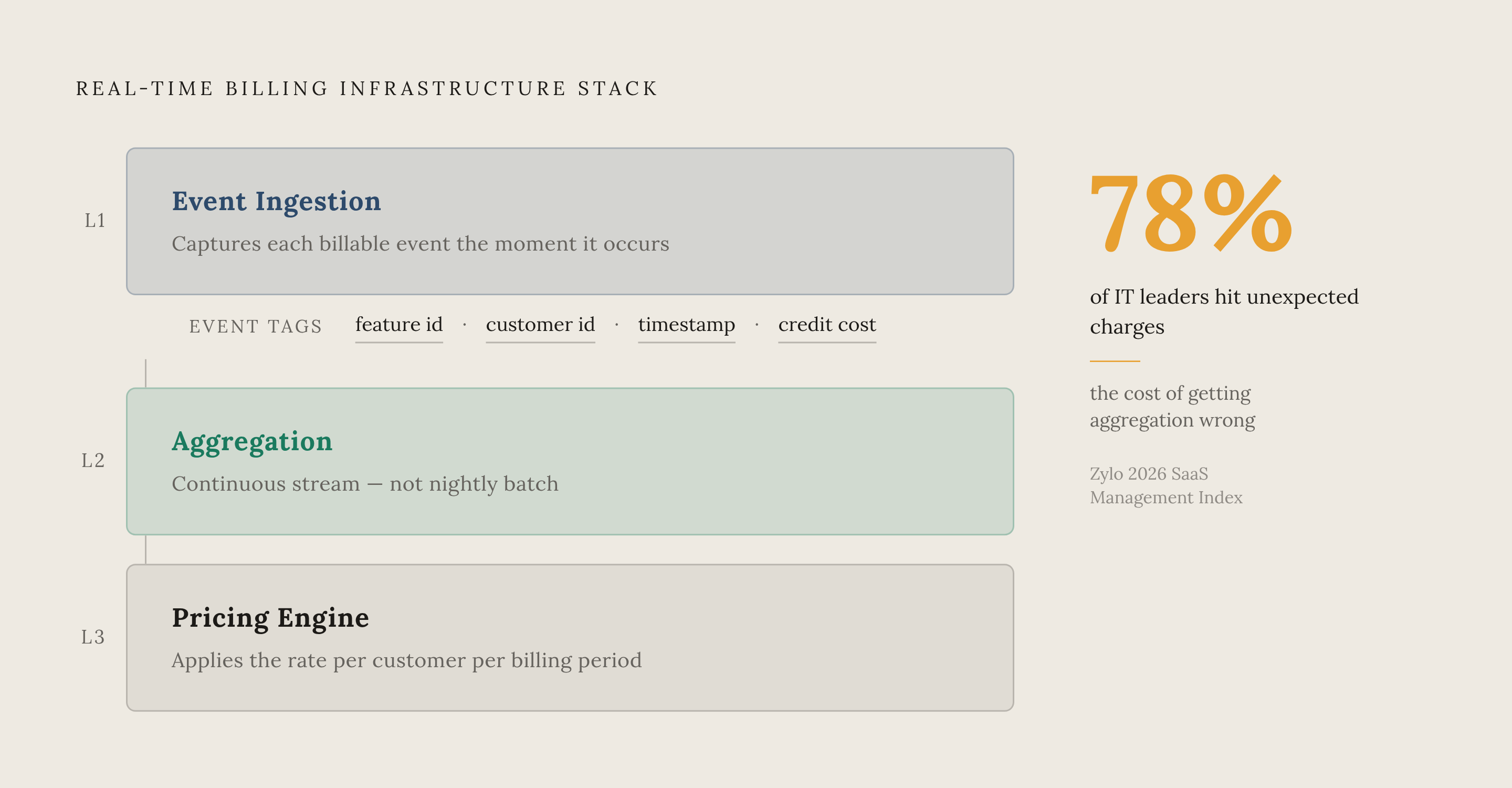
Usage tracking for consumption pricing runs through three layers: an event ingestion layer that captures each billable event the moment it happens, an aggregation layer that totals those events per customer per billing period, and a pricing engine that applies the rate on top. Get the ingestion layer wrong and burn rate is wrong. Get the aggregation layer wrong and feature-level allocation is wrong.
AI products spend credits in milliseconds across thousands of customer workspaces, so at that scale the aggregation layer has to run as a continuous stream, not a nightly batch job. By the time the batch job runs, the damage is already booked.
A full transaction ledger, one that records every credit movement with a timestamp and a feature tag attached, makes feature-level allocation reporting possible. This gap appears constantly in practice: Zylo's 2026 SaaS Management Index found that 78% of IT leaders reported unexpected charges tied to consumption-based or AI features in the past year, and in most of those cases, the billing system simply couldn't show anyone, customers or internal teams, their consumption as it happened. Building a customer-facing balance display, with burn-rate alerts and per-feature usage breakdowns, draws on the same underlying infrastructure that powers the internal reporting. Building it as a separate system doubles the engineering maintenance and opens the door to the customer-facing number disagreeing with what finance eventually books.
ASC 606 Treatment of Prepaid Credits as a Finance Requirement for Product Data
One of the costliest mistakes in credit-based pricing is booking prepaid credits as revenue the moment the customer pays. A customer buys a block of platform credits and the system records the payment, but if that payment gets recognized as revenue immediately, it violates recognition standards that require the money to sit as deferred revenue until the credits are actually consumed.
That requirement pulls product's instrumentation directly into finance's accounting obligations. The timing and feature-level breakdown of consumption is fundamentally a product dataset, but it also doubles as the dataset finance needs to recognize revenue correctly. New Relic's approach to this, disclosed in its FY2023 10-K, recognizes usage above commitment either as it occurs or ratably against an estimate of total usage above commitment, constrained to what the company expects to be entitled to receive. That kind of policy only works if the consumption data behind it is granular and current enough to support the estimate it's built on.
Auditors have taken notice. When auditors review variable consideration constraint logic at SaaS companies running usage-based pricing, they now focus on how accurate the historical consumption estimates have been. The shared metrics discussed here aren't just useful for internal planning: they're audit evidence, and they need to hold up under that kind of scrutiny. The practical consequence for product teams is direct: decisions about how to tag and attribute credit consumption are accounting decisions as much as engineering ones. Making those decisions without finance at the table creates a gap that becomes visible at audit time, long after the sprint that built the instrumentation has shipped and moved on.
Building a Shared Reporting Layer Without Two Systems
The failure to avoid is building two reporting systems, a finance layer and a product analytics layer, that both pull from the same raw event data but aggregate it differently. That setup produces two different numbers for what should be a single metric, and it turns the first week of every month into a reconciliation project nobody budgeted time for.
The fix is to compute each shared metric, burn rate, efficiency ratio, feature allocation, commitment coverage, overage pattern, once, from a single aggregation, and let both teams view it from that same source. What finance sees and what product sees should differ in presentation and in what each is permitted to drill into, not in the underlying numbers. That's a data pipeline decision, not a dashboard design decision.
None of this works without instrumentation built correctly from the start. Every billable event needs a feature identifier, a customer identifier, a timestamp, and a credit cost attached at the moment it occurs. Tagging events after the fact isn't reliable, and it won't hold up under audit. Finance and RevOps also need systems built for reconciliation: auditable transactions, invoiced top-ups, and support for partial credit payments, the kind of detail that prevents month-end from turning into chaos. These happen to be the same properties product needs for feature-level reporting to work. A billing system built with that overlap in mind from day one satisfies both teams; one built without it satisfies neither well.
The build-versus-buy decision matters here in concrete terms. If you build a credit wallet, a transaction ledger, feature-level aggregation, and a customer-facing balance display in-house, that's a multi-week engineering project that competes directly with product work that could otherwise ship. The real cost of the build path is the shipping delay that stacks up while that infrastructure gets built instead of bought, not just engineering hours. If changing a credit rate requires a code deployment, the shared metrics built on top of that system become a lagging indicator, not a lever either team can actually pull. The decision to share infrastructure, not just share reports, has to happen before the pricing model goes live, as a joint call between finance and product, not as a reporting project bolted on after the billing system is already running.
What finance and product each need to commit to for shared metrics to work in practice
A burn rate calculated one way in finance's dashboard and another way in product's is a disagreement waiting to surface at the next planning cycle.
Finance also needs to treat the product event log as a primary accounting source, not a secondary dataset it reconciles against after the fact.
Product needs to flag finance the moment a new feature shifts the consumption pattern that a revenue estimate was built on, and it needs to treat the billing ledger as a product dataset in its own right, not simply a report finance happens to produce.
HubSpot's per-tier credit allocation with defined top-up pricing, and Atlassian's per-meter overage rate structure, both work because the credit cost per feature was set jointly, as a decision finance and product made together, not a number one team calculated and handed to the other after launch. The real test of whether a shared reporting layer is working comes down to two things, and both have to be true at once. Finance should be able to release deferred revenue on a prepaid credit block without running a separate reconciliation step first. Product should be able to spot a feature whose credit cost has drifted from its margin target without waiting for the books to close at month-end. If either test fails, the infrastructure underneath still has two systems pretending to be one.