Seasonality and Spiky Demand in Credit-Based AI Products
Credit pricing absorbs AI's unpredictable usage spikes by decoupling payment from consumption.

Credit-based pricing exists because AI put real, variable marginal cost back into software economics, and the flat-subscription model was never built to carry that cost. Traditional SaaS worked on a simple premise: once the software was built, serving one more user cost almost nothing, so a flat monthly fee was a safe bet for the vendor. AI software runs on a different physics. Every inference call burns compute, and an upstream model provider usually prices it per token, so the cost you pay scales directly with how much you use the product. A single power user running large context windows repeatedly can generate inference costs that exceed what their subscription brings in, turning a vendor's generosity into a direct hit on margin. The response across the industry has been to split the product into two layers: a subscription floor that covers access, and a consumption charge, paid in credits, that tracks the AI usage sitting on top of it. Credit-based packaging became the defining shift in SaaS pricing during this period, with the share of companies offering credit models growing sharply from a small minority to a significant portion of the market, because credits accomplish two things at once: they let vendors recover unpredictable inference cost, and they translate opaque token economics into a unit buyers can actually reason about and tie to the value they're getting.
What spiky, seasonal AI demand actually looks like and why it defeats subscription logic
AI usage does not grow in a straight line, and that fact alone makes subscription billing structurally unfit for it. A customer who signs on during a pilot phase might spend a modest amount in the first quarter and then, once the workload moves into production, spend an amount an order of magnitude higher by the fourth quarter, with no historical pattern available to predict the jump. Vendors who offered generous pilot credits to win deals have routinely found that production-scale usage blew past their cost estimates by multiples of the original figure. Cursor's billing incident made this pattern visible to the public: a single developer's usage generated an invoice far beyond what a subscription tier would ever produce, because nothing in a flat-fee structure caps or anticipates a workload that scales that fast. Agentic systems add a further complication, because an autonomous agent can loop through dozens or hundreds of steps within one session, and if there is no hard ceiling on those steps, the cost of a single session has no real limit. None of this fits inside a subscription invoice, because it stays fixed no matter whether a customer's actual usage came in far under expectations or far over them.
Payment-Consumption Decoupling in Credit Systems
Credit-based pricing handles demand variance because you pay at one moment and use that payment at another. When a customer buys a credit pack, the vendor books that revenue as a liability, deferred until the credits are drawn down, and holds the cash regardless of how fast or slow the customer consumes it. So a spike in usage does not translate into a spike in revenue volatility for the vendor, because the money already changed hands before the spike happened. Customers get something out of the arrangement too: a prepaid credit balance sets a known ceiling on exposure at the moment of purchase. That is why buyers so often prefer committing to a capacity pack over paying per unit as they go. The hybrid structure that has become standard across the industry, subscription seat plus credits on top, builds on this directly: the subscription floor pays for baseline access, and credits absorb the variable AI layer without putting the vendor's margin or the customer's budget at risk. Atlassian's Standard plans show the pattern in practice: a team gets a fixed number of Rovo AI credits per user each month, and pays extra per credit once it goes past that allotment. Zendesk runs the same logic through its AI resolution agent: it prices resolved conversations at $1.50 each for customers on a committed plan, and charges a higher rate if you pay as you go. Adobe Firefly takes a stricter version of the same approach, resetting credits every month with no rollover at all, which makes expiry, not usage limits, the lever that controls Adobe's cost exposure. The structural payoff is the same across all three: a customer whose usage jumps in the third quarter draws down a balance that was already paid for, instead of generating a surprise bill, and the vendor was never exposed to that spike as a cash-flow event. That payoff only holds, though, if the customer bought enough credits to cover the spike to begin with, and whether they did comes down to how rollover and overage are designed.
How Rollover and Expiry Rules Convert Seasonal Peaks Into Predictable Vendor Revenue
Rollover and expiry rules decide whether the payment-consumption split actually smooths out seasonal demand or just moves the volatility somewhere else. A system with no rollover expires unused credits at the end of each period and recognizes them as revenue or forfeits them outright, which punishes a customer who bought ahead of a seasonal lull through no fault of their own. Adobe Firefly's monthly reset is a clean example of a vendor accepting that trade-off deliberately. A cap on rollover limits how much deferred liability a vendor carries forward, because if rollover has no ceiling, a prepaid product turns into an open-ended obligation no finance team can model with confidence. Expiry, in turn, gives a vendor a predictable revenue event: once credits expire unused, the deferred liability on the books gets released as revenue, and a vendor that can forecast its own expiry rate can treat that release as a reliable line item. Vendors have landed on different points along this trade-off. Oracle's Fusion AI Unit packs roll over within the subscription term, but any unused units get forfeited at the end of the term. Microsoft's pre-purchased capacity expires. AWS and Google both issue credits that expire with no rollover. For a product with real seasonality, the rollover window has a direct effect on revenue timing: a 90-day rollover on a product with a slow third quarter lets a customer bank unused credits in Q2 and spend them in Q4, rather than being forced into a new purchase at the exact moment demand has dropped. A customer can burn through their balance mid-period during a spike, and the design response matters: a hard stop protects margin but risks interrupting a live workflow, while a soft overage at a published rate keeps the product running but requires the customer to have agreed to it up front. That choice sits with product and finance, not engineering, and it has direct consequences for revenue recognition under ASC 606, which later sections take up in full.
What Billing Infrastructure Must Do to Work at Burst Speed
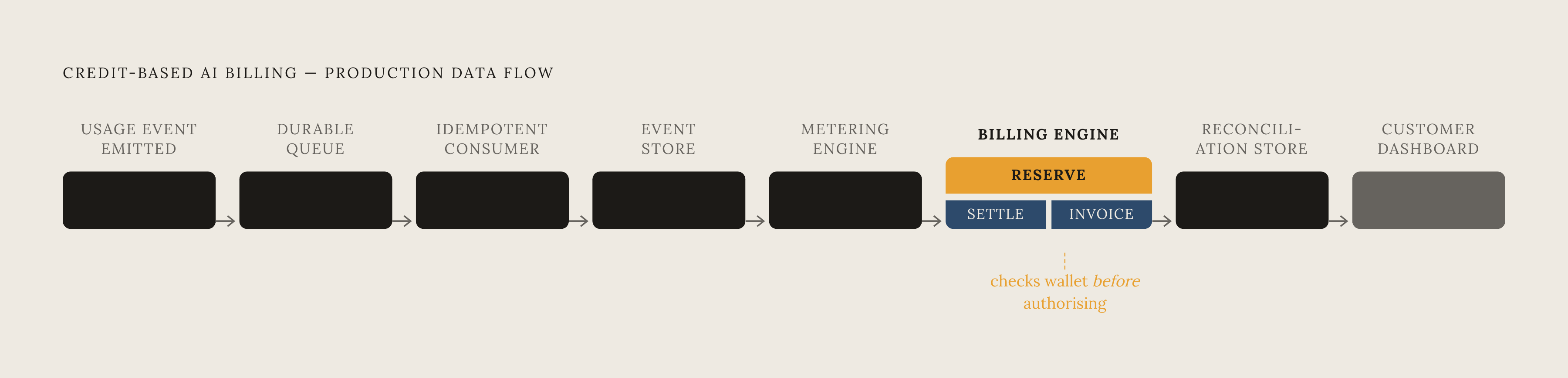
Credit-based pricing promises prepaid budgeting for customers and predictable cash flow for vendors, but both depend on a metering layer that can keep up with the speed AI workloads actually run at. A credit-based product's production data flow runs through a specific sequence: a usage event gets emitted, lands in a durable queue, passes through an idempotent consumer, writes to an append-only event store, moves into a metering engine that applies rules and aggregates usage, hits a billing engine that reserves, settles, and invoices, lands in a reconciliation store, and finally surfaces on a customer dashboard. Each stage has to complete before the next begins, and the reserve step inside the billing engine is what makes the word "prepaid" mean anything at all: the system has to check the wallet balance before authorizing the next call, not after the fact. Deduplication is not optional. Message queues deliver at least once, so the same usage event can arrive more than once through retries or late delivery, and if a metering system double-counts even a fraction of those events, customers see phantom charges, and trust erodes fast. Agentic workloads create a sharper version of the same risk: a single agent session can run hundreds of steps, each one emitting its own usage event, and without a hard per-session cap, the metering engine can drain or exceed a customer's wallet before anyone notices. That cap has to live in the infrastructure itself, not get treated as a product feature to add later. GitHub Copilot's shift to token-based AI Credits in June 2026 showed what happens when this layer is missing: once metered billing took effect, users reported single requests consuming double-digit percentages of their monthly allowance, and the underlying problem was never the pricing model itself but the absence of any visibility into consumption as it happened. A real-time dashboard showing credit balance and burn rate is the mechanism that lets customers regulate their own usage before they hit a wall, which is also what keeps support tickets and churn down. Metering and billing platforms purpose-built for credit-based pricing, Flexprice among them, are designed around exactly this requirement: tracking consumption and enforcing prepaid balances at the millisecond speed AI products actually generate.
Why In-House and Subscription Billing Tools Fail at This Infrastructure Problem
The requirements described above sit outside what subscription billing platforms were ever designed to do, and outside what most engineering teams can build and keep running without a steady, growing cost. Subscription platforms were built to do one thing: issue recurring charges on a fixed schedule. They don't treat a prepaid wallet as a first-class object, they don't check a balance before authorizing an API call, and they weren't built to ingest usage events at the volume and speed AI inference actually generates. The market's standard workaround, pairing a separate metering tool with a separate billing tool and integrating the two, solves part of the problem while creating a new one: the integration itself becomes a third system that someone has to maintain, and any drift between the two systems reproduces the exact reconciliation headache that credit-based pricing was supposed to eliminate. Building the whole thing in-house carries its own weight, since a production-grade system handling hybrid pricing, credit wallets, and basic revenue recognition takes substantial engineering time to get right, and that estimate doesn't include the ongoing maintenance, compliance work, and new pricing dimensions a growing product will keep adding. An in-house build also inherits the full compliance and audit burden directly, but a certified platform can carry that weight instead, which matters most if you operate in a regulated industry or are chasing enterprise contracts with data residency requirements. Once a product combines credits with usage, or usage with a subscription, or either with an enterprise commit, the team is building a billing system whether that was the plan or not, and the cost of that decision grows with every new pricing dimension layered on top. Replit and Vercel both show what buying the right infrastructure unlocks: Replit launched Autoscale with usage-based pricing while keeping the ability to adjust pricing up to a week before launch, and Vercel used purpose-built billing infrastructure to manage pricing agility across a large catalogue of products with complex SKUs, turning billing into something that moves product velocity forward. Companies that eventually go looking for purpose-built billing infrastructure have usually already hit the wall: running multiple billing codepaths side by side, burning engineering time on reconciliation every month, or discovering outright that their subscription tool simply cannot count usage events.
What a Purpose-Built Billing Platform Must Handle
A billing platform built for credit-based AI products needs to treat the credit wallet, the metering engine, and the invoice as one system, not three systems stitched together, and it needs to support the pricing dimensions, deployment constraints, and pricing agility that AI products actually demand. Flexprice is built around exactly that architecture: it ingests usage events at high throughput with low P99 latency, enforces prepaid credit wallet balances in real time as a first-class object rather than something bolted on afterward, and models any combination of pricing dimensions, tokens, GPU-minutes, API calls, agent steps, on the same engine that generates the invoice. So before you commit to a platform, what should you ask when you evaluate billing infrastructure for a credit-based AI product?
- Does the platform treat the credit wallet as a first-class object with pre-authorization built in, rather than a ledger that gets reconciled after the fact?
- Can it ingest usage events at the speed and volume AI inference actually generates, with deduplication built in?
- Can rollover caps, expiry rules, and overage rates be changed without requiring an engineering deployment?
- What on-premises or sovereign cloud deployment options exist for enterprise customers that need them?
- Does it generate accurate invoices automatically, removing the need for manual month-end reconciliation?
- Does it give customers real-time visibility into their own spend and burn rate?
- Can it model hybrid pricing, credits alongside subscriptions alongside enterprise commits, on a single engine?
A product billing simultaneously across tokens, GPU-minutes, audio minutes, megapixels, and hardware tiers needs infrastructure designed from the start to hold that combination together, not a subscription platform stretched with workarounds until it technically does the job.
How revenue recognition works when credits are the billing unit and consumption is the performance obligation
Credit-based billing produces a specific revenue recognition structure: prepaid credits are deferred revenue until a customer actually consumes them, and the metering engine, not the invoice, is the record of when that revenue was earned. Under ASC 606, usage-based revenue is recognized as usage happens, with each token, API call, or agent step counting as a small performance obligation satisfied the moment it's consumed, while unconsumed prepaid credits remain a liability until that consumption event fires. The right-to-invoice practical expedient, under ASC 606-10-55-18, lets a company recognize revenue in the amount it invoices when that amount matches the value delivered in the period. If a consumption contract ties billing to usage and usage to value, that expedient means you don't need to estimate total contract value upfront. Recognition breaks down for teams that treat it as a reporting task performed downstream of billing rather than a property of the same ledger that meters and invoices in the first place, because the mismatch only becomes visible at month-end, when the deferred revenue balance doesn't match what the metering data actually shows. Expiry adds its own recognition event: when credits expire unconsumed, the deferred liability gets released as revenue, and a vendor that can forecast its own expiry rate, based on real usage patterns across its customer base, can treat that release as a predictable line in its revenue forecast. Modeling rollover and expiry across customer segments, usage tiers, and regional currencies takes a billing engine that treats credit wallets and their time-decay rules as core primitives, not features added on top of a subscription system after the fact. A finance team should never have to spend the first week of the month reconciling billing errors by hand. When metering, wallet enforcement, and invoicing run on the same engine, the invoice is a direct output of the meter, not an estimate that needs correcting later. Engineering, product, and finance all need direct access to the same billing data, because routing requests between teams to understand credit burn, deferred revenue, or usage by segment introduces exactly the kind of lag that turns a demand spike into a surprise. Credits only deliver on their structural promise when metering, billing, and recognition run as one continuous system, not three.