Power User Consumption Segmentation for Credit Pricing Strategy
How power users destroy flat-rate AI pricing and why segmentation is the only fix.

A flat credit allowance prices every user in a plan at the same rate, but the cost of serving those users is not the same, and that mismatch is what breaks credit pricing as inference costs climb. Traditional software carried close to zero marginal cost per additional user, so a flat price could absorb the variation across a customer base. AI inference does not work that way: every model call consumes real compute, and a subscription that bundles unlimited AI access into a flat fee is structurally exposed to whichever customers call the model the most.
The failure mode is specific. A vendor sets a credit allowance calibrated to what the median user consumes, and that allowance immediately underprices every customer above the median, sometimes by a wide margin. Vendors that bundled AI into existing plans during 2024 and 2025 to move quickly are now the same vendors reintroducing limits, credits, or base-plus-usage structures to stop the bleeding. Pricing calibrated during a pilot phase routinely turns out to be wrong once usage scales: BetterCloud's analysis of the SaaS industry found the gap between what a pilot predicted and what production actually costs has run from 500% to 1,000% in some cases. Vendors that priced their plans during that pilot phase are absorbing that entire gap on exactly the customers consuming the most.
Worse, the mistake is expensive to walk back once it's made. Customers anchor on the first price they're quoted, and a power user who has already built a workflow around a given credit allowance treats any later reclassification as a broken promise rather than a routine price adjustment. That anchoring effect is why credit-based pricing has become a dominant mechanism for monetizing AI features industry-wide, even as most teams treat the credit model itself as a bridge rather than a finished answer. A bridge implies a destination, and the destination is a pricing architecture built around how usage actually distributes across the customer base, not around the average customer it was originally designed to serve. The bridge collapses under the same cost pressure that made it necessary in the first place without that architecture.
Consumption distribution of a credit-based user base
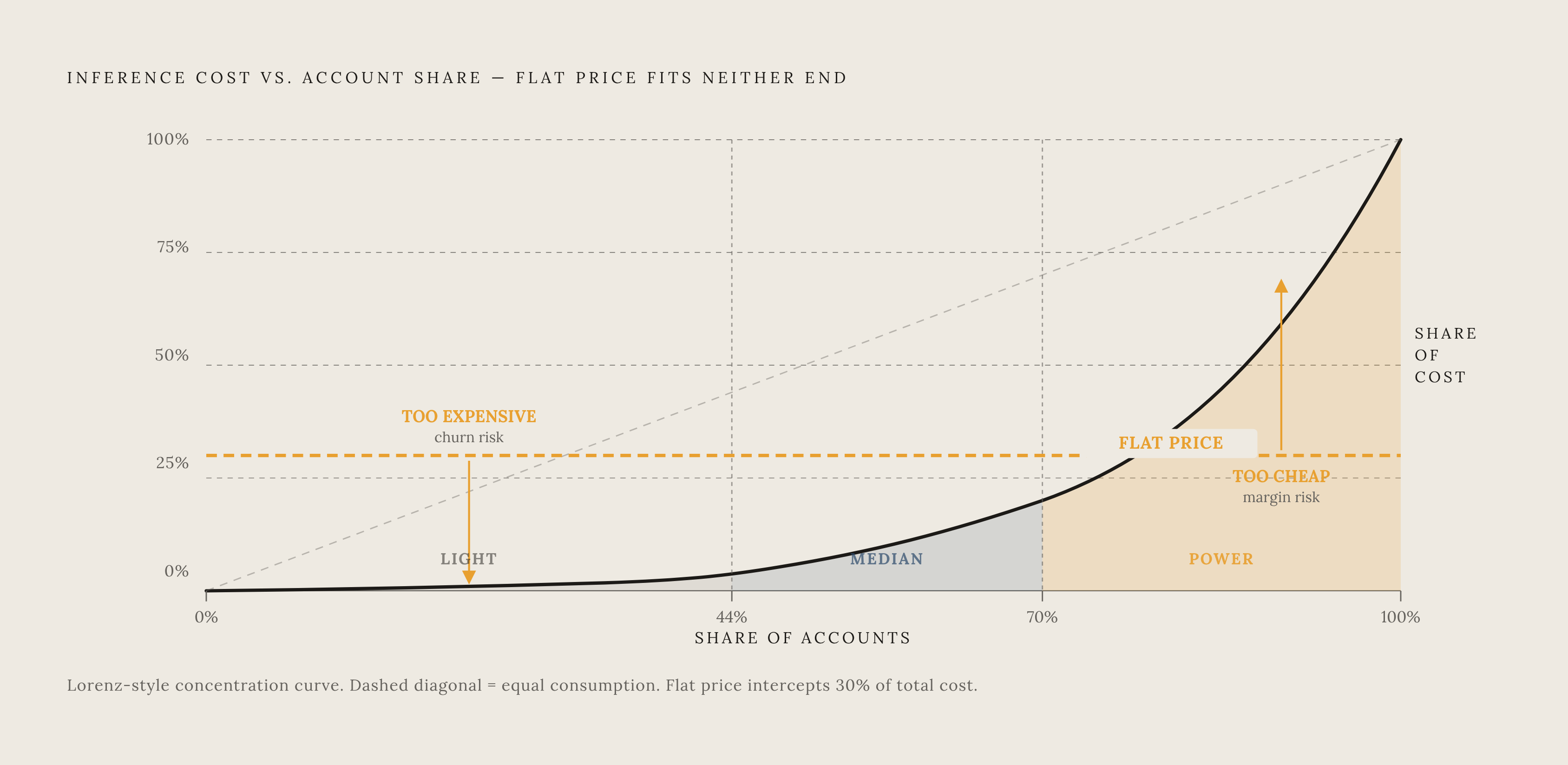
Usage in a credit-based AI product does not spread evenly across customers. It concentrates at the top, so a relatively small group of accounts accounts for a disproportionate share of total inference cost, while paying the identical credit price as customers who barely touch the product. The per-seat pricing analogy illuminates the same distortion: flat models charge a power user and an occasional user the same amount, and the same logic applies with identical force to flat credit tiers.
Two forces are pushing that concentration further toward the extreme. The first is the shift toward agentic AI, which BetterCloud's 2026 analysis describes as being on a hockey-stick adoption curve. An autonomous agent workflow generates inference calls at a volume no individual human user can match, and a single agent session can burn through what a typical human user consumes across an entire billing month, a concentration that is not hypothetical but visible in deployed products once usage scales past the pilot phase.
GitHub Copilot's own pricing transition is the clearest evidence of what an unaddressed distribution problem forces a vendor to do. Copilot originally billed against a premium request unit structure, but moved to AI Credits tied directly to token consumption, citing the rising cost of supporting advanced AI capabilities and the need to tie price to actual usage rather than a proxy for it. Under that model, an organization receives a pool of credits and is billed for whatever usage exceeds that pool. The redesign is an acknowledgment that a flat or loosely bounded allowance could not hold once usage patterns diverged as far as they did between light and heavy accounts.
The lesson generalizes beyond any one vendor. Because the distribution is skewed rather than uniform, a single credit price point is never correctly calibrated for the whole base. It's too expensive for the light users who rarely touch the product, which creates churn risk at the bottom of the curve, and it's too cheap for the heaviest users, which creates margin risk at the top. Segmentation is not a refinement layered on top of credit pricing. Segmentation is the only structural response to a consumption curve that a flat price point cannot fit.
Identifying power users before building tiers around them
Segmentation requires measurement first. A team cannot design tiers around power users it cannot see, and identifying where the consumption ceiling actually sits requires metering at the individual event level, not estimates derived from plan-level averages.
The underlying architecture has a specific shape. Usage events need to be ingested as they occur, normalized into a canonical billing event format so that different feature calls are comparable, deduplicated by event ID so a retried request doesn't get counted twice, and routed into per-customer meters that maintain running aggregated counts. That pipeline is what produces the consumption data that any later segmentation decision depends on.
Batch metering, which reconciles usage after the fact, works for generating an accurate invoice, but it cannot stop a customer from exceeding a limit before the overage has already happened. A real-time system processes events as they arrive and can check a customer's balance before a request completes. It can enforce a limit and flag power user behavior as it happens instead of surfacing it a month later in a reconciliation report. At meaningful scale, that requires a high-throughput ingestion pipeline, a low-latency read layer that enforcement logic can query on every request, and a fallback path for when part of the system is unavailable, typically a local cache of entitlement state so a balance check doesn't require a network round-trip on every call.
What gets measured matters as much as how. At minimum, a usage profile needs token consumption per customer per billing period. More sophisticated implementations break that down by feature type, since different AI capabilities carry meaningfully different inference costs and blending them into one number hides which specific features are driving a given account's spend. Consumption velocity, the rate of use within a billing period rather than the period total, distinguishes a customer who is steadily heavy from one who spikes. Session patterns that look automated or agentic are a separate signal to track, because agent-driven usage behaves differently from human usage even at the same total volume.
That instrumentation produces a consumption profile for every account, and that profile makes power users visible. Without it, pricing decisions get made against averages, and averages by definition conceal the heaviest consumers on the plan. Knowing account-level compute cost is also the precondition the NxCode guide identifies for credit pricing to work at all: credit models hold up when features carry meaningfully different compute costs and when customers value the predictability of a prepaid budget, and both of those conditions require account-level cost visibility before any tier boundary can be drawn with confidence.
Translating consumption data into tier boundaries and credit structures
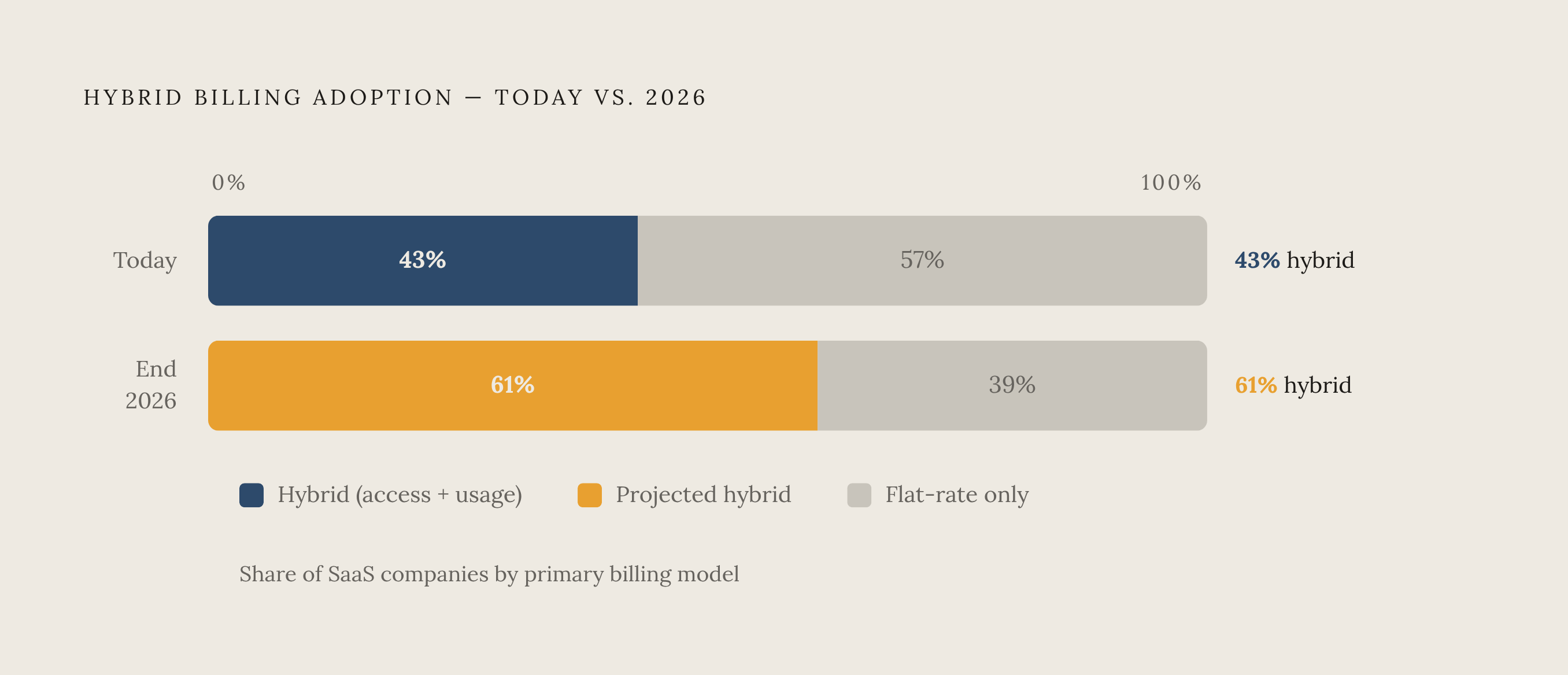
Tier boundaries should sit where inference cost crosses the revenue a given credit price generates, not at round numbers chosen because they look clean on a pricing page. The foundational structural choice is separating access from consumption: a subscription fee buys entry into a tier, and usage, credits, or outcomes are billed on top of that access. This split is already the default pattern across the industry, with 43% of SaaS companies having adopted it: it lets a vendor stay predictable for the buyer while protecting margin on the variable cost. A power user tier operationalizes this same split by pairing a higher access tier with a larger, but still bounded, credit allowance rather than an unlimited one.
Credits themselves are worth keeping as an abstraction layer rather than exposing raw token counts to customers. Tokens are the right unit internally for cost control, but most customers reason more naturally in terms of outcomes: tasks completed, documents processed, analyses run. Denominating credits in those terms keeps a tier limit comprehensible to a buyer without requiring the vendor to disclose its internal cost structure.
Every tier needs an answer for what happens when a customer exceeds the included allowance, and there are only two real options. A gated model stops service at the limit and requires the customer to purchase more credits before continuing. A metered model lets usage continue past the allowance and bills the overage at a per-credit rate. Which one fits a given segment depends on which failure mode does more damage: a hard stop risks a service interruption that a power user in the middle of a workflow will remember, while metered overage risks the kind of bill shock that turns a renewal conversation adversarial. GitHub Copilot's own structure, a fixed credit pool with purchasable additional capacity once it's exhausted, reflects one resolution of that tradeoff.
At the very top of the consumption curve, enterprise buyers are pushing in the opposite direction, asking for flat, unlimited agentic AI pricing regardless of volume. Vendors should treat that demand as a design problem to solve, not a trend to accommodate at face value. The workable response is a dedicated enterprise tier with a floor price calculated from observed peak consumption, not average consumption, so the flat fee is set high enough to survive the worst inference month an account actually produces rather than the typical one.
Credit pricing also has known failure points that tier design alone cannot fix. Customers routinely find credit values abstract and hard to translate into what they're actually getting, and they report feeling nickeled-and-dimed by complicated consumption rates. The answer to that complaint is not to flatten the tier structure back down and give up the margin protection it provides. Transparency tooling that sits alongside the tiers makes the complexity legible, and the next section covers that tooling.
One more mechanical choice belongs at the design stage rather than left for later: whether a segment pays prepaid or postpaid. A prepaid credit wallet gives the buyer budget predictability and gives the vendor cash upfront. Postpaid metered billing gives power users more flexibility but requires that billing can produce an accurate invoice at any consumption level, including levels far above what a typical customer reaches. Many vendors will need both mechanics running on the same billing engine simultaneously, since different segments of the same customer base will reasonably prefer different ones.
Giving power users visibility into their own consumption before the invoice arrives
A correctly designed tier structure can still fail commercially if the customer inside it cannot see their own consumption in real time. Bill shock damages the relationship even when the underlying pricing logic is sound, because the customer experiences the surprise, not the logic.
BetterCloud's 2026 SaaS analysis documents that tracking tokens and usage to prevent invoice shock is now a top-tier FinOps task, buyer-side pressure that vendors must meet with tooling, not just with tier design. Zylo's 2026 SaaS Management Index identifies mid-term changes to variable, consumption-based charges as one of the primary sources of buyer frustration at renewal time, and real-time usage dashboards are the direct mitigation for that frustration.
A usable dashboard should show the current credit balance measured against the included allowance, the velocity at which that balance is depleting over the course of the billing period, and an alert when consumption crosses a threshold the customer has configured themselves. That combination lets a power user manage their own usage before they hit an overage charge or a hard limit, rather than discovering either after the fact.
There's an organizational dimension to this as well. Zylo's research notes that finance teams tend to plan around fixed entitlements, while AI consumption meters generate costs continuously throughout a contract's lifecycle. A power user's team lead needs access to the same real-time consumption data that the finance team eventually sees on the invoice, delivered before the spend happens and the budget conversation goes sideways.
Visibility tooling is also a source of revenue signal, not just a defensive measure. An account that is consistently running near its tier ceiling with meaningful time remaining in the billing period is a qualified upgrade candidate, and the same consumption data that prevents bill shock is the data that identifies which accounts are ready for an expansion conversation. Treated this way, spend visibility functions as a structural piece of the pricing strategy itself, protecting the relationship with heavy users while surfacing the accounts most likely to grow.
Migrating existing users into new consumption tiers without triggering churn
Designing the right tier structure solves only half the problem. Moving an existing base of customers into it without losing the power users the redesign was meant to protect is the harder operational question, because those same customers are the ones with the strongest usage patterns and the strongest memory of what they originally agreed to pay.
The sequencing that limits churn risk starts with new customers, not existing ones: test a new pricing structure on new logos first, and only then migrate the installed base, using a fixed grandfather window that gives existing accounts time to adjust before the new structure takes full effect. This sequencing carries the most weight for power users specifically, since they have both the deepest usage history and the strongest anchor on their original price.
The grandfather window does more than delay an unpleasant conversation. It gives a power user enough time to model their own consumption against the new tier map and choose the tier that actually fits their usage, rather than being assigned one unilaterally. A customer who selects their own tier is measurably more likely to stay than one who is simply reclassified into it.
Forecasting tools make that self-selection possible, and Zylo's 2026 research is explicit that buyers push back hard against surprise overages. Giving a power user their own historical consumption data laid alongside the new tier map, ahead of the migration date, changes the experience from a surprise imposed on them into a decision they can prepare for on their own terms.
Migration also isn't a single event a vendor gets to plan once and file away. The 2026 SaaS Pricing Models guide notes that SaaS companies are now adjusting pricing and packaging multiple times a year, which makes tier migration an ongoing operational competency rather than a one-time project. That cadence only works if product and finance teams can adjust tier configurations directly, without routing every change through an engineering backlog.
For a vendor currently running flat credit plans, the most defensible migration path runs through a base-plus-consumption hybrid rather than a jump straight into a higher flat tier. Hybrid adoption is already projected to grow from roughly two-fifths of companies toward 61% by the end of 2026, and the model gives a power user a predictable floor alongside a variable ceiling. That structure is an easier conversation to have with an existing customer than an outright reclassification, because it preserves some of the predictability the customer already priced into their budget while still capturing the variable cost that a flat fee could never account for.
Billing infrastructure requirements for consumption segmentation
Everything described up to this point, the tier design, the overage mechanics, the visibility tooling, the migration sequencing, depends on billing infrastructure capable of running it in production. Segmentation across multiple tiers, with real-time enforcement, prepaid wallets, and tier configurations that change without an engineering cycle, is not something legacy subscription billing systems were built to do, and the gap between what those systems support and what consumption segmentation requires is architectural rather than a matter of configuration.
The infrastructure needs to do several things simultaneously. It has to ingest usage events at high throughput and update account balances within seconds, so that an enforcement decision at the moment of a request can query a current, accurate meter value rather than a stale one. It has to support prepaid credit wallets and postpaid metered billing running at the same time, since different customer segments will reasonably need different mechanics. And it has to model pricing across multiple dimensions, accounting for the fact that different AI capabilities burn credits at different rates, without requiring a completely separate metering system bolted onto the billing platform.
That last requirement points to a common failure pattern in how vendors solve this today. The standard answer in the market has been to pair a dedicated metering tool with a separate billing tool and integrate the two. Maintaining that integration is a permanent engineering cost, not a one-time setup, and the seam between the two systems is where billing errors and reconciliation failures concentrate in practice. A platform that handles metering and billing as a single system removes that seam entirely, which matters more as tier structures multiply and overage mechanics grow more specific to each customer segment. Consumption segmentation is a pricing strategy that survives contact with a real customer base only if the infrastructure can execute it at the speed and accuracy the pricing model demands.