Communicating Credit Value to Non-Technical Buyers
CFOs need plain language, not token specs, to justify AI credit spending in budget reviews.

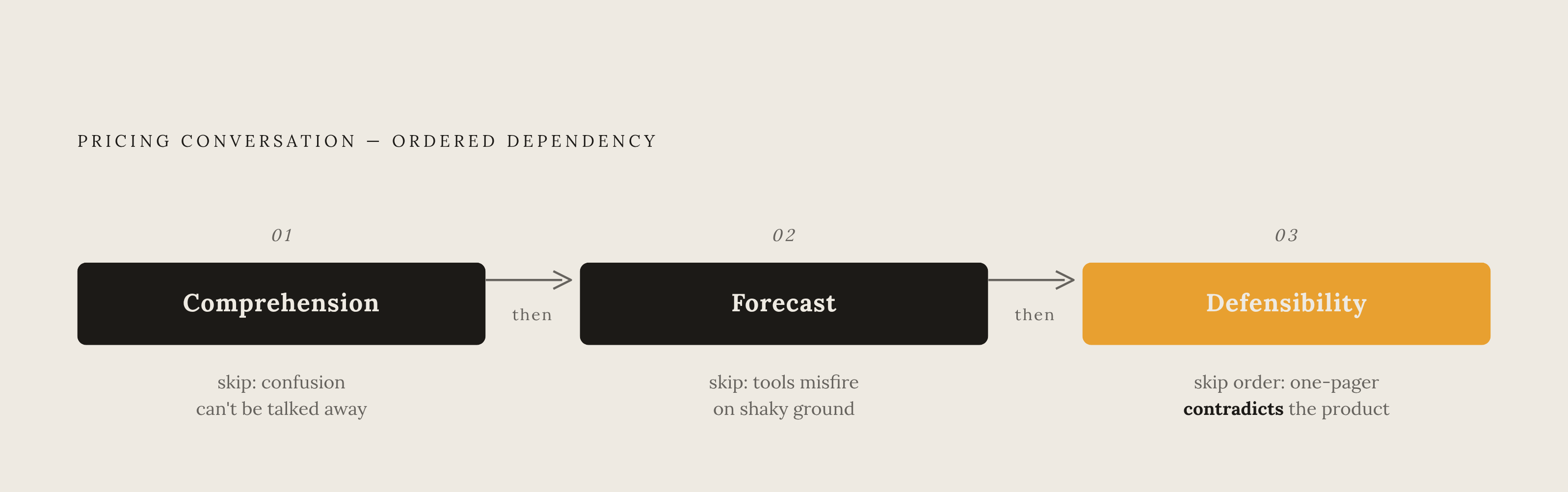
Non-technical buyers don't evaluate credits the way engineers do, and they shouldn't have to. A CFO signing off on an AI vendor doesn't care how tokens map to compute cycles. The CFO wants to know what the invoice will say in March, what a credit actually buys, and whether the purchase survives scrutiny at the next budget review. Credit-based pricing has rapidly become one of the dominant ways AI companies charge for variable-cost products, but most of the market still writes about it like an engineering spec sheet handed to someone who never asked for one. Three lenses fix that: forecast, comprehension, defensibility. Get the order wrong, and the other two don't matter, because comprehension has to come first.
Credits aren't self-explanatory. A buyer prepays for a pool of something that converts into usage according to rules the seller sets, and those rules can shift by package, by customer tier, even by product version within the same contract term. That's a lot of variability to ask someone to accept on faith, and most sellers ask for exactly that anyway.
The real trouble sits in the abstraction layer between what gets paid and what gets consumed. Buyers can't see through it without help, and sellers rarely offer much, so the buyer starts hunting for the catch. An unexplained conversion rate between dollars and outcomes reads as a setup. That reading generates the fear and doubt that kills deals in procurement review, even when the credit structure itself is perfectly fair.
CFOs, procurement leads, and department heads are asking three questions, and only three: Can the spend be forecast? Is it clear what's being received? Can the purchase be defended to the organization? Everything else is noise to them, however important it seemed to the engineer who built the pricing model.
The pricing environment that made credits both necessary and confusing
AI brought real variable cost back into software economics after a decade of flat, predictable SaaS margins. Infrastructure costs for some AI businesses have climbed from roughly 10% of total cost to as much as 35 to 40% as usage scales. At that ratio, flat per-seat pricing stops making sense structurally: a vendor charging one flat rate per seat is either overcharging light users or losing money on heavy ones, and neither error survives long. Credits became the pragmatic fix, a prepaid budget that lets the vendor recover variable cost while giving the buyer something that resembles a fixed commitment.
The shift happened fast, and messily. Among the top 500 SaaS and AI vendors with transparent pricing, there were more than 1,800 pricing changes in 2025 alone, roughly 3.6 changes per vendor in a single year, and that shift happened fast, and messily. That's a market still arguing with itself, not a market converging on an answer. That's a market still arguing with itself.
The evidence points in more than one direction at once, which is itself the point: nobody has settled this. Windsurf retired its credit billing in March 2026 after finding that a flat credit rate charged the same amount for a simple query and a complex one, a design that made users afraid to ask quick questions and pushed them to cram multiple requests into single prompts just to squeeze value out of each credit. Salesforce launched Agentforce at a flat per-conversation rate of $2, then supplemented it in May 2025 with Flex Credits priced at $0.10 each, a structural repricing that forced existing buyers to relearn the entire model mid-relationship. HubSpot and GitHub both announced AI repricing within the same 30-day window in April 2026. Atlassian followed in September 2026 with its own usage-based AI pricing. Three vendors, three different metrics: consumption credits, per-resolution outcome billing, token-denominated AI credits. No standard has emerged, and buyers absorb the confusion every time a vendor picks a new one.
What a buyer needs to understand about their purchase
Sellers keep making the same mistake: they list technical specifications and call it product communication. Nobody wakes up wanting to buy a thousand API calls. They wake up with a document backlog, a customer support queue, or a compliance deadline, and they want that specific, expensive problem solved.
Legible credit communication ties the credit unit to something the buyer already recognizes from their own workflow, not to an infrastructure metric they've never had reason to think about. "1 credit equals 1,000 tokens processed" tells a procurement lead nothing useful. "1 credit equals 1 document summarized," or "10 credits equals 1,000 customer events analyzed," tells them what they need to estimate their own usage without opening a spreadsheet or calling support.
Plain language is the precondition for trust. If a buyer can't quickly work out what a credit is worth or how many they'll burn through completing a normal task, confidence in the whole pricing system erodes, regardless of how fair the underlying rate actually is. Most customers will never learn what a token is, what an embedding does, or what a context window limits, and they shouldn't have to. Translation is the seller's job, and it has to happen in the buyer's domain language, not the product's internal one.
Helping buyers forecast their spend before they commit
CFOs and CIOs like AI. They're curious about it, often enthusiastic about the upside. But when pricing enters the conversation, they default to the model they already understand, and nothing is more legible than a flat fee. A credit model has to actively compete against that baseline. Assuming goodwill will carry it across the finish line is how good pricing dies in committee, and it dies there often.
Sellers should tell buyers how to forecast spend before the buyer has to ask. A usage estimator tied to the buyer's stated workflow volume does a lot of the work: input the number of documents processed per month, get a credit estimate back. Reference points from comparable customers help too, something as simple as "a team running this volume of workflows typically lands in this credit range" gives a buyer a sanity check against the abstract math. And sellers should state what actually drives variability in consumption, whether that's model complexity, document size, or task type, so buyers can reason through their own edge cases instead of guessing at them.
Rollover policy shapes how fast a buyer trusts a new pricing model, more than most vendors give it credit for. Buyers fear losing purchased credits at the end of a billing period, and that waste anxiety drives nearly every complaint about unused balances. Allowing rollover of unused credits cuts that friction directly, and it matters most during migration, when trust in the new model is thinnest.
Hard caps and real-time alerts get undersold constantly: framed correctly, a spend cap is a promise that the bill will never surprise you. Framed correctly, a spend cap is a promise: the bill will never surprise you. That promise speaks to a CFO's actual fear far more directly than any developer documentation ever will.
Giving buyers the language to defend the purchase internally
Enterprise deals rarely close in the room where the pitch happens. Someone has to walk out and re-sell the decision upward, to a CFO, a procurement committee, sometimes a board, usually without the vendor there to field follow-up questions.
Credit-based pricing is unfamiliar enough that internal stakeholders push back hard. "Why aren't we just paying a flat rate like everyone else?" kills the deal if the champion doesn't have an answer ready in that meeting.
Sellers need to arm that champion before the meeting, not after it goes badly. A one-page summary written in business terms, not product terms, one the champion can forward without editing a word of it, saves that person from translating the pitch under pressure. A direct comparison, credits against per-seat pricing, stated in terms of what the buyer's organization actually does (paying for outcomes delivered, not for licenses sitting idle), gives the champion a sentence to repeat verbatim. A named policy on what happens at credit exhaustion, a hard stop, an automatic top-up, or a grace period, shuts down the worst-case scenarios stakeholders will otherwise invent on their own.
Outcome framing wins internally in a way that feature counts never do. Department heads and executives respond to measurable operational results: a package that handles a defined volume of documents means something to them. Ten thousand credits, on its own, means nothing.
Real-time spend visibility and buyer confidence after the sale
Confidence doesn't stop building at the signature. Every billing cycle after that either rebuilds it or quietly erodes it.
Buyers should never open their account and get surprised by a balance they didn't expect. Real-time visibility keeps every promise made during the sales process, the comprehension promise and the forecast promise both, actually true after the contract is signed.
In practice, that means a customer-facing dashboard reporting remaining credits in plain units ("you've used 3,200 of your 5,000 monthly credits") rather than a raw count of backend API events nobody outside engineering can interpret. It means proactive alerts at thresholds that mean something to a budget owner, framed as budget signals rather than system warnings. And it means the invoice matches the dashboard exactly: what the buyer watched happen during the month appears on the bill with no reconciliation gap and no line item that needs an explanatory call.
Products that can't show customers their own consumption while it's happening generate bill shock. Bill shock generates churn, plus a spike in support tickets that never needed to exist. Poor visibility is an active driver of the churn a vendor is trying to prevent. It's an active driver of the churn a vendor is trying to prevent.
Auditing your current credit communication against the three-lens framework
Every piece of buyer-facing material, the pricing page, the sales deck, the onboarding emails, the invoice itself, can be run through the same three questions.
Can a non-technical buyer read the pricing page and say, in their own words, what one credit lets them do? If the answer requires guessing or a support call, the translation layer is missing, full stop.
A concrete tool, a calculator, reference customer data, or a usage estimator, lets a buyer project spend before signing anything, and forecasting depends on that tool existing somewhere the buyer can actually find it. Without one, the seller is asking for approval on an open-ended budget, and few buyers approve that willingly.
Could the internal champion forward a single document to their CFO and have it hold up with no vendor in the room to field questions? If not, the internal selling assets are incomplete, no matter how strong the product itself is.
Running that audit across a typical pricing site, the gaps repeat in the same order every time. Pricing pages written in product vocabulary, tokens, embeddings, inference jobs, with no translation to workflow outcomes. No stated policy on credit exhaustion, rollover, or how price changes get communicated, so buyers imagine the worst version of each scenario on their own. Invoices that don't match the in-product dashboard, probably the fastest way to destroy trust a good sales process spent months building. Sales decks that open with technical architecture instead of what a department head actually walks away with.
The trajectory makes the fix urgent, not optional. Credit-based pricing is becoming the standard pattern for AI-native products, and credit wallets are moving from experimental feature to standard infrastructure across the category. Vendors communicating credits poorly today will run that same failure at a much larger scale tomorrow, with more customers and less room to walk it back quietly.
Sequence matters, and getting the order wrong wastes the work already done. Comprehension comes first: a buyer who doesn't understand the pricing page can't be talked out of that confusion with a slicker one-pager. Forecast tools come second, once the buyer understands what they're looking at and needs to plan around it. Defensibility assets come last, because a polished CFO one-pager built before the pricing page itself is legible just produces a document that contradicts the product the moment someone clicks through to check.