Credit Rate Transparency as a Competitive Differentiator
Vendors win deals on pricing pages that actually explain what credits cost and why.

Credit rate opacity is the single biggest reason usage-based pricing generates distrust instead of goodwill, and 2026 turned that opacity from a footnote in the pricing page's fine print into a competitive liability. When a customer cannot tell what a credit costs, when it gets consumed, or why, the pricing model becomes the product's weakest feature, no matter how good the underlying software is. Vendors that treated credit rates as a disclosure problem to manage got outcompeted by vendors that treated it as a design problem to solve. The distinction affects which vendors survive: disclosure means writing better fine print, design means changing what the customer actually sees before they spend a credit, and only the design approach survives contact with an angry renewal call.
What "credit rate opacity" looks like from the customer's side
A flat credit rate that charges the same for simple and complex requests alike is among the clearest documented cases of this failure. The company charged the same rate for simple and complex requests alike, and the result wasn't confusion so much as behavioral distortion: users started fearing quick questions and began cramming multiple requests into single prompts to avoid "wasting" a credit on something trivial. The problem wasn't that the rate was too high, it was that users couldn't tell what they were paying for, so they changed how they used the product to hedge against a cost they couldn't see coming, and that reaction is the tell. Pricing opacity doesn't just annoy customers, it reshapes their behavior around the product in ways the vendor never intended and rarely notices until usage patterns look strange.
GitHub's move of Copilot to token-based AI Credits addresses the same root issue from the opposite direction. The company's own stated rationale named the mechanism directly: the shift to token-based pricing was a structural change to how usage is tracked and billed. GitHub's transition, effective June 1, 2026, moved Copilot to a model where actual consumption determines cost rather than a flat seat fee.
The pattern recurs across every vendor using the word "credit" as a label. Atlassian has Rovo credits. HubSpot prices AI credits at $10 per 1,000. Zendesk prices them at $1.50. Adobe Firefly runs a variable-rate credit system that changes cost by feature. Four vendors, four units, four rates. The word "credit" communicates nothing on its own; it's a wrapper, and without a stated rate attached to it, a credit is an unbacked promise the customer has to trust blindly. Most customers, reasonably, don't.
Adobe Firefly's own rules sharpen the point further. Generative fill costs more credits than standard image generation, and unused credits reset monthly instead of rolling over. Neither rule is unreasonable as a business decision. But both are exactly the kind of thing a customer discovers mid-task, after the credits are already spent, instead of before they started the job.
The 2026 repricing wave and transparency as a differentiation opportunity
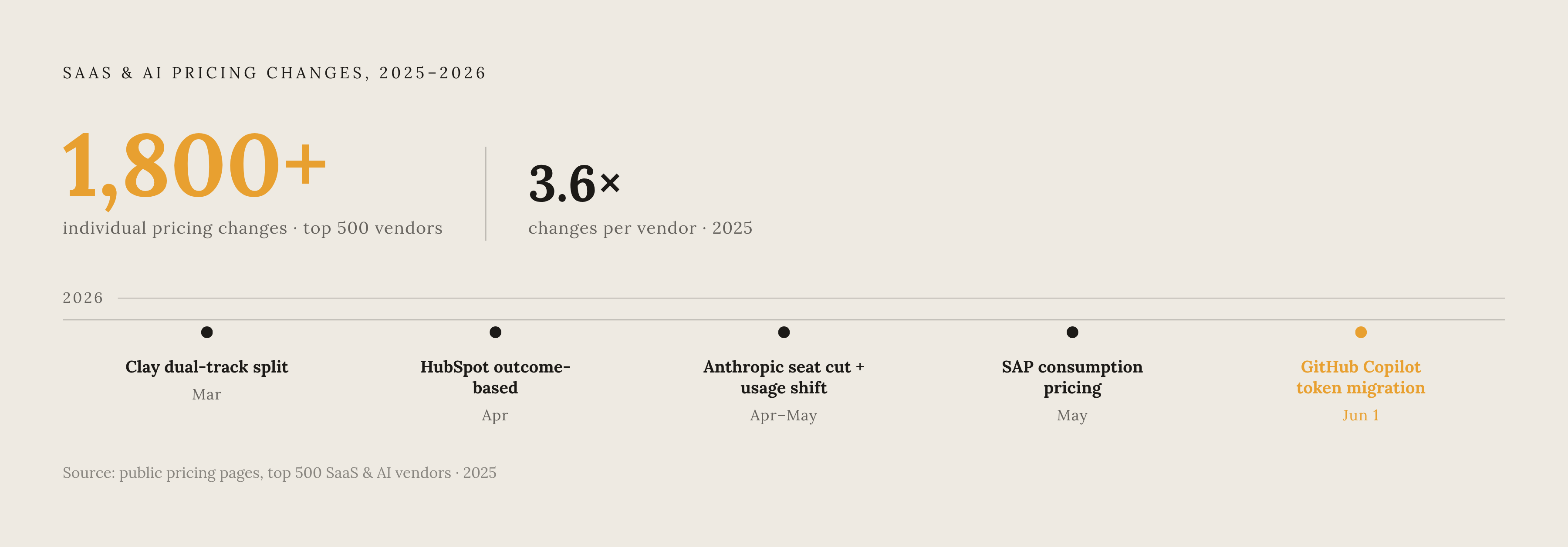
The scale of repricing across SaaS and AI in the past year left customers living inside constant pricing churn. Among the top 500 SaaS and AI vendors with public pricing, there were more than 1,800 individual pricing changes in 2025 alone, an average of 3.6 changes per vendor. Among the top 500 SaaS and AI vendors with public pricing, there were more than 1,800 individual pricing changes in 2025 alone, an average of 3.6 changes per vendor, and it's a market still renegotiating the terms of usage pricing in real time, with customers absorbing the whiplash. It's a market still renegotiating the terms of usage pricing in real time, and customers are the ones absorbing the whiplash.
Several named moves from 2026 show where that renegotiation is heading. Clay introduced dual-track monetization in March 2026, splitting platform value from token cost into two distinct buckets. HubSpot announced outcome-based pricing for its Breeze AI agents that same April. Anthropic lowered enterprise seat prices for Claude while shifting more aggressively to usage-based pricing at the same time. SAP announced its own shift toward AI consumption pricing. GitHub and a number of other major SaaS and AI vendors made meaningful pricing changes across 2025 and 2026 as well.
In a market moving this fast, a pricing page that states what one credit does, and under what conditions, becomes a competitive weapon rather than a courtesy. Set next to a competitor mid-transition, walking back a prior model, or still hiding the rate behind a "contact sales" wall, a vendor that shows the math is making a sales argument without naming a single competitor. Deals get won before the sales call even happens, on the strength of a rate card the buyer could actually read.
The structural argument for separating access pricing from consumption pricing
The dominant pattern across the 2026 repricing wave separates access, the subscription, from consumption: the usage, credits, or outcomes. That split lets a vendor stay predictable on the part of the bill a buyer can plan around, while protecting margin on the part of the bill that scales with actual load. Vendors that collapse the two into a single number are the ones customers trust least, because a blended price hides which part of the bill is fixed and which part is exposed to the customer's own usage decisions. This is where most pricing teams get it backwards: they think a single number is simpler for the customer, when in fact it just moves the complexity somewhere the customer can't see it.
Clay's March 2026 move is the cleanest named execution of the alternative. Platform value and token cost sit in separate buckets, and each is independently legible: a buyer looks at the subscription line and knows what they're committing to, then looks at the token line and knows what they're exposed to. Nothing about the token cost has to be inferred from the subscription price, and nothing about the subscription has to account for AI usage that hasn't happened yet.
The value metric should track how the customer extracts value, not how the vendor's infrastructure happens to be built. A transcription service should charge per minute transcribed, not per unit of backend compute consumed, because a customer has no way to reason about a backend infrastructure measure and every way to reason about minutes of audio. Pricing that exposes the vendor's internal infrastructure layer, instead of the customer's unit of value, creates friction precisely because it forces the customer to translate a cost they don't understand into a value they do.
That separation is also what let a large share of the market handle AI features without repricing the entire base product. In 2025, 68% of vendors restricted AI capabilities to premium tiers, and 37% were already planning further adjustments to that structure. Structural separation between access and consumption is the mechanism that lets a vendor move AI out of a hidden premium tier and into a clearly explained consumption layer, without touching the price of the core product.
Real-time metering infrastructure and credit transparency
None of the transparency described above is a copywriting exercise. It depends on a specific technical pipeline running correctly, every time, at scale, and the pipeline is where most vendors actually fail, not on the pricing page. Get the writing right and the metering wrong, and the pricing page just becomes a promise the product breaks a week later.
The sequence starts when the application emits a usage event on every billable action, such as a completion, an embedding call, or an agent step. That event flows through validation, then buffering, then durable storage. A failure at any one of those stages doesn't just disappear. It either creates a gap in what the customer sees on their dashboard, or introduces lag between when the credit was spent and when the customer finds out about it. Either failure undermines the entire reason the dashboard exists.
Production-grade metering means handling high volumes of these events with sub-second latency. Slower than that, and the customer-facing usage number lags behind actual consumption, reintroducing the exact surprise transparency was supposed to eliminate. A dashboard that's accurate but twelve hours stale is, from the customer's seat, no different than no dashboard, since the customer-facing usage number lags behind actual consumption and reintroduces the exact surprise transparency was supposed to eliminate.
Procurement teams now treat this infrastructure as table stakes. Enterprise and mid-market buyers expect detailed consumption breakdowns as a condition of renewal, and a vendor without the metering pipeline to produce those breakdowns cannot meet that expectation, regardless of how well-written its pricing page reads. The infrastructure is the prerequisite. The pricing page is just the surface people see.
The return on this is easier to state than most in SaaS: retroactive invoice surprises are a churn risk, and the cost of building a real-time usage dashboard is smaller than the cost of one high-profile bill-shock incident. A single angry renewal call, escalated to a champion inside the customer's org, tends to cost more in lost trust than the engineering quarter it would have taken to build the dashboard that prevented it.
The six design practices that turn credit rate visibility into a retention mechanism
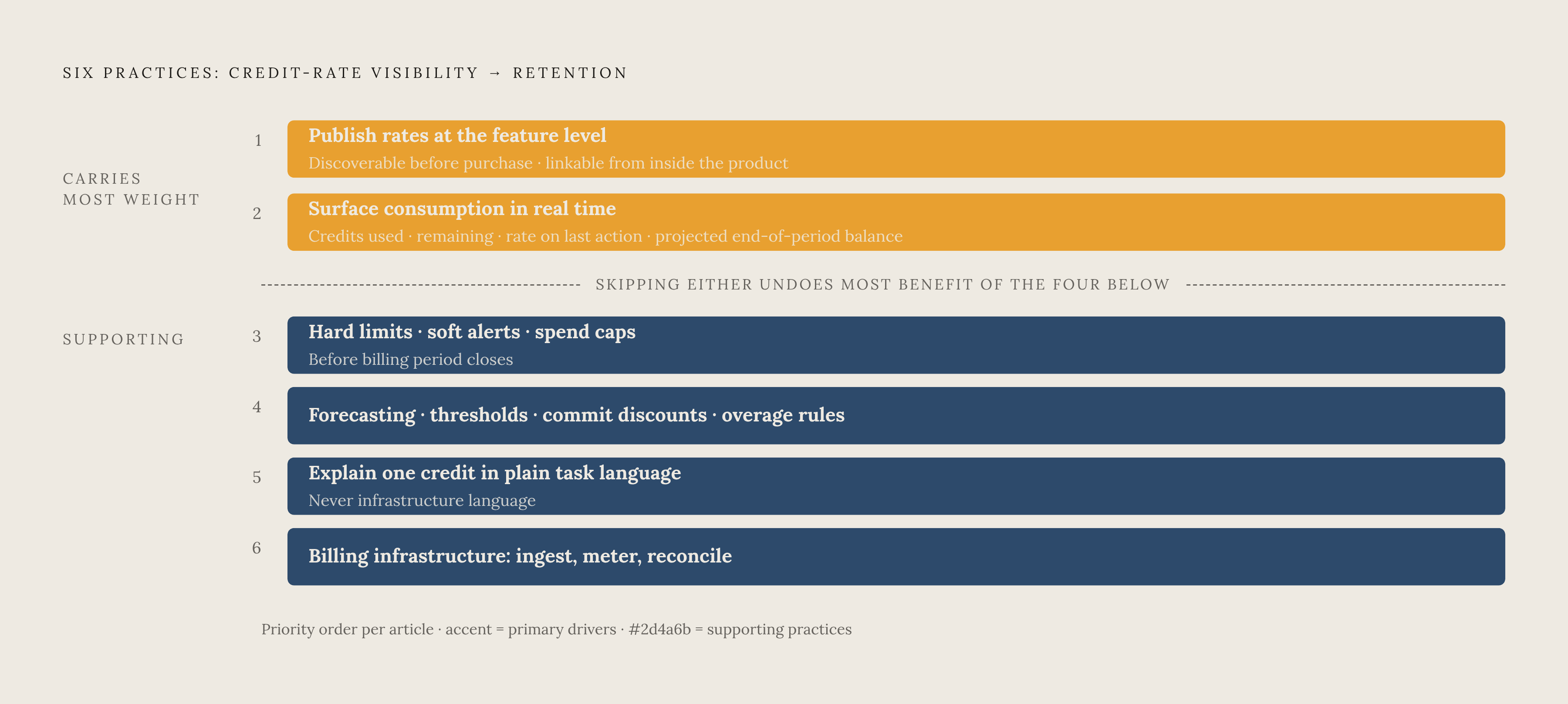
Metering infrastructure creates the possibility of transparency. These practices convert that possibility into something a customer notices and credits the vendor for at renewal time. Two of the six carry most of the weight, and skipping either one undoes most of the benefit of doing the other four well. Rank them wrong and you'll spend engineering time on alerts and caps while the actual rate card stays buried.
Publish rates at the feature level, first, before anything else on this list. Adobe Firefly's variable consumption rates, different features drawing credits at different rates, is the exact failure mode when this is missing: a customer sees the overall credit balance but can't predict which action drains it faster. The fix is a rate card that's discoverable before purchase and linkable from inside the product, not buried in a support article a customer finds only after the surprise has already happened.
Surface consumption in real time, or as close to it as the metering pipeline allows, second. Buyers expect to see what they've used as they use it, not on a monthly statement after the fact. The display should show credits used, credits remaining, the rate applied to the most recent action, and a projected end-of-period balance based on current pace.
The remaining four matter, but in a supporting role, and none of them fixes a broken rate card or a laggy dashboard. Offer hard limits, soft alerts, and spend caps that trigger before the billing period closes, not after. Build forecasting tools, usage limits, threshold alerts, commit discounts, and clearly stated overage rules. Atlassian's Rovo AI credits carry an additional charge of $0.30 per conversation once a customer exceeds their included limit, and the rate itself is fine; what matters is surfacing that overage before it triggers, since letting it appear cold on the invoice is what causes customer frustration. Explain what one credit does in plain task language, never in infrastructure language. A flat credit rate fails this test specifically because it means nothing in task terms, which is what produces the kind of behavioral distortion described earlier. Customers buy outcomes. Vendors buy infrastructure. Pricing that exposes the infrastructure layer, tokens, backend compute, API calls, instead of the outcome layer, questions answered, images generated, conversations resolved, hands the customer translation work that was never theirs to do.
Billing infrastructure as the constraint that limits or enables these practices
Subscription-first billing tools were built to solve a narrower problem: invoice a fixed amount on a fixed schedule. That problem's been solved well for a long time. It isn't the same problem as ingesting high-cardinality usage events fast enough to power a real-time dashboard, modeling a different credit rate for every feature a product ships, or holding a prepaid wallet balance and a postpaid invoice on the same customer inside the same system. Subscription infrastructure wasn't built for any of that, and stretching it to cover consumption pricing produces exactly the gaps and lag described above.
The standard market answer has been to run two separate systems, a metering tool that tracks usage and a billing tool that generates invoices, stitched together after the fact. That works, up to a point. But every integration point between two systems is a reconciliation risk, and the transparency features described in this piece only work if both sides agree on the exact same event record at the exact same time. A metering system that reports one credit total and a billing system that invoices for a noticeably smaller amount is proof to the customer that something is wrong: the vendor's own internal numbers don't agree with each other, and customers notice that faster than vendors expect.
A deployment constraint eliminates some vendors before the transparency conversation even starts. Some enterprise buyers require on-premises deployment or a sovereign cloud environment for regulatory reasons, and a billing system that can't run inside those environments is disqualified from the deal on that basis alone, regardless of how good its dashboards look in a demo.
What makes the six practices achievable without turning into a permanent engineering tax is billing infrastructure purpose-built for usage: designed to ingest usage events at scale, model any combination of pricing dimensions a product needs, support prepaid and postpaid balances at the same time, and expose that data to a customer dashboard without a fresh integration project every time the pricing model changes. Vendors running subscription-era billing underneath a usage-era pricing page produce the reconciliation gaps described above, because the mismatch between the two systems generates them, no matter how good their intentions.
Credit rate transparency's conversion from a trust signal into a measurable retention and revenue advantage
The retention argument starts at renewal. Procurement teams at mid-market and enterprise accounts now expect a detailed consumption breakdown as a condition of signing again. A vendor that can produce one is meeting a requirement that's already on the table. A vendor that can't is manufacturing a renewal risk it didn't need to create, in a negotiation where the customer already holds most of the leverage.
The sales cycle argument runs earlier in the funnel. In a market that saw more than 1,800 pricing changes across leading vendors in a single year, a buyer comparing options is, more often than not, comparing confusion. A pricing page that states its rates clearly, with no asterisk pointing to a sales call, converts better precisely because clarity is rare enough now to stand out on its own.
The churn mechanism runs in reverse too, and this is the part budget owners feel most directly. A meaningful share of organizations, 61% by one recent account, cut projects or entire initiatives because of unplanned SaaS cost increases they never saw coming. A vendor whose dashboard would have flagged that increase before it hit the invoice is the vendor that survives the budget review. The one that skipped building the dashboard becomes the line item that gets cut.
The agentic AI transition raises the stakes further. Gartner projects that 40% of enterprise applications will feature AI agents by the end of 2026, and agent-based products tend to price per outcome or per step rather than per seat, which makes rates harder to track transparently, not easier. Vendors building real-time metering and clear credit-rate disclosure now are building the infrastructure that transition will demand regardless. Vendors that wait are setting up a repeat of the behavioral distortion described above, at a scale where it won't stop at how customers phrase their prompts. It appears in whether they renew.