Hybrid Credit and Subscription Bundle Packaging
Hybrid pricing bundles a base fee and usage credits to solve AI's alignment problem.

AI pricing has a math problem, and it's the reason vendors keep rewriting their price lists. Seat-based pricing assumes usage scales with headcount, but AI workloads don't run on people. They run on tokens, compute minutes, and agent actions that have almost nothing to do with how many seats a company bought.
Seat-based pricing assumes usage scales with headcount, but AI workloads run on tokens, compute minutes, and agent actions that have almost nothing to do with how many seats a company bought. That misalignment punishes vendors twice as AI improves: fewer human seats needed to deliver the same output, while compute consumption climbs. Pure usage-based pricing fixes the alignment problem but makes revenue lumpy for vendors and invoices unpredictable for buyers, which finance teams tend to hate more than a high fixed cost. A hybrid credit-subscription bundle attempts to hold both sides at once, giving the vendor a revenue floor through a recurring base fee while giving the buyer a cost ceiling through an included credit allowance, with overage rates that capture expansion revenue from the heaviest users.
That mismatch has put vendors in a bind. As AI tools get better at automating work, they need fewer human seats to deliver the same output, which shrinks per-seat revenue right as compute consumption climbs. A vendor charging by headcount gets punished twice: less revenue coming in, more cost going out. Pure usage-based pricing fixes the alignment problem (you pay for what you use) but it swaps one headache for another. Revenue becomes lumpy and hard to forecast for the vendor, and the buyer loses the ability to predict next month's invoice, which finance teams tend to hate more than a high fixed cost.
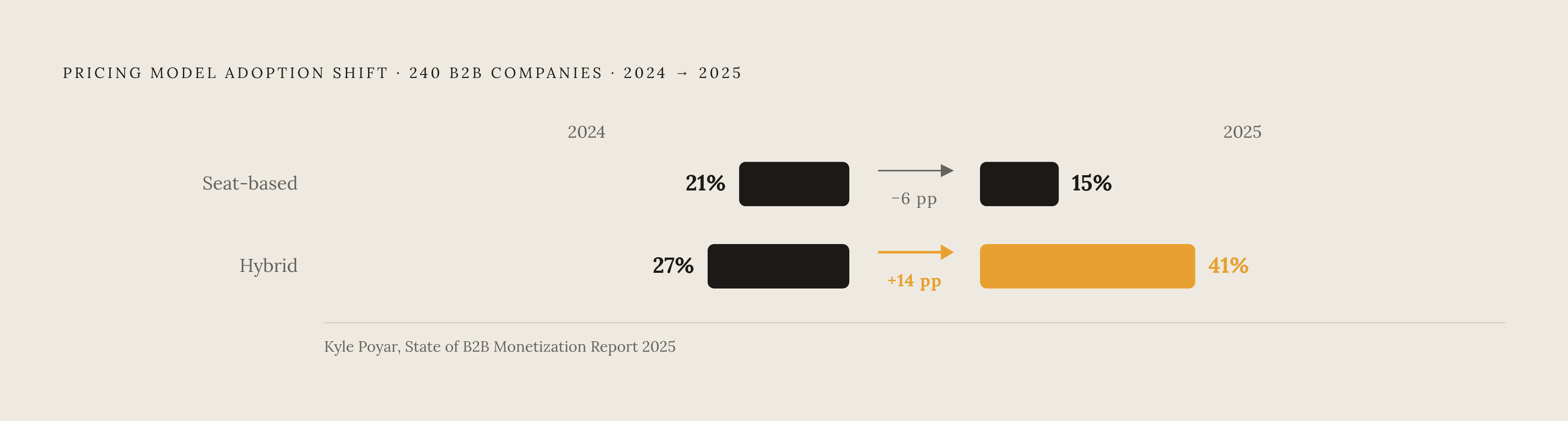
The market has already started voting on this. Kyle Poyar's State of B2B Monetization Report 2025, drawn from 240 companies, found seat-based pricing dropped from 21% to 15% of respondents in twelve months, while hybrid models jumped from 27% to 41%, a sharp single-year shift in the data set. The same pressure shows up above the product team, too: 71% of CFOs report their companies struggle to monetize AI effectively, and 68% say their current pricing models no longer work. This isn't a packaging debate confined to product managers anymore. It's an executive problem.
The structural gap is simple to state even if it's hard to solve: neither a flat subscription nor pure pay-as-you-go can give the vendor a revenue floor and the buyer a cost ceiling at the same time. A hybrid credit-subscription bundle is the attempt to hold both at once. The rest of this piece is about the design choices that determine whether that attempt actually works.
What are the pros and cons of seat-based vs usage-based vs hybrid pricing for AI SaaS products?
A hybrid bundle breaks into four pieces, and each one is a separate decision, not a default setting. There's the base fee, the included credits, the overage rate, and the credit definition itself, meaning what a single credit actually buys.
The base fee is the recurring charge that covers platform access and core functionality. It's the vendor's floor: revenue that shows up whether the customer runs one query or ten thousand. Included credits are the usage allowance bundled into that subscription tier, spent down before any overage charge kicks in. The overage rate is the per-unit price charged once a customer blows through that allowance, and it's the lever that captures expansion revenue from the heaviest users. The credit definition is the abstraction sitting between the credit itself and whatever it's actually made of underneath, tokens, API calls, compute minutes. That last piece is where most of the complexity, and most of the legibility problems, live.
This is a different animal from token pass-through pricing, where the buyer sees raw model cost directly. Credits abstract that cost into a unit the vendor controls, which gives the vendor a margin cushion when underlying model costs move (and they move constantly). It's also different from a pure prepaid model. With prepaid credits, the customer buys a balance directly. With a hybrid bundle, the credits arrive bundled inside a subscription, and the entry point is the subscription itself, not a credit purchase.
Buyers already carry a mental model for this, and it's the phone bill: a fixed plan, then overage charges if you go over. Design against that intuition and you create friction that has nothing to do with the actual pricing math. Design with it, and the model feels familiar even when the underlying mechanics are new.
The market data backs up how fast this shift is moving. Among the top 500 AI and SaaS companies tracked in the PricingSaaS 500 Index (cited via Kyle Poyar's Growth Unhinged), credit-based models grew 126% year-over-year, climbing from 35 companies at the end of 2024 to 79 more recently. Figma, HubSpot, and Salesforce all added credit components to their pricing in 2025. That's not a niche experiment anymore. It's becoming the default answer to a problem seat-based pricing can't solve.
Setting the base fee: what it should cover and what it should not subsidize
The base fee needs to cover platform access, fixed infrastructure, and whatever minimum value a customer gets before spending a single credit. What it must never do is subsidize the compute costs of heavy users. That subsidy is exactly what broke unit economics under pure seat-based pricing, and folding it into a hybrid model just moves the same problem into a new wrapper.
There's a useful test for whether the base fee is sized correctly: a customer who uses zero credits in a given month should still feel like the fee was worth paying. If the answer is no, the base fee isn't really a base fee, it's a discount on credits that hasn't been priced as one.
One pattern shows up again and again in vendor postmortems: the subscription tier quietly failing because heavy users were running negative margins. The base fee was absorbing their compute costs instead of just covering access. That's the failure mode every hybrid bundle needs to be built to avoid.
Annual versus monthly billing for the base fee isn't a universal call, it depends on the buyer. Annual contracts pull cash forward and reduce churn risk, but they raise the commitment bar for a new buyer who isn't sure yet. Monthly billing lowers that bar at the cost of less predictable cash flow. Neither is right in the abstract, only right for a given sales motion and buyer profile.
Multi-tier base fees should differ in what platform capability they unlock, not just in how many credits get bundled in. A vendor that only changes the credit count between tiers has built one product with a price knob, not a real tier structure. And the base fee should never quietly turn into a credit subsidy by stuffing in so many credits that light users never see an overage. That hollows out the exact expansion mechanism the hybrid model exists to create.
Sizing included credits: the tradeoff between adoption, anchoring, and margin
Generous credit allowances make sense in week one. A new customer who hits their credit ceiling before they've had a chance to see real value feels misled, and that feeling shows up in churn numbers a few months later. The included allowance has to be enough to prove the product works before asking for more spend.
But there's a margin problem on the other side. If most customers never come close to their limit, the hybrid model quietly turns back into a flat subscription with extra steps. The overage mechanism, the thing that's supposed to generate expansion revenue, never fires.
Sizing this correctly means starting from actual usage data, not a gut sense of what feels fair. A reasonable target: the included allowance should land the median customer around 70 to 90% utilization in a normal month, enough that it feels fully used without routinely tipping into overage charges on ordinary work. Anchoring matters here too. Whatever number gets included sets the buyer's baseline expectation for what "normal" usage looks like. Set it too high, and any overage feels punitive. Set it too low, and the product feels stingy before the customer has gotten anything out of it.
This is exactly where intuition tends to fail. Data bears this out: 48% of SaaS pricing leaders report making critical pricing calls on gut feel alone, and credit sizing is a case where gut feel optimizes for what sounds generous, not what the usage curve actually supports.
There's also a moving target underneath all of this: inference costs. The cost of a fixed level of AI capability has fallen roughly tenfold per year, according to a16z's November 2024 analysis. An included allowance that looked conservative when it was designed can turn into a very large real-cost giveaway twelve months later, quietly eating margin the whole time. That argues for building a periodic review of credit-to-cost ratios into the pricing calendar, not treating credit sizing as a decision made once and left alone.
Anthropic's Max plan is worth studying as a cautionary case. A new weekly usage cap announced in July 2025 was expected to affect fewer than 5% of subscribers, according to TechCrunch's reporting at the time, concentrated among users running agentic coding workloads. The original allowance simply hadn't been sized against the worst-case consumption pattern of its heaviest users, and the fix arrived after the fact rather than being built in from the start.
Designing overages that expand revenue without triggering buyer panic
Surprise charges are the single biggest threat to a hybrid model's credibility. Per HubSpot's buyer's guide, 78% of IT leaders reported unexpected AI-related charges in the past year. Overage design is almost always the culprit, and the goal has to be legitimate expansion revenue, not a bill that ambushes the customer.
Three mechanics are worth weighing against each other. A hard stop halts usage the moment credits run out, no overage charge, but the customer's work just stops, which is fine for budget-constrained buyers and painful for anyone mid-task. A soft cap lets usage continue past the limit while firing off alerts as the customer approaches and crosses it, preserving workflow continuity while keeping the buyer in the loop. Automatic overage billing charges a stated per-unit rate for everything past the allowance, which maximizes expansion revenue but only works if the buyer explicitly agreed to that rate at purchase, not somewhere buried in a terms page.
The overage rate itself needs to sit above the effective per-credit rate inside the bundle. That gap is the price signal that makes buying more credits, or upgrading a tier, look like the obviously smarter move compared to just eating overage charges month after month.
Prepaid credit top-ups sit in between these options nicely. Letting a customer buy an extra credit pack before or after hitting their limit brings in cash upfront, softens the shock of a big invoice, and gives the buyer a sense of control, spending down a balance rather than watching a bill grow on its own.
None of this works without visibility. Real-time usage dashboards and configurable spend alerts aren't a nice-to-have feature, they're a trust mechanism. A buyer with no view into in-flight consumption will churn after the first surprise invoice, regardless of whether the overage was technically disclosed somewhere in the contract.
Done right, this becomes a flywheel. When overage charges are predictable and the math clearly favors upgrading over paying per-unit rates, a real share of customers will upgrade themselves without a sales call. That self-upgrade behavior is the actual expansion engine a hybrid model is built to produce, and it only runs if the rate structure makes the arithmetic obvious.
Defining the credit unit so buyers understand what they are spending
Credits work as a budget-control layer because they sit between the buyer and the raw cost unit, tokens, API calls, compute seconds. That abstraction is useful right up until the buyer can't answer a simple question: how many credits does this task actually cost?
Two ways this goes wrong. Make the credit too granular, one credit equals one API call, and it feels precise, but now the buyer has to think in API calls, which defeats the entire point of abstracting the cost in the first place. Make it too coarse, one credit equals "one AI task," and if tasks vary by a hundredfold in actual compute cost, buyers get burned by unpredictability that feels like deception the moment they notice it.
The abstraction also serves the vendor's margin. Credits decouple what the buyer pays from what the vendor's inference actually costs. When token prices fall, the credit abstraction creates room for the vendor to retain margin rather than automatically passing changes through. When costs spike, the credit definition can be adjusted rather than touching the plan price directly, which is a much easier conversation to have with customers.
The legibility rule that actually works: tie the credit unit to an outcome the buyer already cares about, credits per document analyzed, credits per 1,000 API calls, credits per completed agent task, rather than to some internal cost metric nobody outside the engineering team understands. Charging different features at different credit rates is completely legitimate, a basic query costs fewer credits, a multi-step agentic workflow costs substantially more, but only if those rates are published up front. Buyers discovering the real cost of a feature after they've already used it is how trust erodes.
Figma's credits for AI features, HubSpot's credits for AI tools layered onto existing tiers, and Salesforce's Agentforce credits per conversation (one of several pricing models Salesforce runs, alongside Flex Credits billed per action and standard per-user licensing) each map credits to outcomes differently. Salesforce's per-conversation unit is probably the most legible of the three, because a "conversation" is something a buyer already thinks in, not a system-level abstraction they have to learn.
Structuring tiers so the bundle scales with customer growth rather than fighting it
Good tiers map to distinct customer segments defined by usage volume and platform need. They are not just a price tag with a different credit number stapled to it.
What should actually separate one tier from the next: platform features, seat limits, support response times, API rate limits, data retention windows, integration access. A tier structure built only around credit quantity gives customers exactly one reason to upgrade, running out, and that reason feels punitive rather than aspirational.
Pooled credits, shared across a team, tend to beat per-seat credits for most enterprise buyers, since pooling absorbs the natural unevenness of individual usage instead of wasting allowance on light users while heavy users run dry. Per-seat credits are simpler to account for, but that simplicity comes at the cost of real waste.
Annual commitments deserve a tangible reward, either a bigger credit allowance or a lower effective rate per credit, not just a percentage off the base fee. And there's a natural trigger point for upgrade conversations: when a customer consistently burns 80 to 90% of their included credits before the month ends, that's the moment the next tier's value should be obvious without anyone picking up the phone to explain it.
Net revenue retention is the metric all of this is really optimizing for. The KeyBanc Capital 2024 SaaS Metrics Survey found the strongest SaaS companies in 2025 running NRR between 115% and 125%, and well-designed hybrid tiers generate that kind of retention through organic expansion, customers growing into higher tiers on their own, rather than through upsell pressure from a sales team.
Rollover policy is a quieter lever than it looks. Letting unused credits carry into the next month feels fairer to buyers but can reduce urgency to actually use the product, which sometimes suppresses feature adoption. Reserving rollover as a perk of the higher tiers turns it into a real incentive to upgrade rather than just a policy footnote.
Keeping the pricing page legible when the model has multiple moving parts
Hybrid bundles are genuinely more complicated than flat subscriptions underneath. The pricing page's job is to hide that complexity, not explain it, at least not all at once.
What belongs on the page: the base fee, the included credits stated in outcome terms a buyer actually understands, the overage rate, and the path to the next tier. Everything else, the internal credit-to-token conversion math, infrastructure cost allocation, anything the buyer can't act on at the moment of purchase, belongs in documentation, not the page they're using to decide.
Dense comparison tables are a trap. Listing every feature difference across every tier produces cognitive overload, and buyers scanning that table aren't looking for a checklist, they're trying to answer one question: which tier fits how much they'll actually use this. A simple usage calculator, where a buyer types in expected monthly volume and sees which tier covers it, answers that question directly and cuts down on support tickets before a purchase ever happens.
Expressing included credits in dollar terms alongside the raw credit count (something like "$X worth of AI features included") gives buyers two ways to anchor the value instead of one, which reduces the anxiety that comes from a totally abstract unit.
None of this holds up if the billing system can't keep pace with the pricing page. Roughly 55% of SaaS companies report they can't easily make pricing changes within their current billing infrastructure, according to 2025 research on the space. A pricing page that reads simply to a buyer still needs a system underneath that lets the vendor adjust credit definitions, overage rates, and tier thresholds without turning every pricing change into a multi-month engineering project.
The billing infrastructure a hybrid bundle actually requires underneath
None of the design choices above mean anything if the billing system can't execute them. Hybrid bundles demand infrastructure that plain subscription billing never had to build.
Real-time credit balance tracking comes first. Both the customer and the product itself need to know the current balance mid-session, not after the fact at invoice time, since a customer running an agentic workflow needs to know before it fails halfway through whether there's enough balance to finish. Every usage event also has to decrement that balance atomically, reliably, and exactly once. Deduplication and idempotency aren't edge-case engineering concerns here, they're the difference between an accurate balance and a customer getting billed twice for one action.
The system also has to run prepaid and postpaid logic at the same time, on the same engine. Included credits behave like a prepaid balance. Overages behave like postpaid billing. Running these as two separate systems that reconcile later invites exactly the kind of drift and delay that turns into billing disputes.
Overage detection has to happen close to real time. A detection pipeline that only catches up an hour after the fact lets a customer rack up consumption the vendor can't stop and the customer never agreed to see coming, which is precisely the surprise-invoice scenario the whole hybrid model was supposed to prevent in the first place.