Credit Package Localization for International Markets
Localizing credit pricing means more than currency conversion.

Credit-based pricing has moved from a niche experiment to standard practice in software, and most companies selling it internationally are getting the international part wrong. Among the PricingSaaS 500 Index companies, credit-based pricing grew 126% year-on-year, from 35 companies to 79, and the list now includes Figma, HubSpot, and Salesforce. These aren't scrappy AI startups testing a billing gimmick; they're mainstream enterprise vendors making a deliberate packaging choice. Credits sit between flat access pricing and pure outcome pricing, giving customers a predictable unit to budget against while protecting vendor margins on variable costs like AI inference.
The mistake shows up the same way almost every time. A team builds a credit system for one market and one currency, then sells it everywhere else without touching the design. Pack size, rollover rules, payment flow: all of it gets built around assumptions specific to the home market, and none of those assumptions survive contact with a market that pays differently, budgets differently, and regulates prepaid balances differently. Running the home-market price through an exchange-rate calculator and calling it "localization" is a shortfall dressed up as a shortcut. It's a mistake dressed up as a strategy.
What "localization" actually means for a credit package, and what it does not
Most teams start the same way. Take the home-market price, run it through the day's exchange rate, display the result in local currency, and call it done. It's fast, it's cheap, and it's wrong often enough to matter.
Currency conversion doesn't touch purchasing power parity. It doesn't touch local payment habits, and it does nothing for the regulatory rules a given country applies to prepaid balances. It also ignores the consumer psychology around what a "sensible" pack size looks like in a market the product has never sold in before. A converted price is a number, not a strategy, and treating it as one is the single most common error in this whole category.
Real localization runs across four separate layers, and each one calls for its own decision. Price localization asks what the credits actually cost relative to what people in that market can reasonably spend. Pack-size localization asks how many credits make sense as a single purchase unit there. Payment mechanics localization asks how people in that market actually hand over money, whether that's a wallet top-up, an invoice, or a local rail. Regulatory localization asks what the law says about expiry, refunds, and tax treatment on prepaid balances.
Layered on top of all four is a simpler problem: credit systems already confuse a lot of users in their home market, because the link between "credits" and "the thing I actually did" is often murky. Translate that confusion into a second language, in a market with no track record for the product, and the confusion compounds instead of fading.
Spotify is worth citing here, not because it sells credits, but because its country-specific pricing shows what disciplined localization looks like: adapting price to local purchasing power market by market, rather than applying a single global price across markets with very different income levels.
How purchasing power shapes credit pack pricing across markets
A $50 credit pack barely registers as a purchase decision for a mid-size company in the US. The same pack, converted at spot rate and sold in Southeast Asia, Latin America, or Eastern Europe, can eat a real chunk of a household's or a small business's monthly discretionary spend. Same number of credits, same converted price, wildly different weight on the decision.
What buyers in that market are willing to pay is the question. It's what share of a typical customer's monthly software budget a given pack eats up in that specific market. Geographic pricing experiments consistently turn up wide variation in willingness to pay across regions, and that variation says price behaves like a local variable, not a universal constant that just needs translating.
In practice, teams need smaller packs at lower absolute price points in price-sensitive markets, even when the underlying per-credit rate stays roughly in line with the home market. A single global price for a credit pack either locks out customers in lower-purchasing-power regions or quietly underprices the product in higher-purchasing-power ones. Neither outcome is acceptable once revenue in the new region actually matters, and picking the second failure mode because it feels safer is still a failure mode.
This gets more complicated under hybrid pricing, which now covers 43% of companies, combining a subscription base with credit consumption on top. There, the subscription floor itself needs purchasing-power calibration before the credit layer even enters the conversation. No formula says a market should price at some fixed ratio below the home market. That number depends on the product category, on whether the buyer is a consumer or an enterprise, and on research specific to the market in question. Anyone selling a universal ratio is guessing, and teams that buy the guess find out the hard way, usually after the market's already stopped converting.
Pack-size design: matching the denominations to how customers in each market want to buy
Pack size signals how much trust and budget authority a customer will commit up front. A large pack, paid for once, assumes the buyer trusts the vendor, controls a budget, and feels confident about future usage. All three assumptions shift depending on the market's buying culture and how mature its software procurement practices are.
In markets where procurement runs through centralized, annual budget cycles, larger committed packs with volume discounts tend to land well; enterprise buyers there already negotiate committed-use deals, the way customers of OpenAI, Anthropic, and Cohere do on the enterprise side. But where purchasing happens ad hoc, driven by an individual rather than a procurement department, and cash flow needs to stay flexible, a small top-up pack with no expiry pressure usually converts better than asking someone to commit to a large balance up front.
Rollover policy gets tangled up in this fast. Whether unused credits carry over to the next month changes whether a large pack feels like a deal or a countdown clock, and that perception isn't consistent across markets. Copy a rollover policy wholesale from the home market and it can undercut the exact psychology a new market needs to convert.
Lindy's approach is a useful contrast: credits billed at a flat rate, overages charged at a premium rate, a straightforward billing structure without a layered credit marketplace. That simplicity helps conversion, because complexity in mapping credits to actual usage erodes trust, and that erosion runs worse when the buyer is reading a pricing page in a second language with no cultural shorthand to fall back on.
Clay runs a different model, with tiered credit packs (2,500 Data Credits versus 6,000 Data Credits, priced at different per-credit rates), which shows the volume-discount mechanic clearly (older Starter and Pro tiers at 2,000 and 50,000 credits are grandfathered for existing customers but no longer sold as of March 2026). The volume tier only works, though, if the entry-level pack feels accessible in the local market first. Nobody climbs a discount ladder they never stepped onto.
One more design choice matters more than it looks: whether credits pool at the individual user level or the organization level. Org-level pooling removes friction in markets where buying decisions run through multiple stakeholders, common in centralized, enterprise-heavy markets and far less relevant where solo or small-team buyers dominate.
Payment mechanics that international customers actually use
A credit package is a prepaid product. The customer pays first and uses later, and that sequencing makes the payment moment the first real test of trust in a new market. Get the payment mechanics wrong, and the pricing and pack size never even get evaluated, because the customer never finishes the purchase.
Payment habits split sharply by region. Card-dominant markets like the US, UK, and Canada run smoothly on Visa and Mastercard rails; the harder problem there is currency and tax display, not the payment method itself. Bank-transfer-dominant markets, including Germany and the Netherlands, don't treat card-based real-time purchase as the default; invoice-plus-prepaid-wallet mechanics feel far more natural to buyers there. Local wallets and mobile payment systems, common across much of Southeast Asia and Brazil (via Pix), aren't a nice-to-have integration. They're often the entry ticket to the market at all. Enterprise-invoice markets, most notably B2B buyers in Japan and Korea, along with large enterprises everywhere, expect an invoice, net payment terms, and credits released against that agreement. The consumer "buy now, use now" model doesn't map onto how those buyers operate, and pretending otherwise is how deals stall in procurement.
Underneath all of this sits a tension that's turning into a hard requirement rather than an edge case: AI and enterprise products increasingly need prepaid and postpaid billing running on the same engine at the same time. A customer might want a prepaid credit wallet for day-to-day self-serve usage and a postpaid invoice to cover end-of-period overages. That's not two billing systems bolted together. It's one requirement, and treating it as two creates exactly the reconciliation mess finance teams dread.
A billing platform with hard currency or geographic limits, US-only pricing floors being the classic example, gets disqualified from international enterprise deals before anyone even evaluates the product. That's a build-versus-buy decision with direct consequences for which markets stay reachable at all.
Spend visibility matters just as much here. A customer paying through an unfamiliar payment rail, in a currency they don't use daily, needs to see the credit balance update in real time to feel any confidence in the purchase. Bill shock in a foreign currency, on a payment method the customer already half-trusts, doesn't stay a trust problem. It turns into a churn event.
Regulatory and compliance requirements that vary by market
Prepaid balances aren't treated the same way twice across jurisdictions. Some jurisdictions apply financial regulations to prepaid balances that can trigger licensing or registration requirements. Others treat them as deferred revenue with specific accounting rules attached. Neither treatment is optional once a vendor actually sells into that market.
Expiry policy runs into legal walls in several places. Parts of the EU and certain US states enforce mandatory no-expiry or minimum-expiry rules on prepaid balances, so a blanket "credits expire in 30 days" policy, exported unchanged from the home market, can be non-compliant the moment it lands somewhere else.
Tax treatment adds another layer. How VAT or GST applies to prepaid credit balances is a jurisdiction-specific question, and getting it wrong creates real audit exposure, not a theoretical one.
Refund obligations complicate pack design further. Some markets impose refund or balance-return obligations on prepaid products. Where that expectation exists, large packs carry less risk for the customer, but more operational weight for the vendor, since every large pack becomes a potential refund liability.
Data residency is its own constraint entirely. Enterprise customers in regulated sectors, financial services, healthcare, public sector, often require that billing records and usage data stay within national or regional infrastructure. That's a legitimate requirement, and any vendor that can't support on-premises or sovereign-cloud deployment gets disqualified from those deals regardless of how good the pricing model is.
Revenue recognition ties all of this together on the finance side. Hybrid models mixing prepaid credits with subscription components carry revenue recognition complexity that varies by jurisdiction and by how the credits are structured contractually. Finance teams without automation for this spend the first week of every month reconciling it by hand, a cost nobody budgets for until they're already paying it.
Regulatory mapping has to happen before pack mechanics get finalized, not after launch. Retrofitting compliance onto a pack structure that's already live costs far more than designing around it from the start, and no team that's had to do the retrofit would recommend it to the next one.
How to run pricing experiments across markets without creating customer fairness problems
Only 24% of SaaS companies run pricing experiments on a regular basis, which means most localization pricing decisions get made on assumption, not data. That's a risky habit anywhere, and it's worse when the assumptions concern a market the team doesn't know well.
Geographic pricing experiments are a well-established format, not an exotic one. Spotify's country-by-country pricing illustrates the same underlying logic that applies to experimenting with credit pack pricing across markets.
Fairness perception is the risk that keeps teams cautious, and it should. When customers in different countries find out they're paying different prices, trust takes a hit, and that risk cuts sharper for global products where users across markets sit in the same community, forum, or Slack channel comparing notes.
A few habits cut that risk without killing the experiment. Framing matters: "pricing for your market" reads very differently to a customer than "we charge them less," even when the underlying math is identical. Segmenting experiments by geography so the comparison never surfaces directly to customers helps too. So does running new pricing on market entry, rather than repricing customers who are already mid-contract and watching closely.
Statistical rigor matters more than it gets credit for. Reliable pricing tests need something like 100 or more conversions per variation before the result means anything. In a new market with limited early traffic, that means either running the test longer than feels comfortable or treating early results as directional signal, not a final answer.
Pricing iteration, at this point, works as an operating rhythm rather than a special project. PricingSaaS tracked 1,800 pricing changes across the industry in 2025, averaging 3.6 per company. Localization experiments should sit inside that same cadence, not require a separate process built from scratch. Test price level first, then pack size, then payment mechanics, one variable at a time. Change all three at once and nobody can say afterward which change actually drove the result.
The billing infrastructure requirements that international credit localization exposes
Multi-currency pricing is the baseline expectation now, not a differentiator, and it isn't sufficient on its own. The infrastructure underneath needs local currency pricing floors, not just converted display prices, along with per-market pack configurations and per-market tax rules, all running at once.
Credit wallets add a harder technical problem. The billing engine has to hold prepaid balances, debit them the instant a usage event happens, and enforce limits in real time. Most subscription billing platforms weren't built for this. They're invoicing engines, built to generate a bill at the end of a period, not ledgers built to track a balance that changes with every API call.
The atomic debit problem shows this gap at its sharpest. Without atomic operations against the credit balance, two concurrent requests can both read the same balance before either commits its change, both get approved, and the balance goes negative. This is a real edge case encountered in daily use. It's a routine production failure in AI products running concurrent sessions against a shared credit pool.
Per-market pack configuration is its own requirement. The billing system needs to define different pack sizes, different prices, and different rollover rules per market without an engineering ticket every time a market wants a variation. Real-time balance visibility matters just as much on the customer side: a customer paying in an unfamiliar currency through a prepaid model needs to see the current balance in-flight, or the result is bill shock and, soon after, churn.
On-premises and sovereign-cloud deployment shows up again here, because enterprise and public-sector customers in regulated international markets will ask for it as a condition of the deal, not a preference they'd like accommodated.
Pairing a separate metering tool with a separate subscription billing tool to cover credit mechanics is the wrong architecture, and teams that default to it usually don't realize the cost until month three. That combination means maintaining an integration across two systems with no single source of truth for balances, usage, and invoices, and it's exactly the setup that produces reconciliation headaches at the end of every month. A metering and billing system built as one engine, handling event ingestion, the credit ledger, multi-currency pricing, and invoice generation together, removes that integration overhead and the disagreement between two systems that don't fully trust each other's numbers.
A practical sequencing for teams entering new markets with credit packages
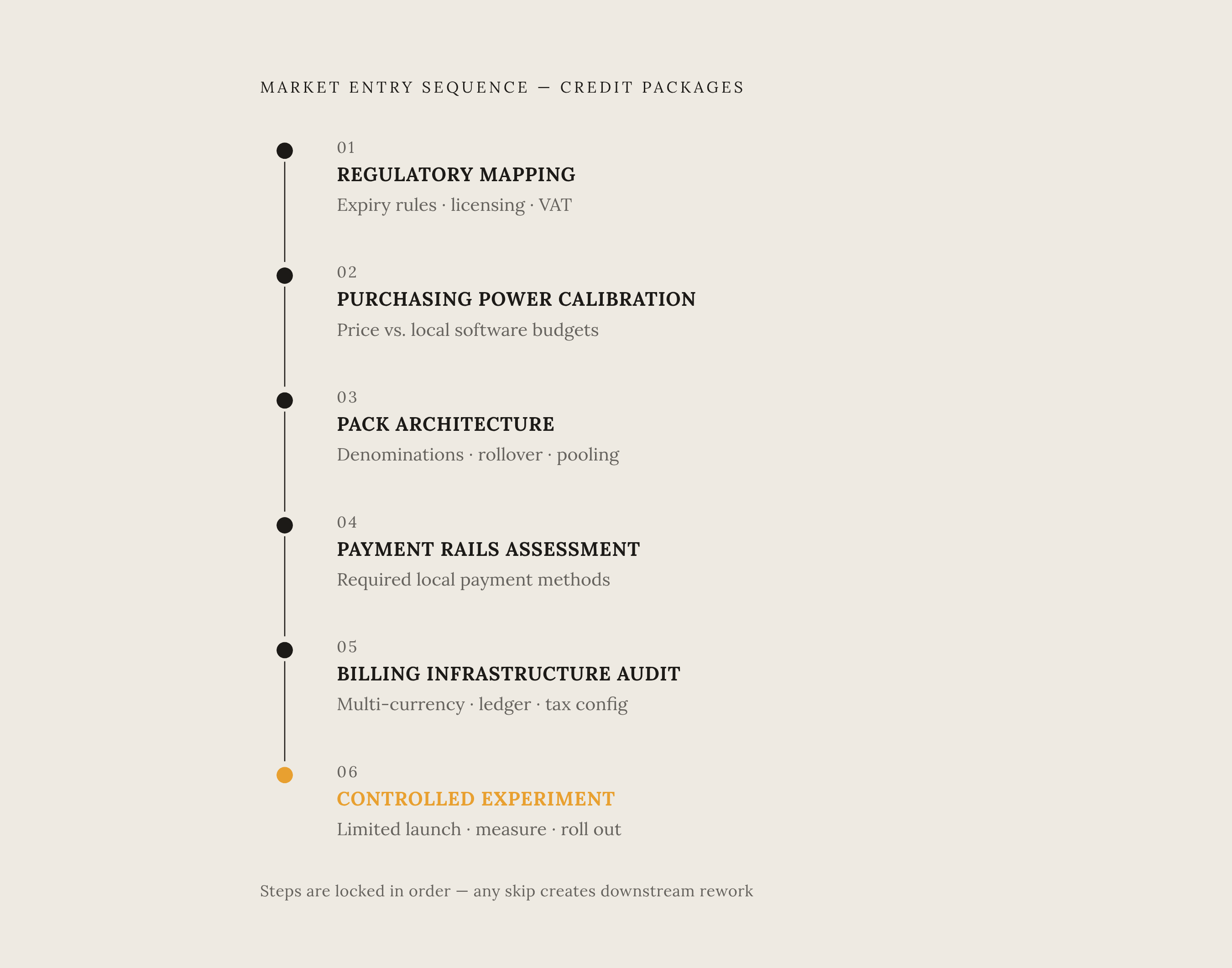
Order matters here, because doing these steps out of sequence creates rework that costs far more than doing them right the first time. Regulatory mapping has to come before pack design. Pack design has to come before pricing experiments. Billing infrastructure readiness has to come before launch, not get patched in afterward.
Start with regulatory mapping: identify the specific compliance requirements in the target market, expiry rules, stored-value licensing questions, VAT treatment at purchase versus redemption, before any pack mechanics get designed. Follow with purchasing power calibration: research what an equivalent pack represents as a share of local software budgets, and use that to set the price range before worrying about the per-credit rate.
Next comes pack architecture: decide on the right denomination structure for the market, whether that's small top-ups or larger committed packs, set the rollover policy, and decide whether credits pool at the user or organization level. Then assess payment rails: confirm which payment methods are actually required for meaningful penetration in that market, rather than assuming a card on file will do the job everywhere.
After that, audit the billing infrastructure itself: verify it can support per-market pack configuration, multi-currency pricing floors, prepaid credit ledger mechanics, and local tax rules, and flag the gaps before committing to a launch date. Only then does the controlled experiment happen: launch to a limited segment, measure conversion and activation against the home-market baseline, and adjust price level and pack size before rolling out fully.
This is an ongoing effort, not a one-time project. With pricing changing at a rate of 3.6 times per company a year among leading SaaS and AI companies in 2025, localized credit packages need continuous adjustment long after the initial launch. The infrastructure and the process both have to support that ongoing tuning without an engineering ticket attached to every change, because a localization effort that can't keep pace with its own market will fall behind the market it was built for.