Credit Expiration Policies and Customer Retention Trade-Offs
Expiration design determines whether customers resume usage or abandon the product after a pause.

If a customer pauses for a quarter, slows down during a budget freeze, or simply misses a cycle, credit expiration policy decides whether they come back to the product or quietly let the contract lapse. Most vendors treat expiration as a default setting inherited from whatever billing platform they happened to implement, rather than as a deliberate choice with direct behavioral consequences. That passivity has a cost: the length of an expiration window, the presence or absence of rollover, and whether a customer can actually see what they have left all combine to decide whether low usage feels like a protected lull or a penalty box. A growing share of SaaS and AI customer relationships now run on credits as the basic unit of exchange. This is no longer a back-office detail. The rest of this piece treats expiration as what it actually is: a retention lever, designed well or designed badly, with outcomes that appear in renewal data rather than in a billing audit.
How Credit Pricing Became the Dominant Model
PricingSaaS's analysis shows credit models grew sharply among the top SaaS and AI companies, and that growth is the reason expiration design now touches a large and expanding population of customers rather than a handful of billing edge cases. The shift has a straightforward cause. AI products incur cost per token processed, per API call, per compute minute, not per seat logged in, so a pricing model built around headcount stops tracking what the vendor actually spends to serve each customer. Kyle Poyar's State of B2B Monetization analysis shows seat-based pricing losing ground, and now most software and AI companies default to hybrid pricing, a base subscription layered with a credit or usage meter.
Credits occupy a middle position in pricing design: more transparent to the buyer than a flat per-seat fee, easier for a vendor to implement than pure outcome-based billing, but considerably harder to get right once you look at the mechanics. That difficulty concentrates in expiration policy. Once credits become the medium through which customers receive value, every rule about when they lapse, whether unused balances carry forward, and in what order different credit types get consumed turns into a direct determinant of whether the customer feels they got what they paid for. The stakes rose with the model's popularity, and they rose specifically around expiration, because expiration is the point where the abstraction of "credits" meets the reality of a customer's bank account and their renewal decision.
The specific mechanisms through which expiration policy affects re-engagement
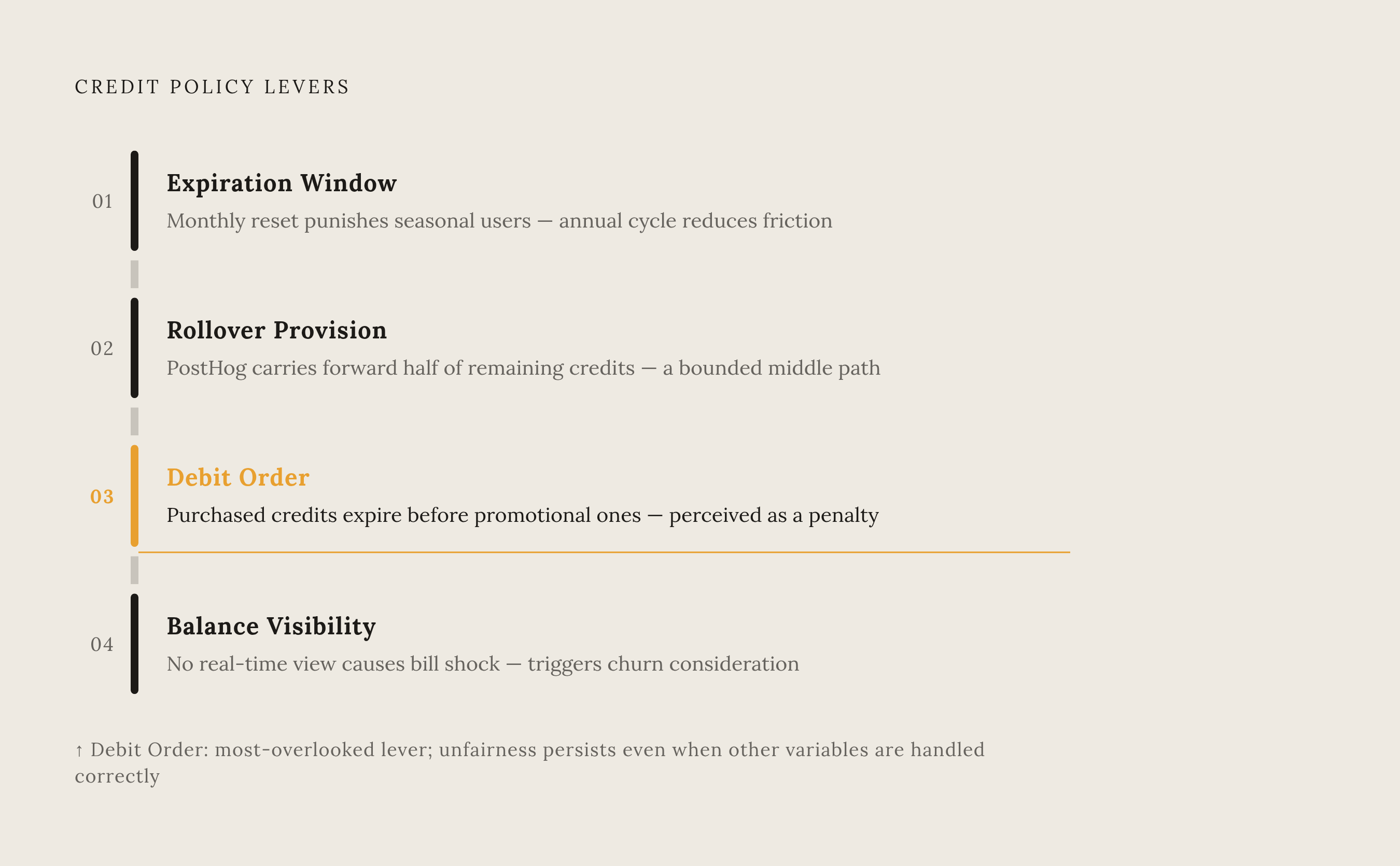
Four separate policy variables, expiration window, rollover provision, debit order, and balance visibility, each produce their own behavioral effect, and the effects compound when the variables are combined without much thought.
The expiration window sets the clock. A monthly reset creates a use-it-or-lose-it pressure that punishes any customer whose usage is seasonal or simply irregular: a marketing team that runs a heavy campaign one month and goes quiet the next will feel penalized twice, once for paying for capacity it didn't use, and again for watching that capacity vanish. Annual cycles reduce that friction and lower the cognitive load on procurement teams who would otherwise have to track monthly burn. The 2026 Buyer's Guide to Credit-Based Pricing Software treats expiration as a core contract term that buyers should insist be spelled out, and it recommends rejecting any vendor proposal that can't show exactly when credits disappear and what happens once a balance hits zero. Adobe Firefly illustrates the hard-reset end of the spectrum: credits reset monthly with no rollover, and a user who hits the limit either waits for the next cycle or buys add-on credits. Every cycle boundary is a genuine break point in the customer's experience of the product.
Rollover softens that break. If you let customers carry unused credits forward, they feel their unused capacity isn't simply forfeited, and the vendor gets more accurate data on what customers actually consume over time, not just what they consume under expiration pressure. PostHog's pre-paid plan rolls over half of a customer's remaining credits into the next contract period, a bounded policy that gives customers a cushion without erasing the vendor's revenue floor. Partial rollover like this balances the vendor's margin protection against customer goodwill, but full rollover maximizes goodwill at the cost of complicating how the vendor recognizes deferred revenue.
Debit order is the sequence in which different credit balances get drawn down, and it is the variable most likely to be overlooked and most likely to generate a sense of unfairness when it goes unaddressed. If a customer's purchased credits expire before their promotional credits are touched, that customer experiences the policy as a penalty no matter how the vendor intended it, because they paid real money for credits that evaporated while free credits sat untouched.
Without visibility into their balance, a customer cannot act rationally: a customer who cannot see a current balance, a projected depletion date, or which tranche of credits is closest to expiring has no way to plan usage around the policy, and the resulting surprise, discovering a zero balance mid-task, is a direct trigger for churn consideration. Real-time balance visibility and usage alerts are not cosmetic dashboard features for metered and AI products: without them, customers run into bill shock, wasted credits, or both.
What happens when expiration policy is poorly designed: named cases
Poorly designed expiration and billing-metric policy does more than irritate customers. It changes how customers use the product and, in some cases, forces the vendor into a public correction.
Klaviyo's early 2025 billing change for legacy accounts moved customers from send-volume pricing to automatic plan upgrades tied to total active profile count, a metric that included every non-suppressed active profile in an account whether or not that profile had been emailed recently. The underlying logic was defensible: profile count is a reasonable proxy for platform usage. The execution still caused backlash, because customers felt the change was imposed on them retroactively, with no clear explanation of why a profile they hadn't touched in months was suddenly counted against their plan.
What these cases share is a pattern rather than a coincidence. In each instance, the policy itself could be justified on the vendor's own economic terms, but customers experienced the change as a breach of an understanding they thought they had, whether that understanding concerned opaque mechanics, a retroactive change in how usage was measured, or a balance that depleted in a way nobody had explained in advance.
The Exchange-Rate Manipulation Problem
Expiration policy does not operate in isolation. When a vendor can change how much a single credit buys without changing the sticker price, the whole expiration structure becomes a moving target, and the behavioral pressure that expiration already creates gets worse with every adjustment.
Credit redenomination, raising the ratio of credits required per unit of work so that each credit buys less than it used to, is harder for customers to notice than a straightforward price increase, which makes it tempting for a vendor facing rising costs or shrinking margins. One documented case shows effective per-unit rates at a major AI tool rising by more than 20 times through a series of successive redenominations, each one individually defensible on its own terms but cumulatively corrosive to customer trust. Chris Mele's analysis of structural flaws in credit pricing names exchange-rate manipulation as one of six core problems with the model: because credits are an abstraction layered over dollars, a vendor can raise effective prices in ways that are much harder for a customer to detect or benchmark against competitors.
The combination of monthly expiration and an unstable exchange rate is particularly punishing. A customer facing both pressures has to worry about losing unused credits at the end of the cycle and about whether the credits they haven't spent yet will be worth less by the time they get around to using them. The rational response to that combination is to burn credits as fast as possible before the next redenomination, which is the opposite of the patient, exploratory usage pattern that actually drives expansion revenue for the vendor. A published, versioned exchange rate, one that customers can rely on not to shift without notice, is therefore not a goodwill gesture. It is a precondition for expiration policy to function as a retention tool rather than as one more reason to leave.
Atlassian's Rovo approach as a case study in deliberate, time-bounded expiration design
Atlassian's handling of credits for Rovo, its AI product, shows what expiration policy looks like when a vendor builds in time, transparency, and a defined transition path before enforcement starts. Atlassian launched Rovo as a standalone add-on priced at $20 per user per month, then folded it into its core product suite at no additional cost, with each tier of Jira and Confluence receiving its own credit allotment.
The more instructive detail is what Atlassian has done, and not done, since. The company is not currently enforcing credit limits on Rovo usage, but it has already triggered a 90-day advance notice period, with enforcement in the form of overage billing scheduled to begin on December 3, 2026. That notice period does two distinct things for the customer relationship. It removes the surprise that makes expiration feel like a punishment rather than a known feature of the contract, and it gives customers a real window, measured in months rather than days, to evaluate their usage, adjust budgets, and plan before the policy actually changes what they experience.
The bundling decision compounds the effect. Because the credit allotment arrived as part of a tier customers were already paying for, rather than as a separately purchased pool, hitting a limit when enforcement begins will register as a usage ceiling inside an included benefit rather than as the loss of something bought outright, which softens the psychological impact relative to a standalone credit purchase. Atlassian's approach, while not flawless, is the best-documented example in current practice of a vendor treating expiration enforcement as an event to be managed deliberately, on a timeline the customer can see coming.
Designing Expiration Policy as a Retention Instrument
The evidence above points toward four design properties that separate expiration policy that retains customers from expiration policy that quietly erodes them: matching the expiration window to the customer's own usage rhythm, making balance state visible in real time, protecting purchased credits ahead of promotional ones in the debit order, and giving customers meaningful advance notice before any change takes effect.
Matching the window to usage rhythm means recognizing that a monthly reset works against any customer whose consumption is seasonal, while an annual cycle reduces how often a customer runs into the wasted-credit feeling that leads to churn consideration. This is the same dynamic Adobe Firefly's monthly, no-rollover structure illustrates on the harder end of the spectrum, and it is the reason many credit-based platforms have been moving toward longer, annual cycles that keep revenue steady while reducing the procurement burden of constant monthly tracking.
Visibility is not optional polish. The 2026 Buyer's Guide treats the ability to explain a customer's balance trace after every single usage event as a baseline requirement, and recommends that buyers reject any Credit-Based Pricing Software that cannot do it. A customer who can watch a balance deplete in real time, and see which tranche of credits is closest to expiring, is a customer who can act before the surprise occurs rather than after.
Debit order deserves the same explicit treatment in the contract that expiration dates get. A customer whose purchased credits expire before unused promotional credits are touched experiences that sequencing as a penalty, regardless of the vendor's reasoning, so publishing the debit order alongside the expiration terms is a baseline of contract transparency rather than an optional disclosure.
Advance notice is the principle with the clearest evidence behind it, in both directions. Atlassian's 90-day commitment stands as the documented benchmark for converting a policy change from a surprise into something a customer can plan around. The Klaviyo case shows the inverse: a metric change that was defensible on its economic merits still produced backlash because customers experienced it as retroactive and unexplained. Bounded rollover, in the mold of PostHog's half-balance carryover, offers a middle path between full rollover's goodwill and zero rollover's predictability, giving irregular users a buffer without erasing the vendor's revenue floor.
The billing infrastructure requirement behind good expiration design
None of these principles survive contact with a system that can't enforce them. An expiration policy that matches usage rhythm, discloses balance state in real time, protects purchased credits ahead of promotional ones, and gives advance notice before enforcement changes requires billing infrastructure capable of tracking balances at the level of individual credit tranches, applying the stated debit order correctly at the moment of consumption, and surfacing that information to the customer continuously rather than at the end of a billing cycle. A vendor that wants expiration to function as a retention tool, instead of a mechanism customers discover only when it fails them, needs metering and billing systems built to make every one of those rules visible and verifiable in the product itself, not just configurable in a back-end settings panel.