Model Cost Pass-Through Strategies in AI Credit Pricing
Why passing infrastructure costs directly to customers destroys both margin and trust.

Charging customers what the inference bill costs can feel like the responsible choice. The number changes with usage and appears on an invoice from a model provider or a GPU cloud that nobody can argue with. That instinct is the problem: it treats a cost input as though it were a pricing unit, and the two are not the same thing. Infrastructure economics describe what a vendor pays to produce an answer. Product economics describe what a customer is willing to pay for the value that answer creates, and the moment a company collapses those two into one number, it has handed pricing power to whichever cloud provider sets the wholesale rate that week.
The trap gets tighter once a vendor denominates its credits in the same unit the upstream provider invoices, tokens or API calls. What was supposed to be a product turns into a visible arbitrage layer, a toll booth between the customer and a price list they could read themselves. There's no mystery left to pay for, so the product stops looking like a product and starts looking like a reseller margin, and reseller margins get negotiated down, not paid gladly.
Three patterns emerged as companies ran into this problem early. That dynamic has a name in SaaS circles, the "success disaster," where the most active customers, the ones a company would normally celebrate, become the least profitable accounts on the books. Other companies passed costs straight through as credits or tokens, which avoided destroying margin but brought back full price transparency and added a new issue: when the upstream provider changes its price, the vendor has no room left to set its own.
None of this is a one-time design error that gets fixed and forgotten. Cost volatility is the permanent condition of building on top of frontier models, not a temporary rough patch. A credit price pegged directly to that volatility has only two ways to respond: absorb the swings and watch margin erode, or pass the swings through and watch trust erode. Building a pricing architecture that survives either kind of shock is the subject of the rest of this piece.
The six ways standard credit pass-through erodes margin and customer trust simultaneously
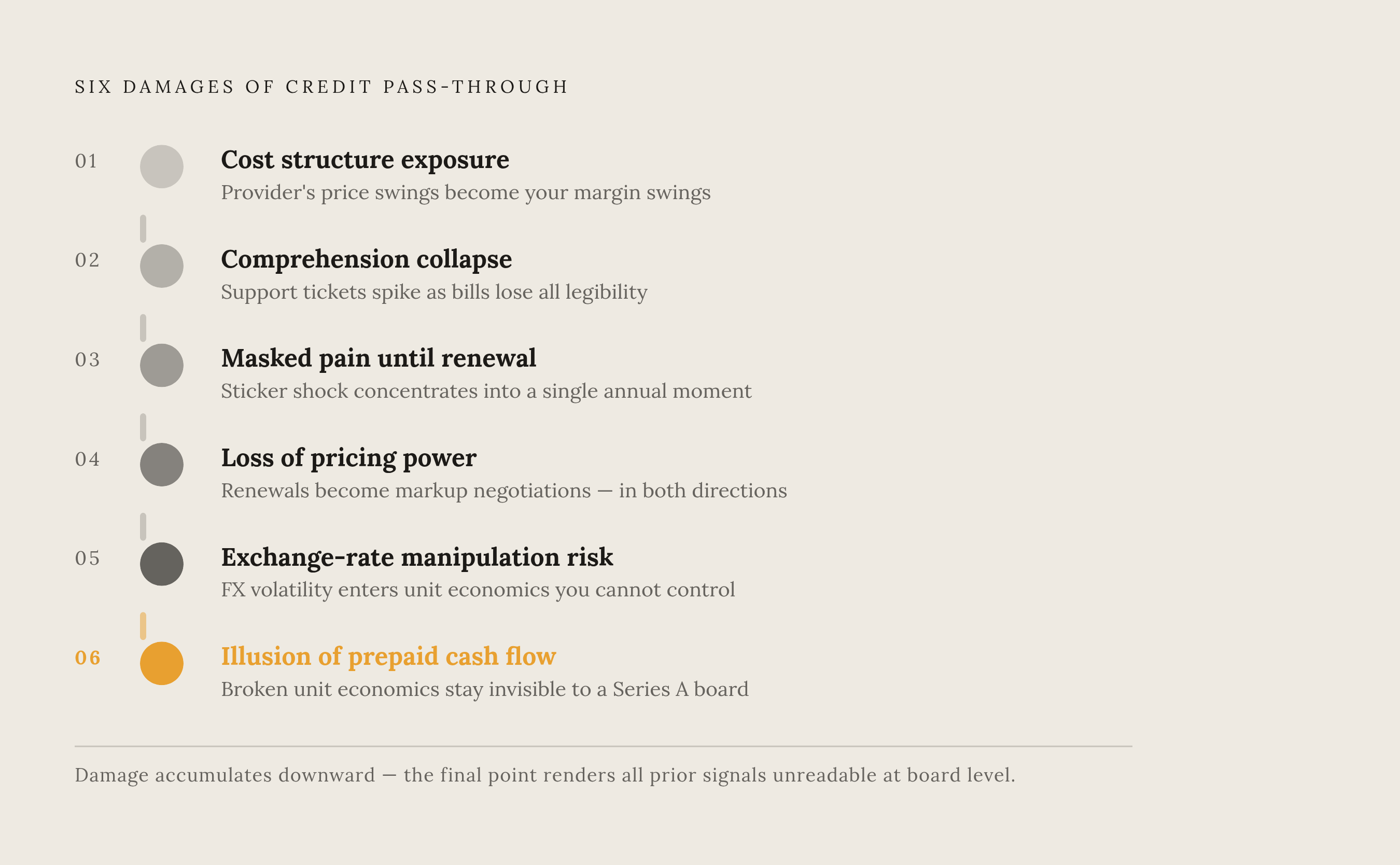
Cost pass-through does not fail in one place. It fails across six separate pressure points, each one capable of damaging a business on its own, and together they are close to fatal for a company trying to scale past its first few hundred customers.
The first is cost structure exposure. A product that could have been sold on outcomes gets reduced to a markup calculation, and once a buyer sees it that way, every renewal conversation becomes a negotiation over the size of that markup rather than a conversation about value delivered.
The second is comprehension collapse. What was meant to read as transparent pricing starts generating support tickets asking why a bill looks the way it does, and confusion breeds distrust faster than complexity ever breeds goodwill.
The third is masked pain until renewal. Prepaid credit wallets feel good at first because the customer doesn't feel the cost of each individual interaction. That calm is temporary: the bill eventually lands in full at renewal, disconnected from the drip-by-drip value the customer received along the way, and sticker shock at the renewal table is exactly when a competitor's sales rep is most likely to get a meeting.
The fourth is the loss of pricing power in both directions. Either direction caps a company's revenue at whatever margin the infrastructure layer allows, and that is not a ceiling any product company should accept.
The fifth is exchange-rate manipulation risk. Cursor's pricing episode, documented across multiple retrospective write-ups after the fact, shows how fast that kind of adjustment can turn into public backlash once customers notice the ratio moved under them.
The sixth is the illusion that prepaid cash flow creates. Credit sales bring in cash upfront, and that cash can make a business look healthy on a bank statement while the underlying unit economics stay broken. Telling a Series A board that "we pass through OpenAI's costs" reads as an admission of zero pricing power, not as a sign of discipline.
What buyers budget against
The unit a vendor prices in should match the unit a buyer uses to think about value, and for almost every application built on top of a foundation model, that unit is not a token. A buyer in finance, operations, or clinical administration does not think in tokens any more than a buyer of electricity thinks in joules. They think in outcomes they can put into a budget line: tickets closed, meetings booked, claims processed.
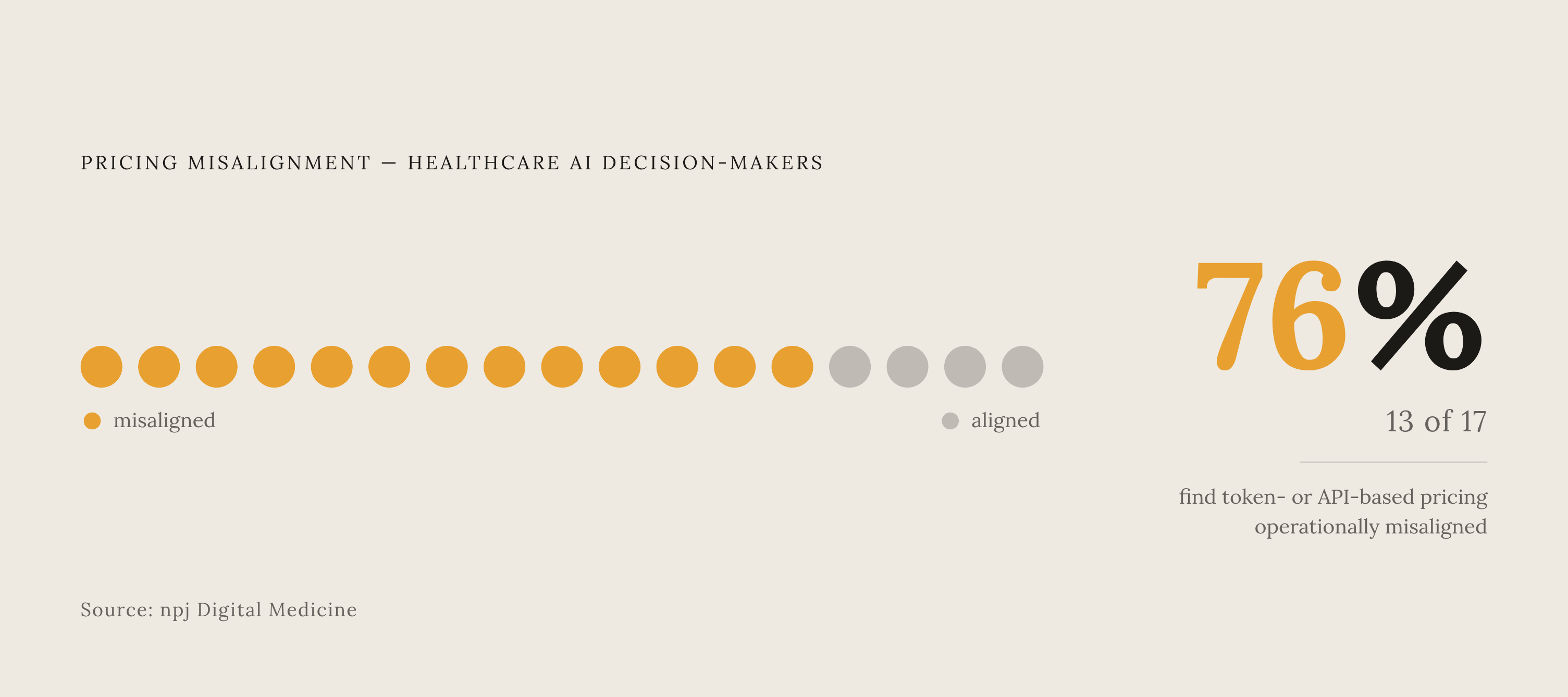
A study published in npj Digital Medicine put numbers behind that intuition. Among healthcare decision-makers surveyed on AI pricing, 13 of 17, or 76 percent, said pricing schemes based solely on technical usage metrics such as token counts, API calls, or computation time were economically and operationally misaligned with how healthcare practice actually runs. That finding generalizes beyond healthcare. It generalizes to any buyer whose job is not to understand inference architecture, which is to say almost every buyer of an application-layer AI product.
Token pricing shows up as the default largely because companies inherit the metric, not because they analyzed it. Application companies built on top of that infrastructure picked up the metric along with the API, but left behind the justification that made the metric sensible. The same inheritance occurs anywhere a company resells an embedded engine, an analytics layer, a search index, and passes the underlying vendor's per-user or per-query pricing straight to its own customers, simply because that is how the invoice arrived.
Buyers have also gotten less patient with paying a flat seat price for AI features whose usefulness is uncertain. They expect what they spend to track what they actually get, and that expectation puts the burden of proof on the pricing model itself. A vendor's job is to find the metric that actually represents delivered value for its product, then build the credit or pricing architecture around that metric rather than around whatever unit happens to be easiest to meter.
Designing credit pricing around delivered value rather than inference cost
The design goal is deliberate abstraction. A credit should represent a unit of value delivered to the customer, with the underlying inference cost absorbed as a line item inside gross margin, never exposed as the pricing mechanism itself. Three distinct approaches have emerged among companies solving this problem, and each represents a different bet on what the real unit of value is for a given product.
The first is consumption credits tied to a platform-defined unit that is not a token. The customer buys something in a unit they recognize, and the vendor manages the inference mix out of view. This approach fits products with many small, repeatable actions where a clean one-to-one mapping between action and outcome would be too rigid.
The second is per-resolution outcome billing, where a customer pays only when the AI finishes a defined successful outcome, so a ticket resolved, a meeting booked. HubSpot and Intercom have both bet on this model for customer-facing AI, charging only for resolved conversations because buyers who have already been burned paying for AI tools that start a job without finishing it respond better to pricing tied to completion. This is the highest-alignment option on offer, and also the hardest to execute, since defining and verifying a "resolution" consistently takes real engineering and judgment.
The third is a weighted credit system for platforms that run multiple models at once. For a platform where customers route tasks across several models depending on complexity, this weighting is close to the only approach that preserves abstraction without forcing a single flat price across wildly different cost profiles.
Whichever approach a company picks, the real payoff appears when the market shifts. The same discipline applies in reverse: when an upstream provider drops its prices, the sound move is to hold the current price for at least one quarter and use that window to invest in differentiation, better fine-tuning, more reliable outputs, smarter model routing, rather than reflexively passing the saving through.
There is one legitimate exception to all of this. That exception belongs only to infrastructure providers close to the hardware the tokens represent. It is not a model for application companies selling an outcome to a buyer who has never heard of a context window.
Hybrid pricing balances margin protection with enterprise procurement
Pure usage-based pricing, even built around a well-chosen value metric, runs into a wall at procurement. Enterprise finance teams need a number they can put into a budget before a fiscal year starts, and a bill that could land anywhere depending on usage is a bill most procurement processes are built to reject, regardless of how sound the underlying metric is.
The structure most AI companies eventually land on combines a base subscription fee, covering product access, support, and whatever SLA commitments the contract includes, with a usage component layered on top to capture value beyond that baseline. The usage layer gives the buyer a ceiling they can still reason about, since it only grows when their own usage grows past an agreed point.
Building that hybrid well comes down to three decisions. The included allowance should be at or slightly below the median customer's usage, so an average account never sees an overage charge and the base price feels like a complete product rather than a teaser for a bigger bill later. Overage pricing should stay denominated in the same value metric as the base plan, actions, resolutions, or credits, never tokens, so the abstraction from inference cost holds even once a customer crosses into overage. For enterprise accounts specifically, a minimum annual commit paired with a per-unit overage rate gives procurement a fixed number to approve, and it still gives the vendor upside if usage runs ahead of the commit.
The hybrid structure also matches how buyers mature. Early-market customers tend to prefer a simple flat subscription because they don't yet know their own usage patterns and don't want to think about it. Customers further along prefer usage-based pricing specifically so they can confirm they are not overpaying for capacity they don't use. A hybrid structure serves both groups at once: the base behaves like the subscription a new customer wants, and the usage layer behaves like the fairness check a mature customer wants, inside a single contract.
Migrating existing customers from cost-pass-through pricing without triggering churn
Moving a customer base off token pass-through and onto value-aligned pricing only works if no existing customer is forced to absorb a change in the middle of a contract term they already agreed to.
The safest sequence starts when you introduce the new hybrid or value-metric pricing for new signups only, so every existing contract stays untouched. At each existing customer's renewal, the new usage component gets layered on top of their current subscription, with the included allowance calibrated so an average user's bill stays the same. Framed that way, the change reads as a product upgrade rather than a price increase, since the customer is gaining a usage-based layer without losing anything they already had.
Cursor's pricing change stands as the clearest cautionary example of what happens when this sequencing gets skipped. The change felt like a rug-pull to customers who had no warning it was coming, and the backlash was severe enough that the company's CEO published a public apology. The core complaint was never about the underlying pricing logic. It was about the sudden loss of predictability, which a sequenced, renewal-timed migration is built to prevent. Vendors should be explicit, at every step, about what a new structure means for an average customer's bill: hiding a change inside a quiet adjustment to the credit-to-compute ratio is the same exchange-rate manipulation problem described earlier in this piece, and customers who discover a hidden change on their own punish a vendor far harder than customers who were simply told in advance.
What billing infrastructure needs for value-aligned credit pricing
None of the pricing architecture described above is harder to design, on paper, than straightforward token pass-through. It is close to impossible to run in production without billing infrastructure built to meter whatever value metric a company has chosen, not just raw token counts pulled from a provider's API response.
Credits denominated in actions, resolutions, or composite outcomes require a metering layer that can track an event across an entire workflow, a conversation that spans multiple model calls, a retrieval step followed by a generation step followed by a verification step, and resolve that whole sequence into a single billable unit the customer actually recognizes. That is a materially different engineering problem than logging a token count per API call, because the billing system has to understand product-level events, not just infrastructure-level ones.
The same system needs to support the weighted-credit and hybrid structures described earlier without hardcoding the weights, because model weights, included allowances, and overage rates are all things a company will need to adjust as provider pricing shifts and as its own product line grows more complex. A pricing architecture decoupled from inference cost only holds up if the infrastructure underneath it can change the weighting, the allowance, and the commit terms without a engineering migration every time the business needs to make an adjustment. Pricing power, in practice, is bounded by whatever the metering and billing layer is actually capable of measuring and changing on demand.