Free Credit Grant Sizing for AI SaaS Activation
How to size free AI credits so prospects reach value before the budget runs out.

Free credit grants for AI products are a pricing problem, a margin problem, and a data problem before they are ever a marketing one. The grant must be large enough to carry a prospect to a meaningful outcome, small enough to protect unit economics, and instrumented well enough that every credit consumed produces information the vendor can act on. Getting that calculus right requires understanding how AI cost structures and consumption patterns interact with billing infrastructure.
Why free credit grants exist: the structural shift from seat pricing to consumption pricing
Credit grants are not a promotional tactic but a structural response to usage-based pricing. When billing is variable and driven by consumption, a deterministic free allocation is the only mechanism that lets a prospect experience the product without unpredictable cost exposure. A seat-based trial simply gates time. A usage-based trial must gate spend, and the free credit grant is the instrument that does so.
The shift is documented and fast-moving. PricingSaaS 500 Index data shows credit models roughly doubled in adoption in 2025 alone, and the structure now appears across household-name SaaS companies including Figma, HubSpot, and Salesforce. The dominant emerging structure is hybrid: a subscription anchors access and predictability, while the metered layer, spanning tokens, API calls, compute credits, and agent resolutions, prices the part of the product that scales independently of who is logged in.
The practical implication is direct. In a seat-only world, a free trial is time-limited access and the design question is how many days to give. In a usage-based world, a free trial requires a finite budget, and how that budget is set determines whether the trial succeeds or fails. The grant is the first pricing decision a prospect meets.
Why AI cost structures make grant sizing harder than it looks
AI products bill on sub-cent, high-volume consumption events. Tokens, GPU-minutes, API calls, image renders, and audio seconds all produce wildly different burn rates depending on the workload, which makes a dollar-denominated grant misleading as a proxy for how much a prospect can actually do. The same dollar figure means different things to different users doing different tasks. A grant that looks generous in dollar terms can be exhausted in hours of real usage, or dramatically oversized for a prototype workload. The uncertainty is structural, not incidental: it follows from the fact that the marginal cost of a unit of product value varies with the work the user asks the model to do.
The analogy to physical goods pricing breaks down completely. A SaaS team can estimate what a free t-shirt costs. An AI team cannot estimate what a free session costs until it knows which model, which prompt length, and how many turns the user will take. Intuitive sizing is unreliable not because AI inference is expensive, but because its cost profile is workload-dependent in ways that have no analogue in previous software pricing.
What "activation" actually means and why the grant must be sized to reach it
The decisive variable in trial conversion is not trial length but activation rate: whether a prospect reaches a meaningful outcome, the moment where value becomes legible, before the grant runs out. The practical design question is therefore what the minimum viable outcome for the product is, the specific action or result a prospect must experience to understand value, and how many credits that outcome consumes. This is a product-definition question before it is a pricing question. Teams that have not identified their activation moment cannot rationally size a grant, because they do not know what they are funding. The floor of the grant is defined by the activation moment, not by what feels generous.
Credit-to-outcome mapping differs by product layer. For infrastructure-layer products, token-based LLM APIs, the activation moment may be a successful first API call or a completed prototype output. For outcome-layer products, an AI agent that resolves a customer service ticket, the activation moment is a resolved interaction, and the credit cost is the full inference cost of that resolution. In both cases, the floor is knowable once the moment is defined.
How to set the ceiling: margin protection, grant abuse, and the cost of over-provisioning
If the activation moment sets the floor, three constraints set the ceiling. A grant that is too large destroys the natural expansion pressure that converts free users to paying customers: if prospects can accomplish everything they need within the free allocation, the conversion trigger never fires. Generosity has a conversion cost, not just a margin cost.
Over-provisioning compounds the problem at the unit economics level. At scale, free credits that do not convert are real inference costs with no revenue to offset them, and at AI workload volumes those costs compound fast. The margin constraint asks what the inference cost of the grant is at the expected mix of workloads, and whether that cost is defensible as a customer acquisition cost.
Grant abuse is a structural risk unique to AI products. Because inference is cheap to trigger programmatically, free grants attract automated abuse at a rate seat-based trials do not. A grant sized for one human session may be consumed by a script in minutes. The abuse surface constraint asks whether the grant is large enough to be worth gaming, and what friction, such as card requirements, identity verification, or rate limits, offsets that risk.
The card-required versus no-card debate is a ceiling question. Growth Unhinged conversion benchmark data shows card-required trials convert at multiples of the rate of open trials, but cull signup volume. A smaller, more committed cohort burning a larger grant is often more defensible than a large, uncommitted cohort burning a small one.
Four structural decisions that determine whether a grant actually converts

Credit grant design is not one decision but four, and each interacts with the others. Getting one wrong can undermine the rest. The combination of choices matters more than any single decision.
The first decision is what a credit buys and where it sits on the value chain. As the PricingSaaS credit framework establishes, credits can map to inputs such as tokens and API calls, intermediate actions such as enrichments, lookups, and renders, or outcomes such as resolved tickets and completed tasks. The closer credits sit to outcomes, the easier the return on investment story for the prospect, but the more variable the credit cost per unit, because outcome complexity varies. Dollar-credit parity, one dollar equaling one credit, maximizes legibility but removes pricing flexibility. Abstracted credit costs, credits per action type, allow margin management but require clear communication to avoid confusion.
The second decision is grant size and progression: one-time versus staged. A single upfront grant is simple but creates a cliff. The prospect either converts before it runs out or churns. Staged grants, a small initial allocation followed by demonstrated engagement and then unlocked additional credits, tie spend to signal. Each stage consumes budget only if the user has already demonstrated intent. The Microsoft Founders Hub progression structure, which starts at a small initial credit allocation and unlocks higher tiers based on business verification, service adoption, sustained Azure usage, and in many cases investor or accelerator affiliation, is a directly analogous model at the infrastructure layer: size the next grant on the signal from the previous one.
The third decision is earn-back and referral mechanics as grant multipliers. A smaller initial grant paired with an earn-back mechanic can outperform a larger one-time grant, because scarcity drives referral behavior rather than passive consumption. This shifts the grant-sizing calculus: the question is not only how many credits to give, but how users earn more, and whether earning more makes them more or less likely to pay.
The fourth decision is rollover, pooling, and expiry. As the PricingSaaS credit framework identifies, whether credits roll over, whether they pool at the user or org level, and how additional purchases are handled determines how customer-friendly or vendor-friendly the credit model is. Expiring credits create urgency but also anxiety. Non-expiring credits reduce urgency but build goodwill. The right choice depends on whether the product's activation moment requires sustained use or a single demonstration.
Why consumption data — not conversion rate alone — is the real output of a grant program
A credit grant that converts users is useful. A credit grant that also reveals how users burned their credits, where they stopped, and which usage patterns preceded conversion is a product development and pricing asset. The consumption data from a well-instrumented grant program answers questions conversion rate alone cannot: which workloads exhaust the grant fastest, which users hit the limit and do not upgrade, which patterns of credit use predict eventual paid expansion.
Budget volatility is a documented barrier to conversion. SaaS pricing benchmark data shows IT buyers have experienced unexpected charges tied to consumption features, and prospects who fear runaway costs after the grant will resist converting even if they found value in the trial. Burn-down visibility during the grant period addresses this objection before it becomes a sales obstacle.
The data also drives grant size iteration. If most users consume their grant without reaching activation, the grant is too small. If most users convert having consumed less than a third of their allocation, the grant is oversized. Neither is knowable without per-user, per-event consumption data.
What the billing infrastructure underneath a grant program actually needs to do
A credit grant program is a prepaid credit wallet that must be tracked as deferred revenue, decremented in real time as consumption occurs, and recognized as revenue only as credits are consumed. This reconciliation requirement is one that batch billing systems and subscription-first platforms cannot handle. The accounting reality reinforces the point. Under ASC 606, prepaid credit grants that vest on consumption create real-time revenue recognition obligations, and free promotional credit grants are generally treated as marketing expenses. The system must know, at the moment a credit is consumed, what usage event triggered it, at what rate, and against which customer's balance.
What the infrastructure must actually do is specific. It must ingest usage events at the speed of inference, millisecond-level token consumption, API calls, or compute events, not batched at end-of-day. It must maintain a live credit balance per customer that decrements in real time and triggers alerts for the customer and conversion signals for the vendor at defined thresholds. It must model prepaid credit wallets alongside postpaid invoicing on the same engine, because enterprise customers often need both, and the grant-to-paid transition is not a billing-system migration but a balance transition. It must surface consumption data to product, finance, and customer success teams simultaneously, not routed through a single system owner. It must support on-premises or sovereign cloud deployment for enterprise customers in regulated sectors where cloud-hosted billing infrastructure is disqualifying.
The common failure mode is running the grant on a separate codepath from production billing. That workaround creates reconciliation debt and makes the consumption data from the grant period inaccessible to the billing layer that eventually prices the paying customer. The build-versus-buy tension is real here. The pricing model, token counts, compute minutes, credit burn-down, encodes revenue strategy in ways that generic vendor defaults often cannot accommodate at the edges, which makes in-house billing feel appealing. But the engineering cost of building and maintaining production-grade usage metering is a permanent burden, not a one-time project.
How to iterate grant sizing once the system is instrumented
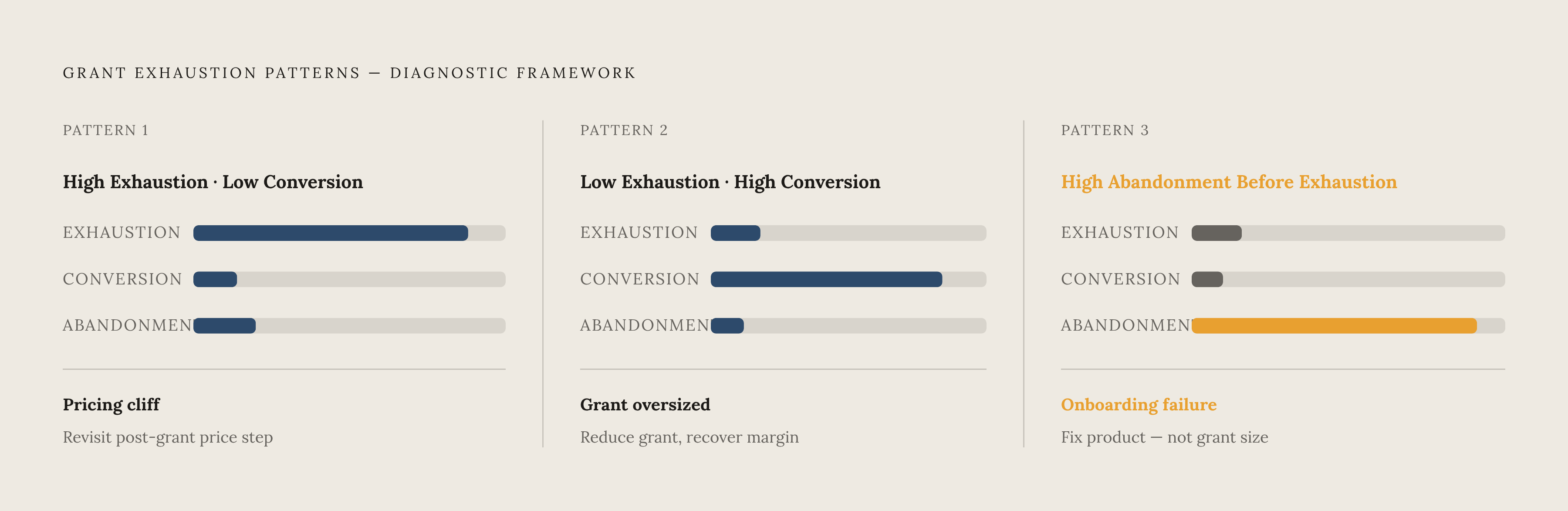
Grant sizing should be treated like a pricing experiment: set an initial allocation based on the activation moment analysis, instrument the consumption, measure conversion at each usage threshold, and adjust. The signals that indicate a grant needs resizing are identifiable. High grant exhaustion rate with low conversion means the grant is reaching activation but not creating enough expansion pressure. Either the post-grant pricing feels like a cliff, or the activation moment was not actually reached before exhaustion. Low grant exhaustion rate with high conversion means the grant is oversized. Users are converting with significant credit remaining, which means the grant is more expensive than the activation required. High abandonment before exhaustion means users are leaving before consuming the grant, a product or onboarding problem, not a grant-size problem. The grant cannot fix an activation flow that does not work.
Grant size, activation threshold, earn-back mechanics, and card-requirement decisions can all be varied independently. The team that has instrumented its grant program is running a continuous product-led growth experiment, not waiting for the next pricing review cycle. The pricing velocity documented across top SaaS companies reflects this. PricingSaaS records Lovable making roughly one meaningful pricing update per month and Salesforce iterating through multiple pricing models, including credit structures, within 18 months. Those are teams that built the infrastructure to see consumption data and act on it quickly.
The teams that get this right treat grant sizing as a continuous growth lever that product and finance can pull without an engineering ticket. That requires the instrumentation described above and a billing system that lets pricing changes propagate without a code deployment. The companies winning at credit-based activation are not the ones who guessed right on day one. They are the ones who built the feedback loop that let them get there faster.