Pricing Psychology of Credit Pricing vs. Dollar Pricing
When customers can't explain what one credit costs them, the pricing model has already failed.

Pricing Psychology of Credit Pricing vs. Dollar Pricing.
Credit pricing growth outpacing team understanding
Pricing in credits rather than dollars does not just change the unit of account. It changes how a customer perceives cost, evaluates value, and decides how much to consume, and the difference between a credit model that earns trust and one that quietly burns it comes down to psychology, not arithmetic. Credit models became the defining pricing innovation of 2025: companies using them grew 126% year-on-year, from 35 to 79 in the PricingSaaS 500 Index Growth Unhinged 2026 State of B2B Monetization. The same index tracked more than 1,800 pricing and packaging changes among the top 500 B2B and AI companies that year, an average of 3.6 changes per company PricingSaaS 500 Index.
The reason is economic. AI margins run around 50%, far below the 70 to 80%-plus margins SaaS companies got used to, because every inference costs real compute money, and the heaviest users can cost a vendor an order of magnitude more than the lightest ones Growth Unhinged 2026 State of B2B Monetization. Flat pricing cannot survive that kind of cost variance without someone losing money. Credits look like the fix: charge per unit of consumption, protect margin, keep the packaging flexible. And this is not a story confined to scrappy AI startups burning venture money PricingSaaS 500 Index. Salesforce, Anthropic, HubSpot, OpenAI, Clay, Figma, Canva, SAP, and GitHub all made significant pricing moves toward credit or usage structures in early 2026. That is the roster of an entire industry recalibrating at once.
None of this is inherently good or bad for buyers. It is simply the fact pattern. What follows is the psychology behind why credit pricing works when it works, and why it collapses, publicly and expensively, when it does not. AI credit adoption today is 29% of companies surveyed; a further 33% say they plan to introduce AI credits within 6–12 months, per Kyle Poyar's State of B2B Monetization survey of 230 companies Growth Unhinged 2026 State of B2B Monetization.
The pain of paying and how abstraction changes it
Every purchase carries a small jolt of loss alongside the anticipated gain. Prelec and Loewenstein's 1998 double-entry mental accounting model describes this directly: paying triggers an immediate negative affective response that counterbalances the pleasure of acquiring something, and the size of that response depends heavily on how vivid and immediate the act of paying feels. Handing over cash, watching a stack of bills get smaller, produces a sharper version of that pain than swiping a card or clicking to confirm a subscription. Vendors have known this for decades. It is why frictionless checkout became gospel in e-commerce, and it is exactly why credit pricing exists as a category.
Credits insert a conversion step between the dollar and the action. A customer buys a block of credits once, up front, and then spends them gradually valueaddvc.com. That conversion step matters because it separates the moment of financial pain (the purchase) from the moment of consumption (the usage), and separating those two moments dampens how sharply the customer feels each individual unit of spend.
That is not the same as saying credits make people spend irrationally. Dampened pain of paying is not irrationality. It is lowered friction, and lowered friction can be entirely appropriate in cases where the friction was artificially high to begin with and blocking value that both sides wanted to transact. SaaS pricing has run versions of this principle for years: charm pricing, bundling, anchoring against a decoy tier. Credit pricing is simply the usage-era descendant of the same idea, except it operates at the level of the unit of account itself rather than at the level of a single price point. Framed honestly, this is not a trick. It is cognitive architecture, and any team setting a credit price is making decisions about that architecture whether they mean to or not.
Credits and customer perception of what they are buying
Dollar pricing gives a buyer something to check the number against. The unit is familiar and the comparison is direct, so the cognitive labor of deciding whether the price is fair is genuinely light.
Credit pricing removes that shortcut. A buyer first has to build a mental model of what a credit actually represents, a search, a token, an agent action, a resolved ticket, before they can even begin to ask whether the price is fair. That is an extra step of interpretation sitting in front of every value judgment, and it changes what "value" means to the buyer. Credits occupy a strange middle position: more transparent than a legacy per-seat license, because the customer can at least see which actions are consuming their balance, but easier for a vendor to implement than a true outcome-based structure, which requires defining and measuring a result rather than an action. That middle position is exactly why so many teams reach for credits as a first move. It is faster to ship than outcome pricing and feels more honest than a flat seat fee.
The test for whether a credit system is working perceptually is this: if a customer cannot explain, without opening a help doc, what one credit buys them, the system has already lost the argument. That test carries a deeper trap: it produces a false sense of clarity even when the underlying credit system remains confusing in other ways. SaaS customers spent roughly two decades being trained on near-zero marginal cost, generous free tiers, flat monthly fees, unlimited seats within a plan. Moving that customer from free or flat access to a metered credit balance is experienced as a loss, and the loss registers as larger, psychologically, than the appreciation the customer felt when the free access was first granted. Loss looms larger than an equivalent gain, a finding that appears across behavioral economics generally, and it explains a pattern that otherwise looks strange: major AI companies keep free tiers alive well past the point where the unit economics justify it, because pulling the tier triggers a loss reaction that a slow price increase never would.
The double conversion problem: where credit pricing loses customers
The first conversion turns dollars into credits at the moment of purchase. It is visible, stable, and usually disclosed clearly on a pricing page. The second conversion turns credits into actual work, tasks, tokens, or outputs at the moment of use, and this one is variable, controlled entirely by the vendor, and often opaque even to a careful customer.
The customer's felt cost of the product depends almost entirely on that second conversion, which they neither control nor can reliably predict. Finance leaders inside customer organizations report losing the ability to explain, in plain terms, what they are actually paying for once a product shifts to credits. The ROI calculation used to justify the spend in the first place stops being something anyone can defend in a budget review.
That second conversion also gives a vendor a lever to change effective pricing without ever touching the sticker price. Adjusting the credit-to-dollar exchange rate, or how many credits a given action consumes, is far less visible to the customer than raising a posted price outright, which makes it tempting during a margin squeeze and dangerous for trust the moment customers notice.
Picture a mid-sized team that signs up for a platform at a clearly disclosed credit rate, budgets accordingly, and settles into a rhythm. Then the vendor ships a new feature that quietly consumes credits at several times the rate of the tools the team was already using, and nobody flags it in advance. The team's monthly allowance runs dry with a week left in the billing cycle, work stalls, and the finance conversation that follows is never really about the dollar amount. It is about the fact that nobody saw it coming. Double conversion can be named and defined as the phenomenon identified in a July 2026 analysis.
Real credit pricing failures and their costs
Cursor, the AI coding tool valued at roughly $9 billion, offers the clearest cautionary case in the category. One developer generated a $7,225 invoice in a single day in July 2025 after a teammate burned through 500 requests on an annually-billed plan, and the post describing the bill reached 797,000 views within a week digitalapplied.com.
Windsurf took the opposite path and retired credit billing entirely in March 2026. The company's explanation: a flat credit rate charged the same amount for a simple question and a complex one, which taught users to fear asking quick questions and to cram several requests into a single prompt just to avoid wasting credits. That is a vendor admitting, in its own words, that its credit system reshaped customer behavior in a direction nobody wanted, proof that the second conversion problem is not theoretical.
Salesforce Agentforce launched at a flat $2 per conversation, then replaced that in May 2025 with Flex Credits priced at $0.10 per discrete action, alongside a Flex Agreement letting enterprises convert unused user licenses into credit budgets. By 2026, buyers could choose among Flex Credits at roughly $0.10 per action, the flat $2-per-conversation rate, or a $125-per-user-per-month unlimited plan, effectively letting the customer pick their own risk tolerance rather than forcing everyone through the same meter valueaddvc.com.
HubSpot Breeze moved in a different direction again. Starting in April 2026, the Breeze Customer Agent price dropped from $1.00 per conversation to $0.50 per resolved conversation, tying the charge explicitly to a successful outcome instead of a mere attempt valueaddvc.com. Its Prospecting Agent went further still, charging $1 per qualified lead valueaddvc.com. GitHub Copilot transitioned to token-based AI Credits effective June 1, 2026, a move the company framed around a real structural problem: flat per-seat pricing punishes customers for adopting the very capability the product is meant to sell them on.
Clay stands out as the clearest recovery story in the group. Its March 2026 overhaul adopted a no-result-no-charge rule and, unusually, published its internal pricing memo publicly alongside the announcement. Clay's pricing page states directly that its plan thresholds were chosen specifically to reduce customer anxiety about how usage translates into spend, a level of attention to the psychology of pricing that most AI vendors simply do not apply.
Line these cases up and a pattern falls out cleanly. The failures share one structural flaw: the second conversion, credits into actual work, changed without adequate warning. The recoveries share the opposite structure: the vendor made that second conversion legible, or tied it directly to an outcome the customer could see and verify for themselves. In early 2026, effective per-unit rates were reported to have increased more than 20x through further credit redenomination, with trust damage compounding with each change. Cursor's June 2026 restructuring set individual plans ranging from free Hobby to $20/month Pro, $60/month Pro+, and $200/month Ultra, with Pro bundling a $20/month credit pool tied directly to underlying API costs from OpenAI, Anthropic, Google, and Cursor's own first-party models including Grok and Composer, while a team Premium seat at $120/user/month, compared with $40/month for Standard, offers 5x the usage at 3x the cost in a deliberate move to reward heavier users with better unit economics valueaddvc.com.
The stronger choice for the buyer and seller: dollar pricing
Dollar pricing carries a real perceptual advantage that credit models simply cannot replicate: there is no conversion overhead at all. A buyer evaluates the cost against a known reference point immediately, and a procurement or finance team can forecast spend without modeling a second, vendor-controlled variable that determines the first.
That advantage matters most in specific conditions: when consumption is fairly uniform across the customer base, without wide swings in per-user cost; in enterprise sales, where procurement needs a single line-item dollar figure that maps cleanly onto a budget category; and whenever a vendor's own cost base is stable enough that a flat or per-seat price will not get crushed by a handful of unusually heavy users.
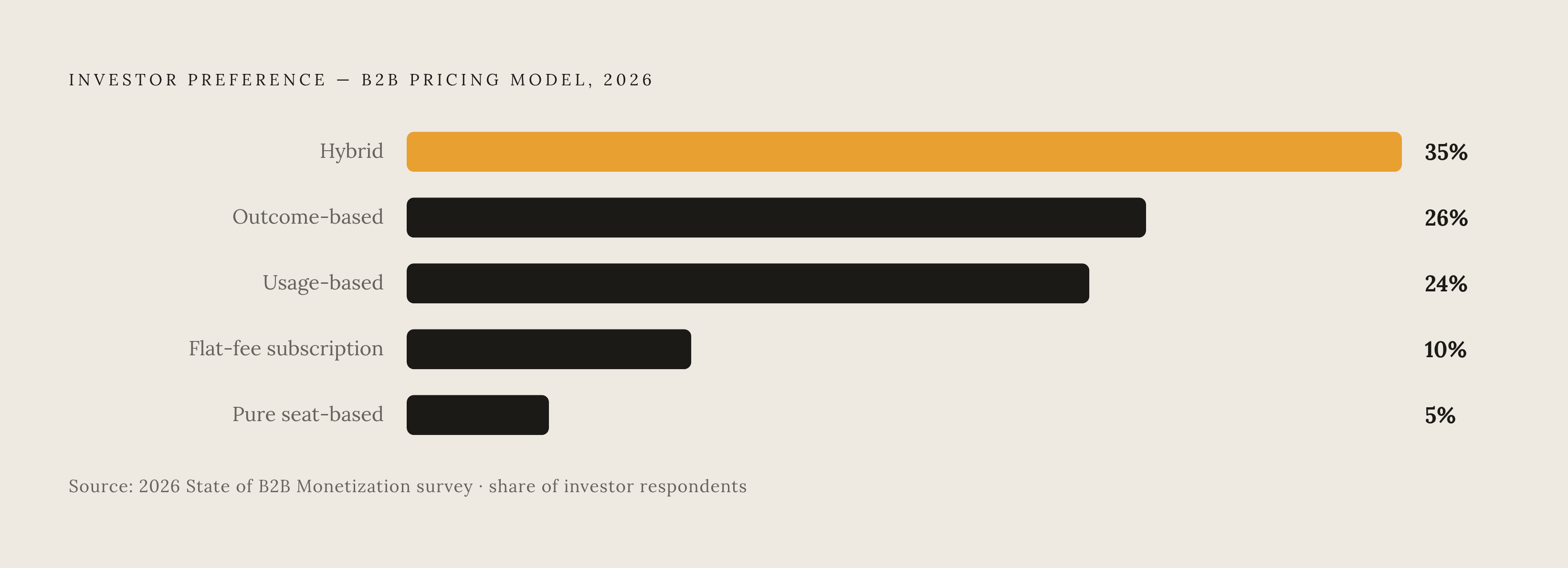
Hybrid pricing has emerged as the practical resolution for a lot of companies caught between these two worlds. Of the 230 companies surveyed for the 2026 State of B2B Monetization report, 37% now run hybrid as their primary structure, the single most common model in the survey, because it keeps dollar-denominated predictability at the base of the plan while confining usage variance to the margin Growth Unhinged 2026 State of B2B Monetization. There is a real irony sitting inside that number, though: companies running hybrid pricing report being the happiest with their own model, yet they also struggle to explain that same pricing to their customers, the same dynamic of a dollar cost hidden behind a usage-based conversion. Investor sentiment backs the shift toward blended models too. Only 5% of investors favor pure seat-based pricing and just 10% favor flat-fee subscriptions, while 35% favor hybrid, 26% favor outcome-based pricing, and 24% favor usage-based pricing Growth Unhinged 2026 State of B2B Monetization userpilot.com. Dollar pricing has not lost, in other words. It has simply moved into a supporting role inside a blended structure rather than standing alone. Early-stage products with insufficient usage data to set credit rates confidently saw early-stage businesses with less than $5M ARR gravitate most strongly to flat fees, per Growth Unhinged.
The pendulum toward simplicity in credit model design
Pricing trends move in swings, and the credit swing of 2025 looks close to its peak PricingSaaS 500 Index Growth Unhinged 2026 State of B2B Monetization. The more credit models flooded the market that year, the more customers started asking, loudly, to go back to something simple and predictable, and the expectation heading into 2026 is that the pendulum tips back toward simplicity. That does not mean credits disappear. It means the teams that treated credits as a permanent architecture, rather than a stopgap, are the ones due for a reckoning.
One head of product monetization at an AI vendor put it about as honestly as anyone in the industry has: credits were never loved, they were just the fastest thing to ship while outcomes remained too hard to define and measure. Plenty of teams admit, in effect, that credits are a workaround. The direction of travel splits along a fairly clean line. Vendors who can define and measure a real outcome are moving toward outcome-based pricing, HubSpot's $0.50 per resolved conversation and Clay's no-result-no-charge rule both point that way valueaddvc.com. Vendors who cannot yet define an outcome with confidence are moving toward simplified hybrid structures instead valueaddvc.com.
For anyone designing a credit system today, several implications follow directly. Credit rates that shift without warning are the single fastest way to trigger the kind of reputational event Cursor lived through. Real-time spend visibility and proactive alerts are not a nice-to-have layered on top of a credit system, they are the mechanism that prevents bill shock, churn, and a spike in support tickets. And when a product bills across several dimensions at once, tokens, agent steps, output types, the underlying abstraction still has to reduce to something a customer can explain in one sentence, or it has already failed the test.
Seven principles for credit pricing that preserves rather than erodes trust
A widely cited framework for customer-friendly credit pricing lays out seven principles, and they hold up well against the case evidence above. The first and most load-bearing principle is to make the second conversion visible: disclose exactly what a credit costs per action, per feature, per unit of output, rather than leaving that rate implicit and discoverable only through trial and error. A customer who can predict, before they act, roughly how many credits an action will cost is a customer who trusts the system even when the number is not small.
The remaining principles extend from that same instinct, transparency before the fact rather than explanation after it. Rates should not move without advance notice, because a silent change to the credit-to-dollar ratio is functionally a price increase dressed up as a technical adjustment, and customers eventually notice the dressing. Usage should be reported at a granular level, itemized by task and by user, not bundled into a single opaque balance that only shows a number going down. Where an outcome can be defined and measured, tying the charge to that outcome, the way HubSpot ties Breeze pricing to a resolved conversation, removes an entire layer of anxiety that a pure action-based credit meter cannot. Free tiers and thresholds deserve to be set with the customer's own anxiety in mind, which is precisely the reasoning Clay cited publicly when explaining its own plan structure.
None of this asks a vendor to abandon credits. It asks a vendor to treat the second conversion with the same seriousness as the first, because that is the exact point where trust is won or lost, and the market has already produced enough public case studies to prove it.