Hackathon and Developer Event Credit Sponsorship Strategy
Credit-backed sponsorships turn developer adoption into a measurable revenue signal.

Hackathon credit sponsorship is a go-to-market strategy for companies with usage-based pricing that funds developer events. It pays off when developers go from trying the product to building working projects and keep using it. That requires more than a generous credit allocation. Sponsors need an event package that gets developers to adopt the product, credit balances they can see, and a way to link those who take part to later paid usage.
Why developer event sponsorship is shifting from brand expense to adoption motion
Consumption pricing changes what a sponsor can earn from an event. When revenue scales with usage, a developer who builds on an API can become a source of future consumption, rather than simply someone who recognizes the vendor’s logo. Adoption becomes part of the revenue model. Sponsors can therefore judge the sponsorship by API activity after the event as well as the exposure it brings during it.
For a usage-based vendor, the marginal cost of issuing a meaningful API credit allotment is near zero, while the potential return is a developer who has shipped something on its infrastructure. Issuing credits does not, however, establish that developers will use them or stay. The investment case depends on what the event gives participants a reason to build, which makes the sponsorship package itself the next decision.
What sponsors actually receive from a hackathon investment
Hackathon sponsorship combines five distinct assets, including a challenge track, a workshop or tech talk slot, logo placement and brand exposure, access to participant resumes and project submissions, and judging panel presence. These assets serve different goals. A sponsor focused on its brand may want more visibility, while a usage-based sponsor has more reason to ask for ways to get developers using the product. The challenge track is the highest-leverage asset for adoption because it makes building on the product a condition of competing.
The AAAI Hackathon 2025 sponsorship package illustrates how those assets appear in tiers. Platinum included prominent logos across the website, T-shirts, banners, and event materials, a 5-minute opening presentation, a 30-minute workshop or tech talk, and a judging seat. It also included a branded prize category, resume and GitHub link access, pre-event Discord engagement, post-event networking, and a VIP dinner invitation. Gold offered logos on the website, T-shirts, and banners, a 20-minute presentation or demo, a judging option, branded swag, a named challenge prize, and post-event networking. The difference extended well beyond logo prominence.
Silver offered website and T-shirt logos, mentorship, a social media shoutout, swag distribution, and access to final submissions. Bronze, at $2,500, offered website and signage logos, swag distribution, and social media recognition. Cash was not the only contribution accepted. The package also accepted laptops, GPUs, software licenses, cloud credits, APIs, datasets, and other technical resources. This gives credit sponsors a place in the package without making any tier inherently the right choice.
Akamai Cloud (Linode) made activation compulsory at DeveloperWeek 2026. Hackers entering its challenge had to set up a new Akamai Cloud Computing account using a $1,000 promotional credit to qualify for the sponsor prize. Crusoe’s track at the DevNetwork [AI + ML] Hackathon 2026 similarly tied prizes to infrastructure use. It required a Hermes/NemoClaw agent running Nvidia Nemotron on Crusoe Cloud Managed Inference, with an NVIDIA DGX Spark for 1st place and a Mac mini for 2nd place.
How to structure a credit package so developers actually build with it
To help developers build substantial projects with that product use, sponsors should plan how credits are denominated, how developers get them, and how they are split between participation and prizes. Denomination must reflect the API’s cost structure. A voice transcription API consumes credits differently from an LLM inference API, so a nominally generous balance may not fund a meaningful build. Developers should get enough credits to try things out without running out midway through the project.
Delivery determines how participants reach that allowance. Flat per-participant credits give every registered developer the same amount at kickoff. Groq’s model combines that baseline with a bonus pool for the best project built on its inference API. Compulsory account setup instead makes the credit allocation part of entry itself, as in the Akamai challenge.
Prize-only credits fund a winner, but they do not give every participant resources to build during the event. Broad participant allocations support a larger group of developers who can finish projects on the platform. For a sponsor measuring post-event retention, that cohort is more useful than a prize recipient alone.
Where credit sponsorships break down and why opacity is the main failure mode
Even a well-sized package can fail when developers cannot see consumption. The main failure mode is opaque credit burn. Participants need to know how much remains while they are building. Without that visibility, some conserve excessively and attempt less, while others exhaust their credits before they can finish. Either response weakens the adoption signal the sponsorship was meant to produce.
Cursor’s June 2025 Pro plan change provides a concrete example of that design problem. The plan moved from a fixed fast-request allowance to usage billed at API rates, and users burned through the allowance in a handful of complex Claude prompts and received surprise bills. The CEO apologized publicly within weeks and refunded unexpected charges from a three-week window. An allowance is difficult to use confidently when its rate of depletion is unclear.
At a hackathon, the same problem unfolds on a compressed schedule. A team that reaches a credit wall on Saturday afternoon may lose momentum and ship a less substantial project, or nothing at all. Sponsors should therefore provide a sponsor-side dashboard or participant-facing usage meter that exposes consumption in flight. Visibility does not replace adequate funding, however. An inference-heavy workload against a large model can still exhaust a poorly sized package in a single test run.
How to approach vendor programs and timelines when applying for credit sponsorship
For organizers sourcing credits, the practical starting point is a formal program and an early, specific application. These programs often take longer than organizers expect, though the program details available give no single application deadline that applies to all of them. The prospectus is the central application artifact. It should give the event name, date, format, expected attendance, audience breakdown, evidence from past editions or institutional backing for a first edition, sponsor tiers with explicit perks, and one point of contact. That specificity helps a developer-relations team seek budget approval.
AWS Activate has formal credit tiers for startups and events, from low four figures through self-service to six figures for AI programs that qualify. OpenAI community hackathon support has a direct application form for API credits, Codex access, and prizes. Anthropic Claude community ambassadors get funds for events and personal API credits each month exclusively for their own use in demos at Claude-focused events. The distinction is important when estimating what an event can distribute.
Anthropic’s startup program is a separate route. Its FAQ states that VC funding is not required, accepted startups receive higher API rate limits, and credits apply only to the first-party Claude API through Claude Console, with AWS Bedrock and Google Vertex AI excluded. Groq’s Service Credit Terms set a general expiry at one year after purchase or issuance unless otherwise specified. Its startup credit program page now redirects to the homepage, so that page should not be treated as an active application route. Mistral’s “Mistralship” application page was returning an error as of August 2026.
Organizers of events focused on RAG or vector search can also approach Pinecone. It runs branded hackathons and has hosted one with AWS, OpenAI, Hugging Face, and LangChain as co-sponsors. The program on offer still needs to fit the planned event. In the prospectus, organizers should offer a “Best use of [product]” challenge judged by the sponsor with its own prize. That gives the vendor a way to get developers using its product without having to commit a large amount of cash.
What to measure after the event to determine whether the sponsorship worked
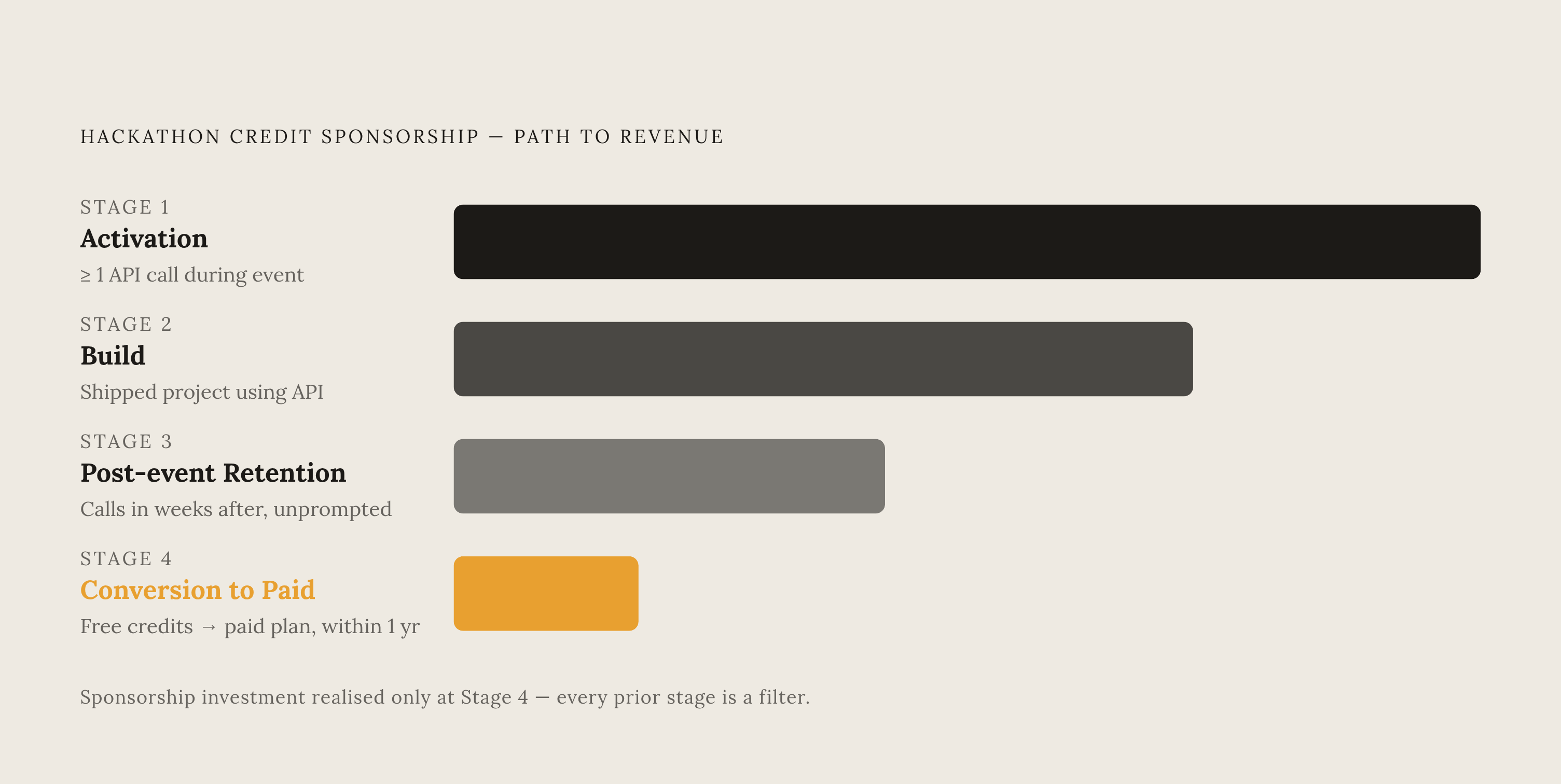
A sponsorship needs a post-event measurement protocol to distinguish pipeline from anecdotes. Participant counts and social impressions do not establish adoption. The useful funnel has four stages, which are activation, build, post-event retention, and conversion to paid.
Activation rate is the share of credit recipients who made at least one API call during the event. Build rate asks what share shipped a project that used the sponsored API meaningfully. Post-event retention then measures the share making API calls in the following weeks and months without further prompting. Conversion to paid measures the share moving from promotional credits to a paid plan within the credit expiry window, typically one year.
However, individual adoption does not automatically become organizational consumption spend. Developers can return from an event to enterprise procurement processes that default to seat-based contracts, even when they have built successfully on a sponsored API. The highest-value outcome is an internal champion who draws on that build experience to advocate for the platform and accelerate procurement. Sponsors commonly fail to track whether their event cohort produces those champions.
Why the billing infrastructure behind the credits determines whether the motion scales
The measurement requirement turns credit sponsorship into an infrastructure question. Per-participant allocations, live balances, expiry enforcement, and conversion tracking all depend on consumption data that reaches the right audience at the right time. An invoice generated in arrears cannot tell a developer what remains during a build. The underlying system must meter usage at event speed while exposing it to participants and sponsors.
Credit wallets need more than a promotional discount. They require prepaid credit drawdown at API call speed, real-time balance updates, configurable expiry, and support for postpaid invoicing within the same system. Subscription billing tools do not natively support this credit-and-consumption architecture. A company built around subscription plans may be able to grant a one-time discount but still need custom engineering for participant balances, event-level expiry, and cohort attribution.
Attribution adds a requirement beyond accurate balances. To link later consumption to a named hackathon, the billing system must tag usage events with source metadata. That supports the usage-based parts of activation, retention, and paid-conversion analysis. Build rate also requires evidence that a submitted project used the API meaningfully.
Operational costs grow as the program adds events, participant allocations, and tiered prize pools. Manual reconciliation after each event becomes a recurring burden, while automated issuance, consumption tracking, and expiry management make the program repeatable. A purpose-built usage-based billing platform has the tools to do that work. For most companies running these programs, building the wallet, metering pipeline, and participant-facing dashboard internally costs multiples of operating such a platform and creates a permanent maintenance obligation. The infrastructure decision is therefore part of the sponsorship economics and needs attention before the event is over.